



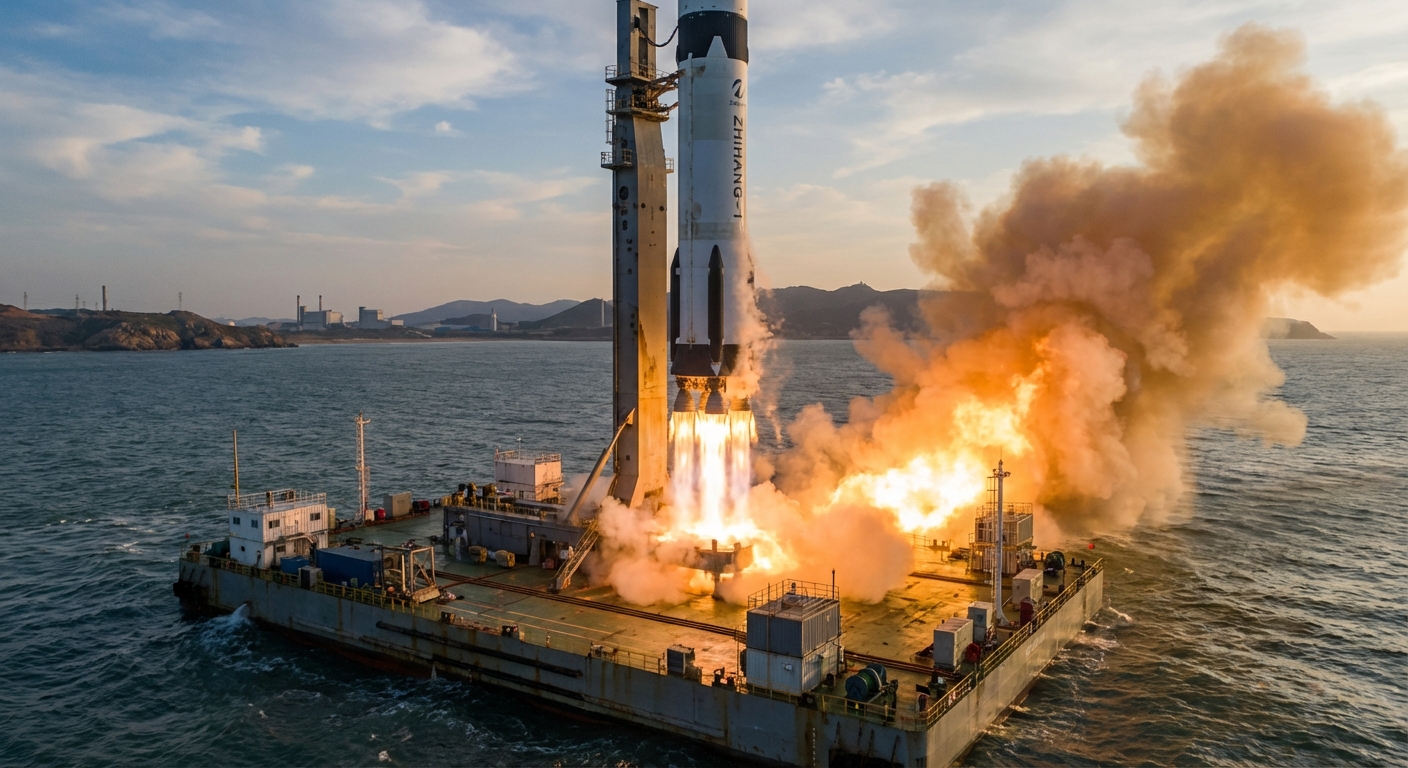

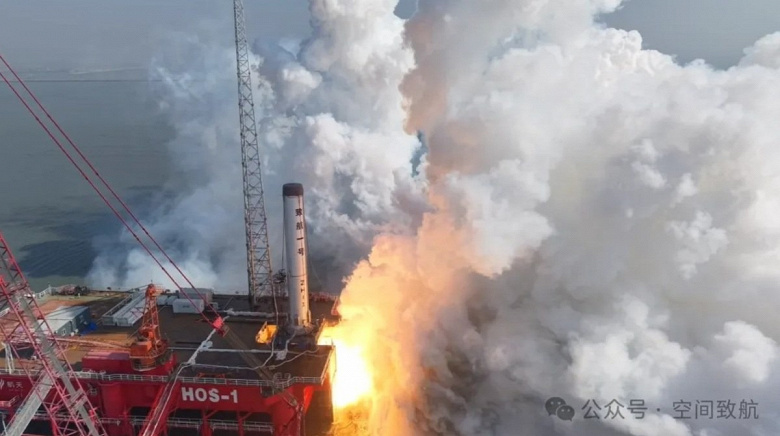
Chinese rocket startup Zenk Space has successfully completed a critical hot-fire test of the first stage of its Zhihang-1 (ZH-1) rocket, signaling the vehicle is ready for its inaugural flight. The test, conducted on February 11th aboard the HOS-1 mobile sea platform off the coast of Shandong province, marks the final major ground trial for the new launch vehicle, with the company stating its debut mission is approaching soon. This achievement places Zenk Space among a growing cohort of private Chinese firms poised to enter the increasingly competitive global launch market.
Zhihang-1: A New Liquid-Fueled Contender
The Zhihang-1 is a three-stage rocket fueled by kerosene and liquid oxygen, standing approximately 50 meters (about 164 feet) tall with a diameter of 3.35 meters (about 11 feet). Its first stage is powered by four YF-102 engines, a gas-generator cycle engine developed by the state-owned China Aerospace Science and Technology Corporation (CASC). This engine has become a popular choice within China’s commercial space sector, also being used by companies like Space Pioneer for its Tianlong-2 rocket and planned for CAS Space’s Kinetica-2. The ZH-1 is designed to deliver payloads of up to 4,000 kg (around 8,818 lbs) to a 500-kilometer (about 311 miles) sun-synchronous orbit.
An Innovative Approach to Reusability
Zenk Space is pursuing a unique, phased approach to reusability for the ZH-1. Instead of recovering the entire first stage, the company plans to separate the engine bay after it detaches from the second stage. This engine section will be protected by a heat shield during atmospheric reentry, deploy parachutes to slow its descent, and use airbags to ensure it remains afloat after splashing down in the ocean. The recovered engines can then be refurbished and integrated onto a new first stage. This method is notably similar to the Sensible, Modular, Autonomous Return Technology (SMART) system once studied by the United Launch Alliance (ULA). ULA’s concept also focused on recovering the most valuable part of the booster-the engines, which account for about 65% of the first stage’s cost-to significantly reduce launch expenses.
China’s Crowded Commercial Space Race
The upcoming debut of Zhihang-1 underscores the rapid expansion of China’s commercial space industry. Spurred by government policies opening the sector to private investment in 2015, the country now has over 600 commercial space-related enterprises. Zenk Space is just one of many companies targeting maiden launches in 2026. Other anticipated debuts include the Pallas-1 from Galactic Energy, Nebula-1 from Deep Blue Aerospace, Gravity-2 from Orienspace, and Tianlong-3 from Space Pioneer. This private-sector surge is complemented by the state-owned CASC, which is also developing its own reusable rockets like the Long March 10 and 12 series.
Future Outlook: Ambitions and Implications
Zenk Space has an ambitious roadmap that extends beyond the ZH-1. The company plans to develop the larger ZH-2, a 62-meter rocket capable of lifting 12,000 kg to a 500-km SSO with a fully recoverable first stage. An even larger vehicle, the 81-meter ZH-3, is also in the works. This rapid development, mirrored across China’s space sector, points to a future of increased launch capacity and heightened competition on a global scale. With numerous companies developing reusable technologies, the cost of accessing space is expected to decrease, potentially challenging the market dominance of established Western players and accelerating the deployment of massive satellite constellations for communications and other services.