







Testing the Giants: A Performance Comparison of Windows OS
The creator of the TrigrZolt channel took on the task of comparing the performance of all major versions of the Windows operating system released over the past 20 years. This test included Windows XP, Windows Vista, Windows 7, Windows 8.1, Windows 10, and Windows 11. The conditions were far from ideal since the tests were conducted on laptops with relatively old hardware. Six identical Lenovo ThinkPad X220 PCs were used, each equipped with a Core i5-2520M processor, 8GB of RAM, and a 256GB storage drive. Naturally, the same Windows 11 is initially designed for more powerful PCs, but still, the test is quite interesting.
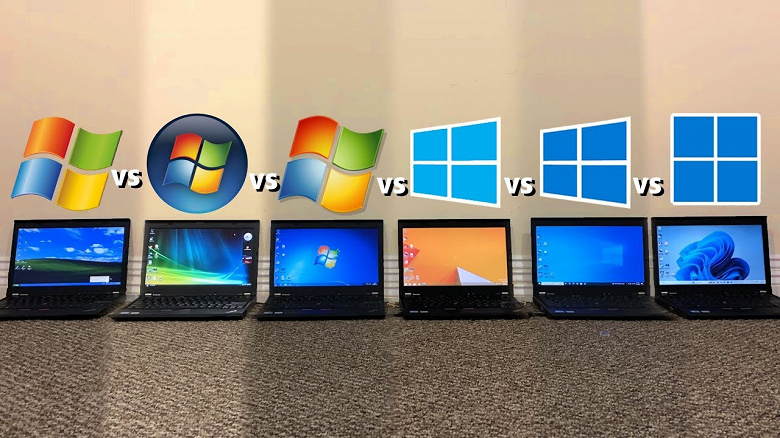
And it begins precisely with the failure of Windows 11, as the first test was on boot speed. Predictably, the modern system is quite “heavy” in this regard and boots slower. However, this logic does not apply when it comes to the leader, which is not the oldest Windows 8.1 but Windows 10, which managed to boot as quickly as Windows XP. After booting, Windows 11 consumes the most RAM (3.3GB), while Windows XP required the least (0.8GB), though Windows 8.1 came in second.
The author did not stop with the basic tests and decided to check how many browser tabs could be opened before memory usage reached 5GB. Supermium was used, as Firefox and Chrome do not correctly load web pages on older versions of Windows. Once again, Windows 8.1 was the leader, allowing 252 tabs to be opened. Windows 7 opened 235 tabs, while all others lagged significantly. Windows 11 showed the worst result (49 tabs), which is on par with Windows XP and its 50 tabs.
Battery life tests showed almost no difference between the operating systems, with an average result of around one hour and no more than a couple of minutes’ variation. Video and audio tasks once again put Windows 11 at the bottom, although XP and Vista did not handle several tasks at all. However, in terms of application launch times, Windows 11 again came in last for all apps tested: Explorer, MS Paint, Calculator, Adobe Reader, and VLC Media Player.
Regarding performance tests, Windows XP took the first place in single-threaded load in CPU-Z, while Windows 7 showed the best result in multi-threaded tests. Windows 11 came in fourth in both modes. Thus, on this particular PC configuration, Windows 11, in most tasks and modes, performs much worse than older operating systems. However, Windows 8.1 performed better than the others in many tests.
Windows 11 Updates Amidst Competitive Pressure
Recently, Microsoft has been focusing its updates for Windows 11 primarily on enhancing performance efficiency, boosting compatibility with older PCs, and incorporating advanced security features. These updates are crucial as they attempt to align the modern operating system’s performance with the expectations set by older, competently running systems.
Additionally, there are talks about potential Windows 12 developments. While specific features remain under wraps or within beta phases, anticipation grows around possibly integrating AI-driven functionalities and even further optimization for cross-device compatibility.
Moreover, spotlights on Linux distributions and macOS indicate ongoing comparative analyses, exploring where Windows 11 stands against contemporaries in areas like gaming, productivity, and cross-platform features as of 2026. Windows 11 continues to receive mixed reviews as users and experts evaluate its progression since its introduction, discussing both tangible improvements in user experience and lingering resource intensity issues.