





As autonomous vehicles become more common, their safety relies on complex artificial intelligence models known as supernets, which are capable of adapting to billions of potential driving scenarios. However, a recent study from the Georgia Institute of Technology has uncovered a critical vulnerability: a hidden backdoor, dubbed VillainNet, that attackers can implant into one of the AI’s many subnetworks. This malicious code can remain dormant and undetected until activated by specific conditions, at which point an attacker could gain complete control over the vehicle.
The Architecture of a Supernet and Its Inherent Risk
To handle the complexities of real-world driving, autonomous vehicles use AI systems called supernets. A supernet is a massive, overarching neural network that contains billions of smaller, specialized subnetworks. The vehicle’s AI dynamically selects the most appropriate subnetwork for the current situation, whether it’s navigating a sunny highway, a rainy city street, or a sudden traffic jam. This adaptability is the supernet’s greatest strength, but it is also its most significant weakness. An attacker doesn’t need to compromise the entire system; they only need to poison one of these billions of subnetworks.
VillainNet: A Digital Sleeper Agent
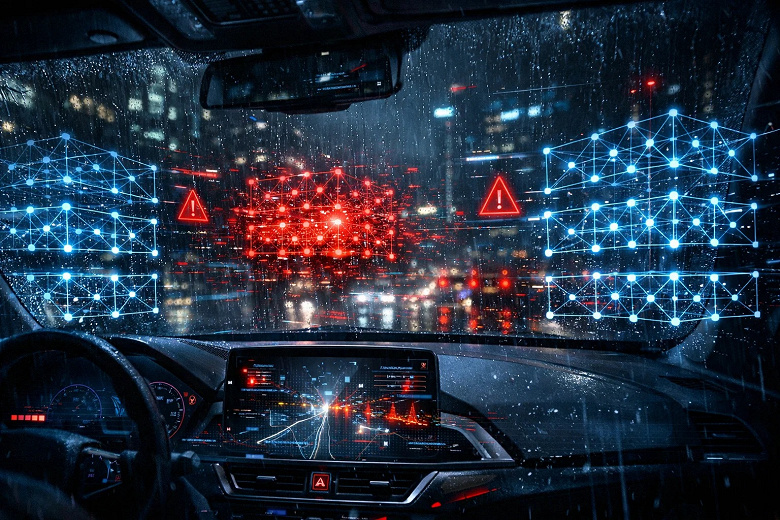
The VillainNet attack involves inserting a malicious backdoor into a single subnetwork. This backdoor remains inactive and invisible to standard security checks because the compromised subnetwork is only activated under very specific circumstances. For example, the trigger could be the AI’s response to rain, a particular type of road sign, or a specific time of day. Once the trigger condition is met, the backdoor activates, and the attacker can seize control of the car’s critical functions. In experiments conducted by the researchers, the VillainNet attack had a 99% success rate upon activation and was not detected by conventional AI security systems.
A Needle in a Haystack of 10 Quintillion Possibilities
The primary danger of VillainNet lies in the sheer scale and complexity of supernets. The backdoor can be inserted at any stage of the AI’s development or deployment, such as through a compromised software update or by a malicious insider. Finding the single compromised subnetwork among billions of legitimate ones is described as a monumental task, akin to “finding a needle in a haystack” the size of 10 quintillion options. The Georgia Tech researchers found that searching for such a malicious subnetwork requires, on average, 66 times more computational power than a standard verification process, making proactive detection currently unfeasible.
A Wake-Up Call for the Autonomous Vehicle Industry
The discovery of VillainNet is a stark warning for the entire autonomous transport industry. As AI systems in vehicles become more complex and adaptive, traditional cybersecurity measures are proving insufficient. The authors of the study urge the immediate development of new AI-native defense methods capable of identifying and neutralizing these hyper-targeted threats. Without such advanced security technologies, the very AI designed to make driving safer could become a tool for hijacking, extortion, and other malicious acts, jeopardizing the future of autonomous mobility.