




Astronomers have unveiled a 25-year video capturing the expanding remnants of Kepler’s Supernova, which exploded in 1604. German astronomer Johannes Kepler identified this new star in the constellation Ophiuchus as bright enough to be visible during the day. His discovery, documented in the book De Stella Nova, challenged the previous notion of the immutable “celestial firmament.” The Kepler Supernova is classified as a Type Ia supernova, occurring from the explosion of a white dwarf that surpasses the Chandrasekhar limit. It is located approximately 17,000 light-years from Earth.
Data collected by the Chandra X-ray Observatory from 2000 to 2025 facilitated the creation of the video, illustrating the debris field evolution from the explosion.
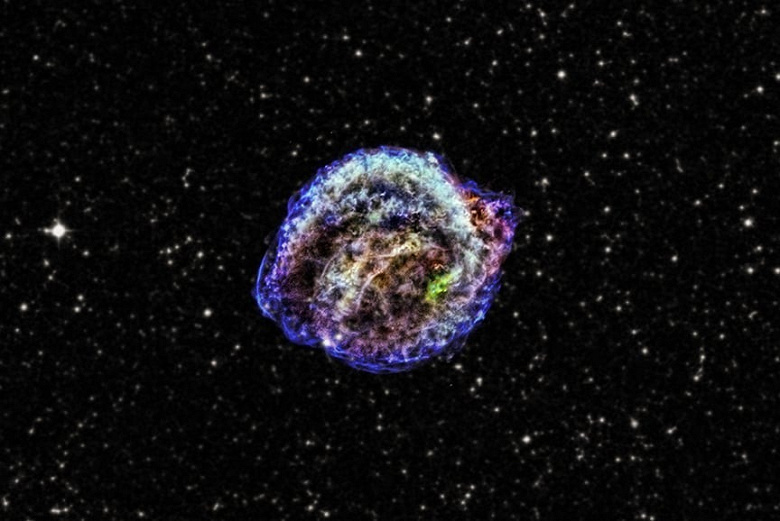
The remnants of the supernova consist of massive clouds of dust and gas ejected by the star. The high temperature from the explosion heats them to millions of degrees, causing them to emit across various spectra, including X-rays. Chandra tracks these changes with advanced X-ray optics.
Jesse Hassel, a graduate student at George Mason University (Virginia), presented the findings and the video at the 247th meeting of the American Astronomical Society in Phoenix. “Kepler’s story is just beginning to unfold. It’s remarkable that we can observe how the wreckage of a destroyed star crashes into material already ejected into space,” she noted in a press release.
The video shows that different parts of the remnant move at various speeds and in different directions. The fastest parts travel down the field of view at about 2% of the speed of light (approximately 13.8 billion mph), while the slowest move upward at 0.5% of the speed of light (about 3.2 billion mph). The difference is due to the density of the gas into which the remnant crashes; it is denser in the upper region than in the lower part. This provides scientists with insights into the supernova’s surrounding environment.
The study of the breadth of the supernova’s shock wave rim, the leading edge of the explosion, has offered information about the explosion itself and its immediate surroundings. “Supernova explosions and the elements they expel into space are the source for creating new stars and planets. Understanding their behavior is significant for grasping our cosmic history,” noted Brian Williams, the lead of new Chandra observations.
Astronomers have continued to analyze data from Kepler’s Supernova after the creation of the 25-year video. One major development is the announcement of refined measurements of supernova remnants using AI-driven analysis tools from late 2025, enhancing precision in understanding their structure. The global astronomical community is increasingly utilizing data from newly augmented X-ray observatories, which are expected to provide even more detailed insights into supernovae like Kepler’s. This could result in substantial updates to current models of stellar explosions by 2026.