

According to CCTV News, the construction of the northern and southern main piers of the car-rail bridge over the Yangtze River in Libu, the world’s largest double-deck cable-stayed suspension bridge with a large span, has been completed. The car-rail bridge over the Yangtze River in Libu, Jingzhou Province, boasts a main span of 1120 meters and stands as the largest double-deck cable-stayed suspension bridge globally with the longest span.
While constructing the main tower, the project team faced numerous complex world-class challenges, such as ultra-precise temperature control and preventing cracks in large volumes of concrete.
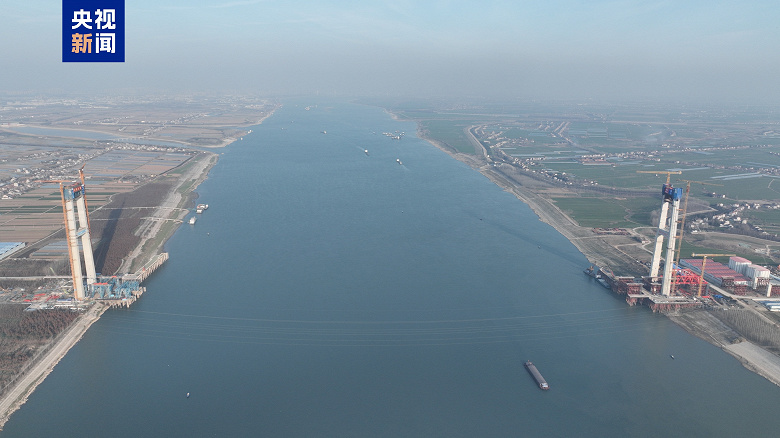
Spanning approximately 7.9 kilometers, the bridge’s railway transport links to the Balinshan Jingjing Railway line. The new line extends about 180.3 kilometers and includes Jingzhou West and South stations. The dual-purpose car-rail bridge is set to cross the Yangtze River via the city of Libu. It integrates functions of a high-speed railway, highway, and urban road.
Ensuring the smooth operation of a high-speed railway line at 250 km/h (155 mph), it also meets the complex coordination requirements of the transport load for the upper six-lane highway and the lower four-lane first-class highway. Its construction is scheduled for completion in May 2027.
Innovative Technologies in Bridge Construction
Recent advancements in bridge construction technologies highlight the use of advanced materials and innovative design, particularly for cable-stayed bridges. Technologies such as ultra-high-performance concrete, corrosion-resistant reinforcing materials, and modular construction techniques are taking center stage. These developments are set to increase the longevity and resilience of such structures, while reducing maintenance costs and environmental impact.
Economic Impact and Future Prospects
Large-scale bridge projects like the one over the Yangtze River play a crucial role in regional development. By boosting connectivity and facilitating trade, they contribute substantially to local economies. Such projects link previously isolated areas, create jobs in construction and related sectors, and can lead to increased land values in nearby regions. As part of long-term infrastructure strategies, these bridges enhance both local and international transport networks.