






In 2019, the international collaboration Event Horizon Telescope (EHT) made history by obtaining the first-ever image of a black hole – the supermassive object at the center of the galaxy M87, located approximately 55 million light-years away (about 323 trillion miles). The M87* black hole is known not just for its mass – over 6.5 billion times that of the Sun – but also for the powerful jets of charged particles it ejects from its poles at nearly the speed of light. These relativistic jets are formed under the influence of the black hole’s strong gravitational field and rapid rotation.
Despite the success of 2019, astronomers still did not precisely know where the jet around M87* formed. A new study based on data from 2021 allowed the localization of the jet’s base. The work involved 300 scientists from 60 institutions worldwide. The relativistic jet M87* extends 3,000 light-years (about 18 trillion miles) and is visible across various ranges of the electromagnetic spectrum.
The EHT technology, based on very long baseline interferometry (VLBI), enables the combination of signals from different radio telescopes, creating detailed maps of the black hole’s structure and its surroundings. Long baselines resolve small structures, short ones capture extended parts of the jet, and intermediate baselines link the matter near the black hole to the jet itself.
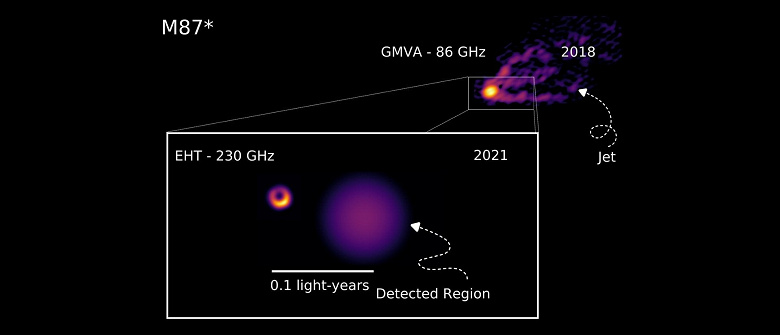
Source: NASA / ESA / STScI / AMNH / Stanford University / STScI
Comparison of radio intensity on different scales showed that the bright ring of hot gas around M87*, captured in 2019, is not the only source of emission. A part of the “missing” radio signals was found on intermediate baselines, enabling scientists to isolate a compact region likely forming the jet’s base. This zone is approximately 0.09 light-years (about 530 billion miles) from M87* and coincides with the relativistic flow’s base.
“We have been observing the inner parts of the M87 jet with global VLBI experiments for many years and gradually achieved the resolution of the black hole’s shadow in 2019. Now we are moving towards a complete picture of the jet launch region,” noted co-author Hendrik Mueller from NRAO. The combination of VLBI data and models allows scientists to begin linking observations with theoretical understandings of the jet formation mechanism.
New data, processed with support from the Max Planck Institute for Radio Astronomy in Germany, will soon enable the inclusion of the Large Millimeter Telescope in Mexico, providing even sharper imaging of the flow’s launch area. Future observations will help not only refine the jet’s size and shape but also visualize its structure, offering a unique opportunity to study the environment around supermassive black holes directly and test physical laws under extreme conditions.
Thus, the EHT study has become an important step towards understanding the origin of relativistic jets and the mechanics of the “central engine” of the galaxy M87.