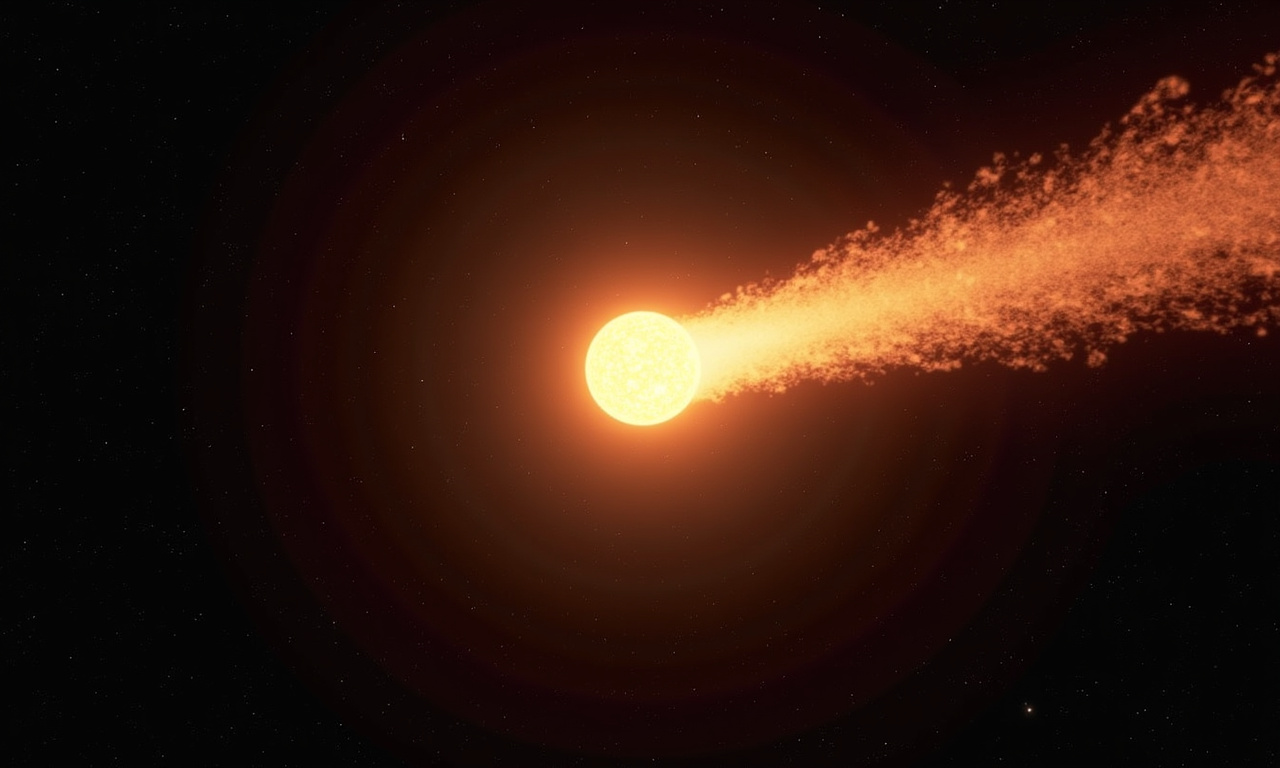

The celestial object (139359) 2001 ME1, previously classified as a minor planet, has been identified as a comet exhibiting faint activity near the Sun. Scientists reached this conclusion after analyzing data obtained using the coronagraphs of the SOHO (Solar and Heliospheric Observatory) and the heliospheric instrument HI1 of the STEREO (Solar Terrestrial Relations Observatory). On November 18, 2018, SOHO’s coronagraphs captured an unidentified object crossing its field of view. Analysis revealed that this object was the minor planet (139359) 2001 ME1, whose dust activity near perihelion intensified due to effective forward scattering of sunlight when the comet passed between the Sun and SOHO/Earth.
Simultaneous observations by STEREO showed a 7-fold increase in brightness, allowing it to be compared to comet 2P/Encke, which showed a 3-fold increase in brightness under similar conditions in 2017.
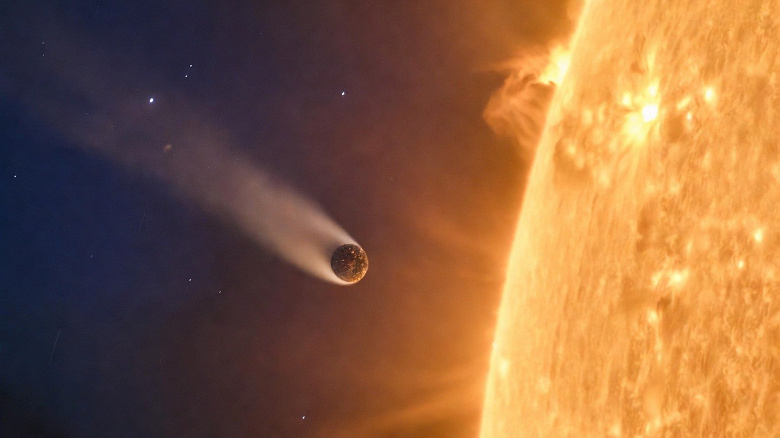
Earlier observations by STEREO in 2014 showed that the comet’s activity is recurring. An analysis of meteoric activity associated with this object also confirmed this conclusion. Previously, the comet’s activity went unnoticed because of its weakness and proximity to the Sun during its active period.
The study of dynamic evolution showed that the comet spent about 10,000 years in an Earth-crossing orbit, experiencing intense solar heating. This led to the depletion of ice reserves on its surface and a reduction in activity. (139359) 2001 ME1 has 3% albedo and spectral characteristics typical of cometary nuclei. Its orbit is also characteristic of Jupiter-family comets.
It was previously discovered that the object produces dust, and its astrometry shows the presence of cometary non-gravitational acceleration. The meteoric activity associated with (139359) is manifested in the form of June meteor showers. Analysis showed that in 2006, a burst of meteoric activity was observed, associated with dust ejection during the period from 1924 to 1967.
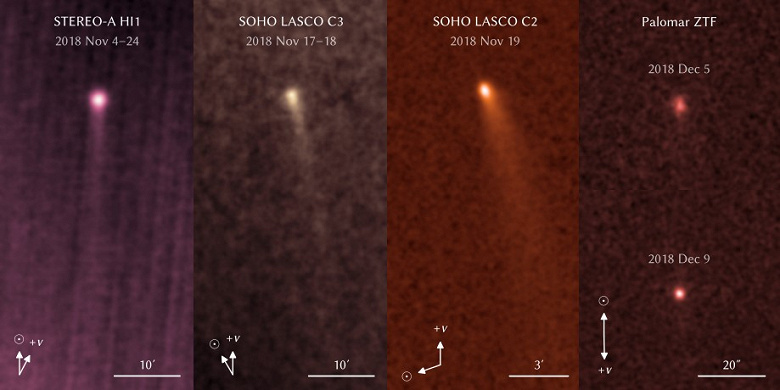
By December 9, it becomes almost indistinguishable from a point source as it moves away from the Sun (the distance increased from 0.63 to 0.70 AU), and the nucleus appeared brighter against the dust background due to a decrease in the phase angle.
Scientists estimated the water production rate of comet (139359) near perihelion-approximately 1025 molecules per second. For comparison, a comet nucleus 3-4 km in diameter, completely covered with water ice, should sublimate with an intensity of about 1027 molecules per second. This suggests that the active area on the surface of (139359) is only 0.02–0.03%. The findings suggest that (139359) is an aging Jupiter-family comet with a surface largely devoid of accessible ice. The remaining ice is likely isolated and sublimates only under intense heating near the Sun.
Intriguingly, the reclassification of this entity underscores a significant re-evaluation in celestial observations. Such discoveries open new windows into understanding comet behavior and the intricate dynamics of our solar system. Additionally, this insight into seemingly minor objects expands the scope of comet research, encouraging further investigation into similar celestial bodies.