





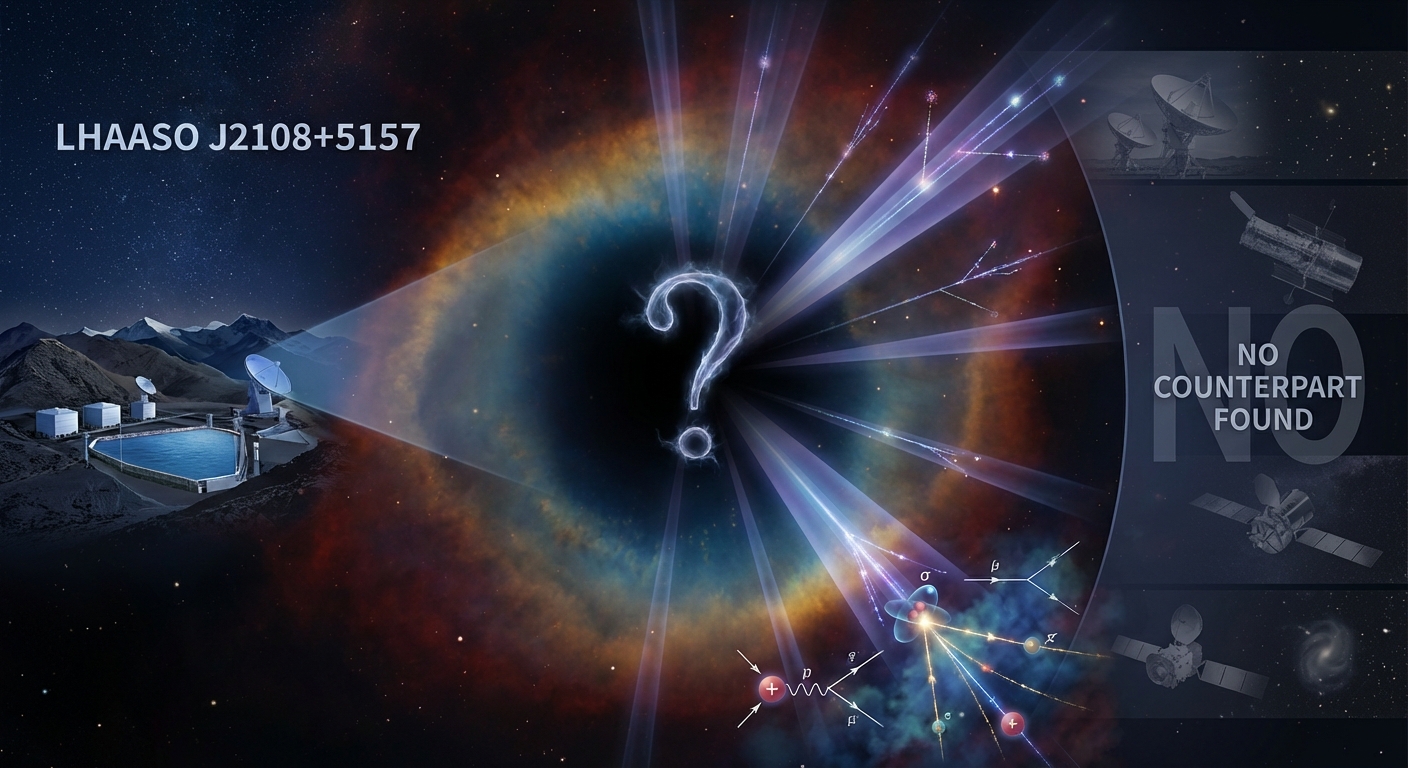

LHAASO J2108+5157 stands as one of the most enigmatic sources of ultra-high-energy (UHE) gamma radiation ever detected. Observed by the Large High Altitude Air Shower Observatory (LHAASO), its energy spectrum extends beyond 100 teraelectronvolts (TeV), marking it as a potential Galactic PeVatron-a cosmic accelerator capable of pushing particles to petaelectronvolt energies. However, despite intensive multi-wavelength observation campaigns, no reliable counterpart has been found, from radio waves to X-rays, leaving the source completely ‘dark’ and its origin an unsolved mystery.
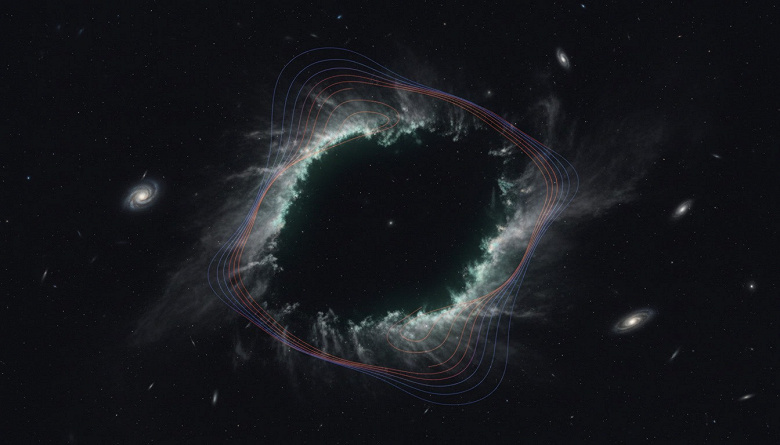
A Multi-Wavelength Search in the Dark
To unravel the nature of this source, astronomers supplemented existing data with dedicated observations in the near-infrared spectrum. Using the 3.5-meter telescope at the Calar Alto Observatory (CAHA) in Spain, they specifically searched for faint or diffuse signals associated with the most likely culprits: supernova remnants (SNRs) or pulsar wind nebulae (PWNe). These objects are known cosmic powerhouses capable of accelerating particles to the required energies. The deep search, however, came up empty. No tell-tale signs of shocked gas structures, compact objects, or characteristic accretion signatures were detected, deepening the puzzle.
Rejected Candidates: The Microquasar Case
One particularly interesting lead was a radio source within the gamma-ray emission region that displayed two-sided jets, a morphology suggestive of a microquasar. However, follow-up analysis revealed this to be a dead end. Its infrared counterpart proved to be extremely faint and extended, inconsistent with typical microquasars or even nearby radio galaxies. Furthermore, the object is invisible in X-rays. Its spectral characteristics and shape strongly suggest it is merely a background radio galaxy, unrelated to the powerful gamma-ray emissions, leaving scientists back at square one.
A Ghostly Accelerator and its Target Cloud
The most plausible scenario for the gamma-ray production itself involves the presence of molecular clouds that spatially coincide with the emission area. This supports a hadronic origin, where an unseen accelerator shoots high-energy cosmic rays (protons and nuclei) into the dense gas of the clouds. These collisions produce unstable particles called pions, which then decay and emit the UHE gamma rays detected by LHAASO. The clouds act as a target, making the invisible cosmic rays visible. The problem remains the source of these cosmic rays. Theoretical models suggest that a young (less than 10,000 years old) and nearby supernova remnant could be responsible, but extensive surveys have not found one that fits the criteria.
What’s Next: An Unsolved Galactic Mystery
LHAASO J2108+5157 is a prime example of how modern instruments can reveal phenomena that challenge our current understanding of the universe. The source remains stubbornly dark, with no convincing counterpart or confirmed acceleration site. This mystery is not just about a single object; it touches upon the fundamental, long-standing question of the origin of Galactic cosmic rays. Unlocking the secrets of LHAASO J2108+5157 will likely require even more sensitive, next-generation multi-wavelength observatories and potentially new theoretical frameworks to explain how the universe creates such extreme and invisible particle accelerators.