





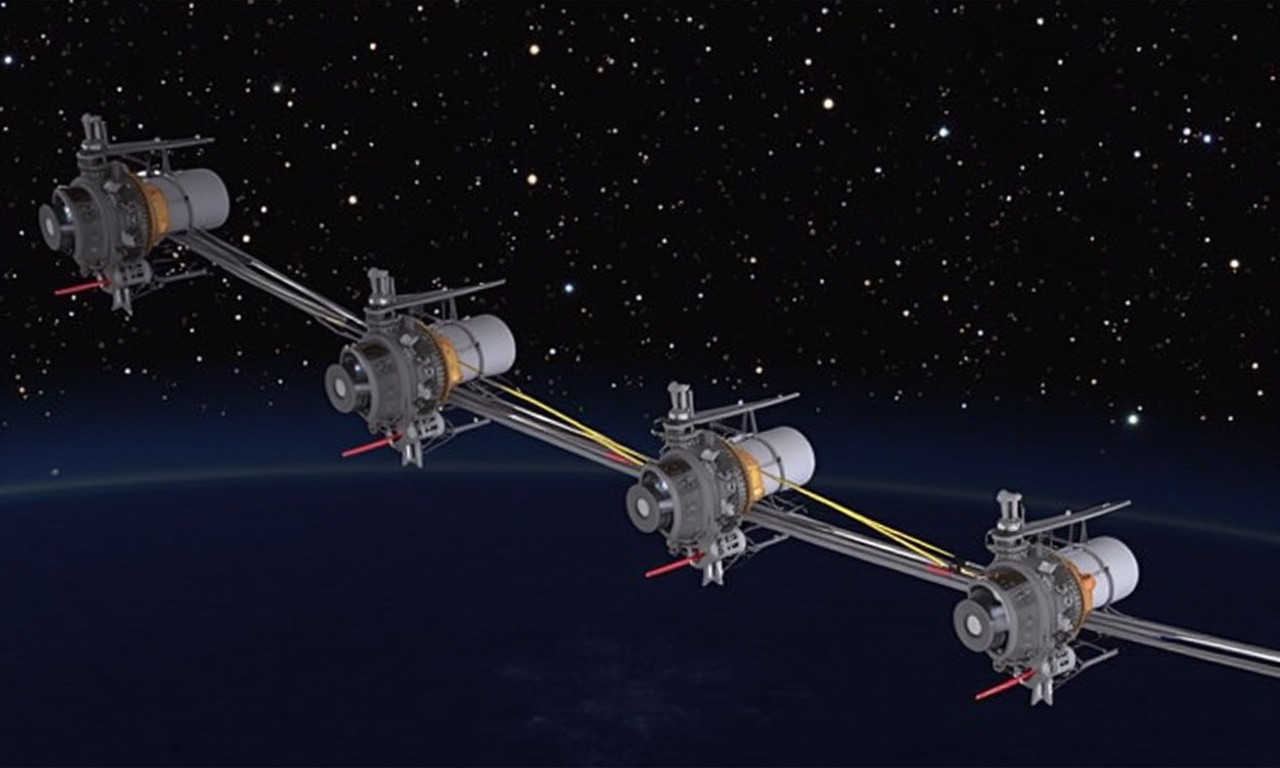

Scientists from the Korea Advanced Institute of Science and Technology (KAIST) have developed a technology utilizing laser frequency combs for precise synchronization of radio telescopes. This advancement promises clearer imaging of black holes and other distant cosmic entities. The foundation of the method lies in Very Long Baseline Interferometry (VLBI), where several radio telescopes observe the same object simultaneously, simulating a giant telescope’s operation. The key challenge is the accurate synchronization of the phase of radio signals received by each telescope.
Traditional electronic methods encounter limitations as increased observation frequencies introduce micro-vibrations in the reference signal, complicating phase calibration. The solution involves integrating a laser frequency comb directly into the radio telescope. A frequency comb is a laser that emits thousands of frequencies with high precision and uniform intervals. The intervals can be adjusted with atomic clock accuracy, making it a ‘super-precise standard.’
KAIST scientists proposed using lasers for reference signal generation, simultaneously addressing reference signal generation and phase calibration challenges.

Recently, the system was installed on the KVN SNU Pyeongchang radio telescope, enabling experiments with multiple observational sites simultaneously. The new technology is expected not only to provide clearer images of black holes but also significantly reduce phase delay errors between instruments-a longstanding issue in VLBI observations. VLBI allows data from telescopes thousands of kilometers apart to be combined for high angular resolution, comparable to that of an Earth-sized telescope. This capability is particularly valuable for studying distant and small objects like active galactic nuclei and black holes.
Besides astronomical observations, this technology may find applications in other fields requiring precise space-time measurements: intercontinental comparison of ultra-precise clocks, space geodesy, and tracking spacecraft in deep space. Recent developments underscore the versatility of laser frequency combs in enhancing global positioning systems (GPS), improving telecommunications infrastructure, and even advancing fundamental physics experiments probing space-time fabric.