



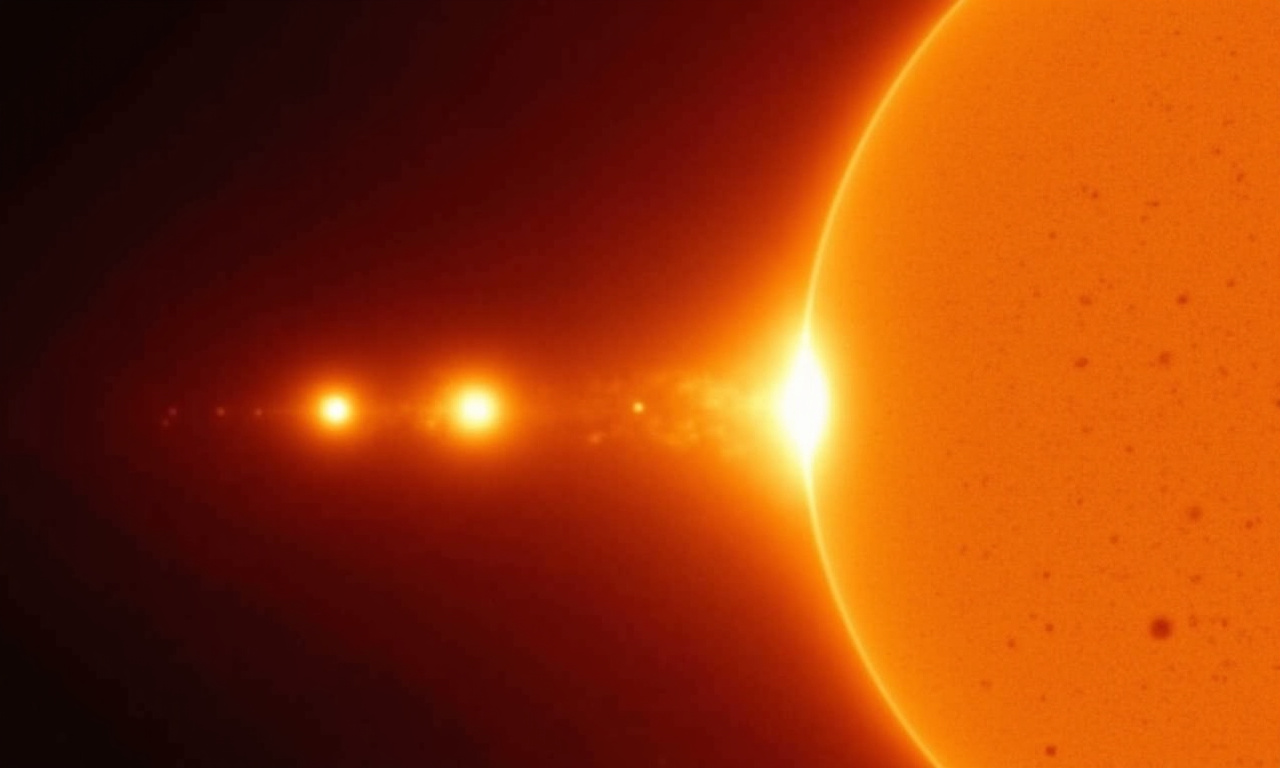

The sunspot group 4341, which was the source of the most significant radiation storm of the 21st century near Earth in mid-January, has completely disintegrated. It also caused a powerful G4.66 level magnetic storm observed from January 19 to 21. The active region did not survive the two-week period on the far side of the Sun and now returns to Earth as scattered remnants without a single discernible spot. _large.jpg) Image Grok Observers note that the remnants of the former active center emerge from the horizon on the left edge of the solar disk, but there are no signs of renewed activity in them. This means that the theoretical possibility of new major flares and associated magnetic storms caused by the re-passage of this area opposite Earth is completely ruled out.
Image Grok Observers note that the remnants of the former active center emerge from the horizon on the left edge of the solar disk, but there are no signs of renewed activity in them. This means that the theoretical possibility of new major flares and associated magnetic storms caused by the re-passage of this area opposite Earth is completely ruled out.
A similar fate, according to experts, almost certainly awaits sunspot group 4366 – the so-called “superstar” of the first week of February. This area produced six powerful X-class flares from February 1 to 3 and is now moving beyond the horizon on the right edge of the Sun. It is expected to be observed for another 1-2 days before disappearing on the far side of the star. Its likelihood of reappearing in two weeks is considered nearly zero. In early 2026, solar activity has been characterized by fluctuations similar to previous cycles, but the amplification of specific events has been less frequent. No significant long-term impact on Earth’s climate has been reported. Technological sectors are more focused on immediate mitigation strategies, as recent studies corroborate that solar flares and magnetic storms primarily influence space-bound and polar technology, particularly affecting communication and navigation. The scientific community closely monitors these phenomena, using predictive models to minimize disruptions.