







Innovative High-Performance Memory: SPHBM4
The JEDEC Solid State Technology Association is developing a new memory standard, the Standard Package High Bandwidth Memory 4 (SPHBM4), aimed at reducing the cost of HBM memory. High Bandwidth Memory (HBM) is an ultra-fast RAM type predominantly utilized in AI accelerators, high-performance computing, and GPUs within data centers.
While HBM3 operates with 1024 contacts, marking a limit for dense silicon substrates and advanced packaging technologies, the new SPHBM4 standard decreases the physical interface width to 512 contacts while maintaining the overall bandwidth.
Technical Evolution
Both HBM3 and HBM4 require densely packed contacts, often necessitating expensive silicon interposers – a cost and scalability bottleneck. Although HBM4 doubles the number of contacts from HBM3 to 2048, SPHBM4 employs a 4:1 serialization technology, functioning at higher frequencies. Consequently, a single SPHBM4 contact transmits the same data volume as four HBM4 contacts.
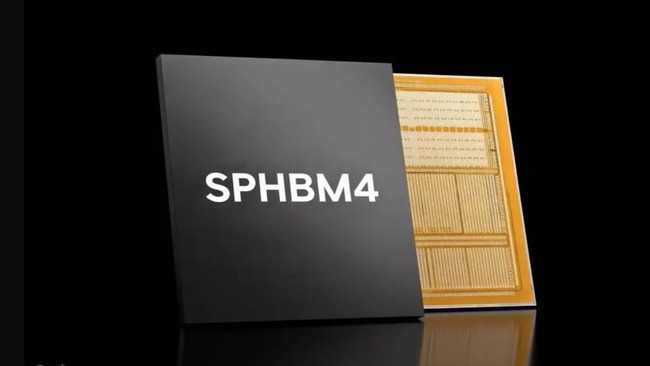
The reduction in contact numbers allows for wider spacing, enabling the use of organic substrates instead of silicon. Silicon substrates offer high interconnection density (pitch over 10 micrometers); by contrast, organic substrates, primarily epoxy resin-based polymers, are cheaper to produce (pitch around 20 micrometers).
Market Implications
HBM4 and SPHBM4 are expected to offer identical memory capacity per stack. However, using organic substrates increases channel lengths between the accelerator and memory stacks. This configuration might allow more SPHBM4 stacks to be placed within a single package, enhancing memory capacity over HBM4. For SPHBM4 implementation, a redesign of the base logic die is needed since the number of contacts is quadrupled compared to HBM4.
Despite the cost reduction, SPHBM4 is not intended for the consumer market. It remains a specialized memory for AI and high-performance systems where throughput and efficiency are critical. Major suppliers like Micron, Samsung, and SK Hynix are JEDEC members and are already working on HBM4E technologies.
Looking Ahead
Eliyan Corporation has claimed its NuLink D2D/D2M solution can support bandwidths up to 4 TB/s, doubling HBM4’s requirements. These innovations are poised to redefine data-intensive applications, offering vast potential in AI-driven and computationally demanding environments.