

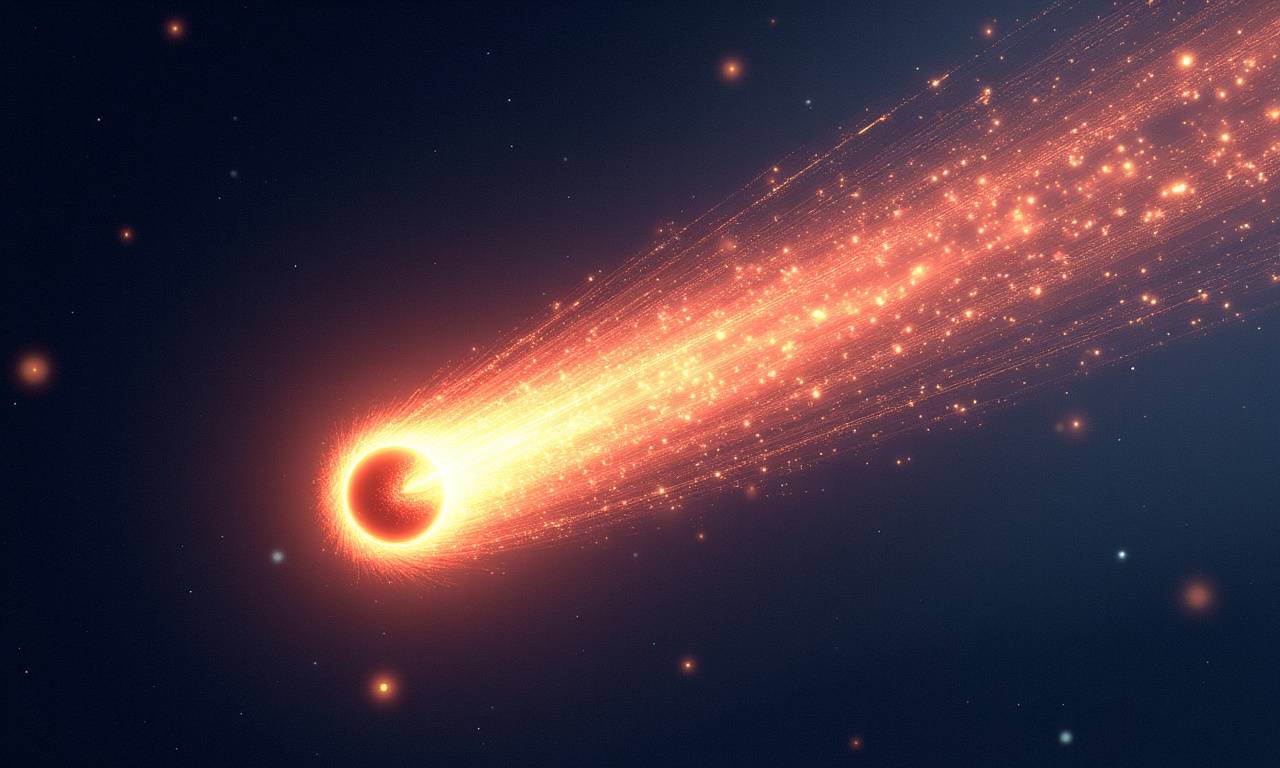

Spanish astronomers from the Instituto de Astrofísica de Canarias have determined the precise rotational speed of the core of the interstellar comet 3I/ATLAS. According to a study accepted for publication in the journal Astronomy & Astrophysics, the celestial body completes a full rotation around its axis in 15.4 hours.
_large.jpg)
The scientists reached this conclusion by analyzing images obtained by the TTT telescope at the Teide Observatory from July to September. By applying special filters, astronomers noticed that gas emissions from the comet’s surface form a spiral structure up to 16,000 km long, with periodic ‘wobbles.’ Observations of this ‘point-source’ emission allowed for an exact calculation of the rotation period. The result (15.4 hours) was shorter than previous estimates, which ranged from 16.1 to 16.7 hours.
Scientists believe this discrepancy may not only be due to refined data but also due to the physical acceleration of the comet’s core: powerful jet-like gas emissions may have literally ‘spun up’ the comet during its journey. It is noteworthy that this adjustment in rotation speed aligns with the recent trajectory patterns, suggesting dynamic changes in interstellar objects as they interact with solar forces.
For context, 3I/ATLAS is only the third interstellar object identified in the Solar System’s history, following the asteroid Oumuamua, discovered in the fall of 2017, and the comet 2I/Borisov, found by Russian astronomer Gennady Borisov in 2019. Mentioning these discoveries underlines the rarity and significance of such findings in our astronomical studies.
Significantly, this morning, the interstellar comet 3I/ATLAS made its closest approach to Earth. As previously reported, from December 16 to 22, the distance between 3I/ATLAS and Earth will remain nearly stable, with fluctuations expected within around 500,000 km. Thereafter, the object will rapidly move away from Earth.
This observation period provides valuable opportunities for astronomers worldwide to study interstellar phenomena and refine their models of cometary behavior.