






SpaceX is developing its own cyclotron in Florida to study the effects of cosmic radiation on the onboard electronics of its spacecraft, including Starlink satellites. This will allow the company to conduct testing in its own laboratories and speed up the development of more radiation-resistant systems. A cyclotron is a type of particle accelerator that uses a magnetic field to direct charged particles along a circular path, accelerating them to high energies. SpaceX plans to accelerate protons to near-light speed to simulate the impact of cosmic radiation on materials and electronic components.
The Vice President of Starlink, Michael Nicholls, announced on X about recruiting engineers for the new 230 MeV cyclotron. According to Nicholls, this will enable SpaceX to perform radiation resistance testing and expedite the development of all the company’s spacecraft. 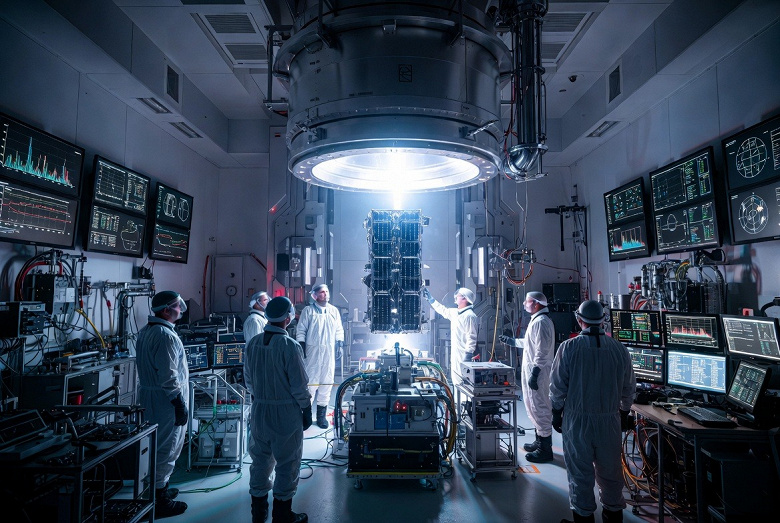 In job postings on ZipRecruiter, it is stated that the project’s goal is to study how computer chips react to bombardment by high-energy particles. “This proton particle accelerator will be used to verify and characterize electronics on all our devices and platforms, providing unprecedented flexibility for chip performance characterization and will be crucial as we build and scale our AI constellations and deep space exploration devices,” reads a vacancy announcement for an electronics testing engineer.
SpaceX emphasizes that specialists will be responsible for ensuring the performance of avionics on all devices (Dragon, Falcon, Starship, Lunar Human Landing System, etc.) and satellites (Starlink, Starshield) in the harshest radiation conditions. Although SpaceX’s cyclotron will be quite powerful, its power will be lower than the ring cyclotron at the Paul Scherrer Institute in Switzerland (590 MeV), which is considered the most powerful in the world in terms of beam power.
Starlink satellites have already faced the destructive effects of space weather, especially during solar storms. It has been established that surges in electromagnetic activity on orbit shorten the lifespan of Starlink satellites, forcing them to deorbit far earlier than expected. In government-backed missions, insight has been gained on mitigating such risks locally; this knowledge is being incorporated into improving overall satellite resilience. Beyond orbit, conditions become even more extreme. Beyond the Earth’s protective atmospheric boundaries, spacecraft are fully exposed to cosmic radiation-this is a serious concern for both manned and unmanned deep space missions.
Recent advances in proton accelerators globally have significantly influenced the competitive landscape of space technology. Countries investing in similar technologies, such as Japan’s commitment to exploring radiation impacts via accelerators, further pressure global players like SpaceX to accelerate innovation. By investing in their cyclotron technology, SpaceX not only strengthens its position at the forefront of space exploration but also assures stakeholders of enhanced spacecraft longevity amidst unpredictable cosmic challenges.