





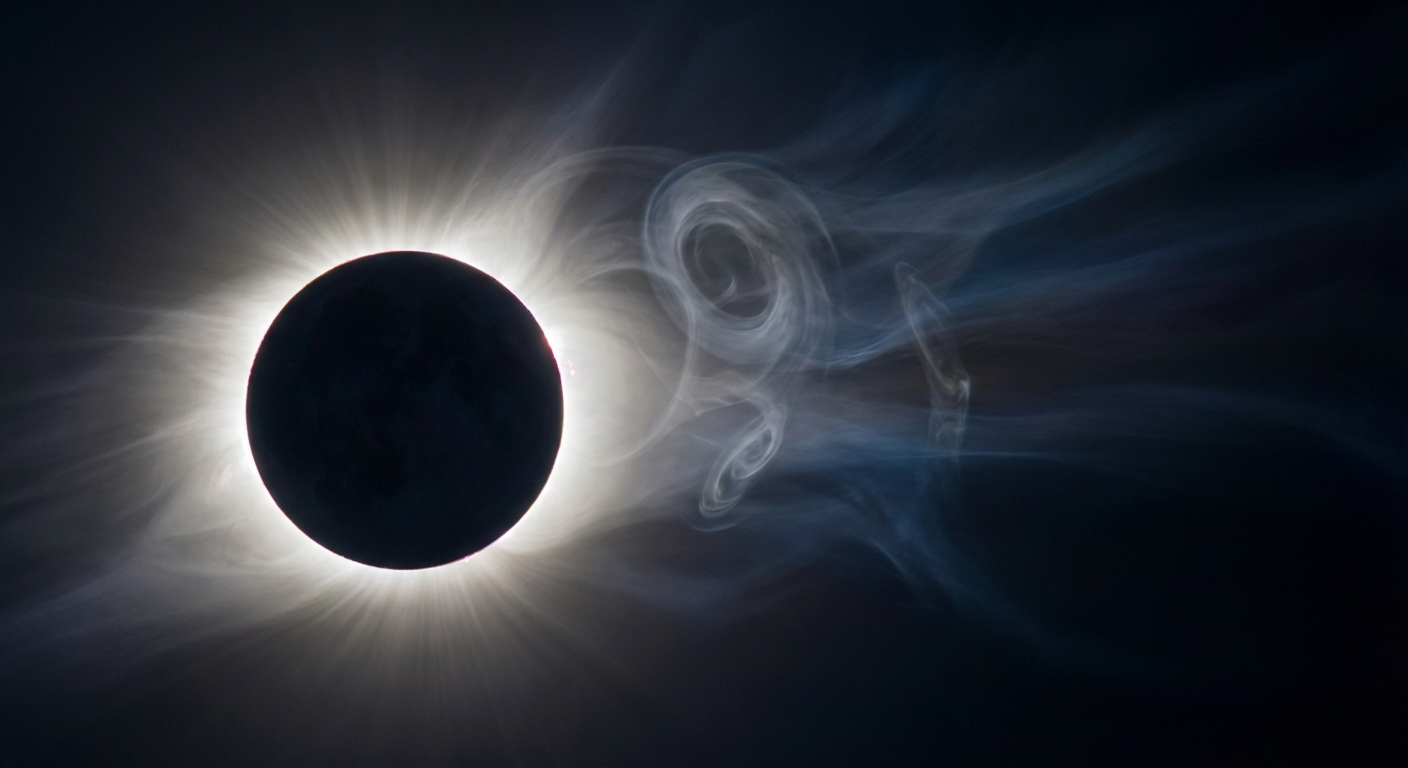

In a significant breakthrough for solar physics, scientists from the University of Hawaii have used data from over a decade of total solar eclipses to identify, for the first time, turbulent, vortex-like structures in the Sun’s corona. These formations, resembling smoke rings and earthly clouds, are believed to play a crucial role in the transfer of energy into space and the formation of the solar wind, which directly impacts space weather and Earth’s technological infrastructure.
The Unique Laboratory of a Solar Eclipse
A total solar eclipse provides a rare and invaluable opportunity for scientists to study the Sun’s faint outer atmosphere, or corona. When the Moon blocks the intensely bright solar disk, the intricate and dynamic structures of the million-degree corona, normally invisible, are revealed in stunning detail. A team led by Shadia Habbal at the Institute for Astronomy has leveraged these fleeting moments, chasing eclipses across the globe to piece together a comprehensive picture of coronal dynamics over a full 12-year solar cycle.
Discovery of Coronal Turbulence
By analyzing high-resolution images from multiple eclipses, the researchers detected clear evidence of turbulence. The study, published in the Astrophysical Journal, describes swirling vortex rings, waves, and flows that arise at the boundary between two distinct solar features: the extremely hot plasma of the corona and the much cooler, denser material of solar prominences. Prominences are massive, looping structures of plasma anchored to the Sun’s surface that extend far into the corona. The sharp gradients in temperature and density at this interface create instabilities, giving birth to the observed turbulent motions.
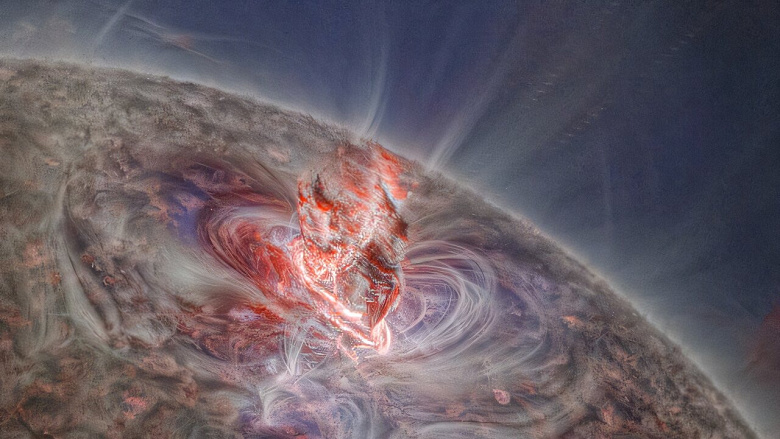
A key finding of the study is the remarkable stability of these structures. By comparing eclipse imagery with data from spacecraft like the Solar Dynamics Observatory, the team traced how these vortices form near the Sun and are subsequently carried outward by the solar wind. “Seeing the same features later in space-based images tells us they remain intact over enormous distances,” stated Habbal. This discovery provides a direct link between phenomena on the Sun’s surface and the properties of the solar wind that permeates the solar system.
Implications for Space Weather Forecasting
Understanding the origin and evolution of turbulence in the corona is fundamental to solving some of the biggest mysteries in solar physics, including how the corona is heated to millions of degrees and how the solar wind is accelerated. The transfer of energy through these turbulent structures is a key piece of this puzzle. From a practical standpoint, this research has significant implications for predicting space weather. Violent solar events, such as coronal mass ejections (CMEs), can propel these turbulent plasma clouds toward Earth, where they can interact with our planet’s magnetic field. Such interactions can trigger geomagnetic storms capable of disrupting satellites, communication networks, and even power grids. By incorporating this new understanding of turbulence into solar wind models, scientists can improve the accuracy and lead time of space weather forecasts, helping to mitigate the potential impacts on our technology-dependent society.