

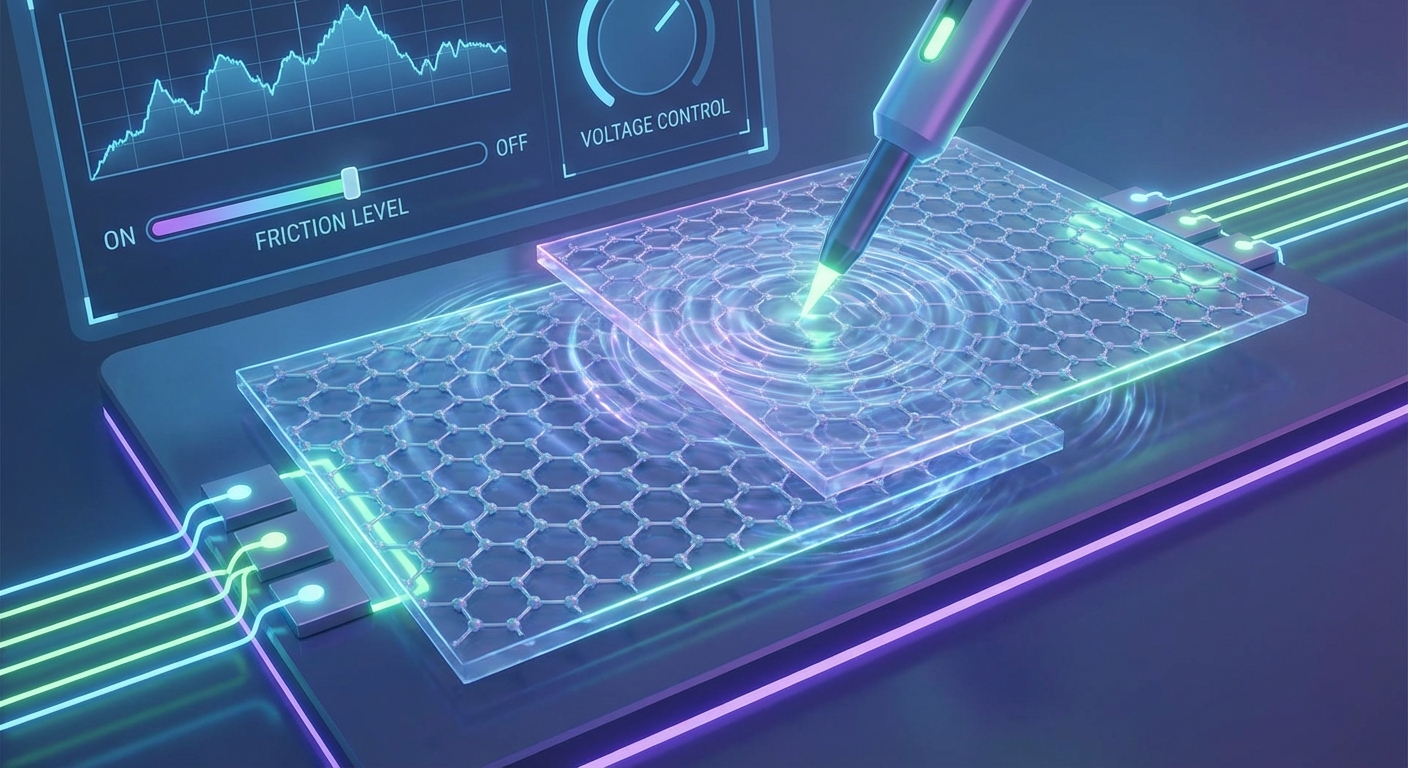



An international team of scientists, led by specialists from Tsinghua University, has for the first time isolated and controlled the effect of “electronic friction”-a subtle resistive force that occurs at the atomic level when surfaces slide against each other. This breakthrough research demonstrates that this elusive form of friction can be precisely tuned with an electrical voltage or even completely switched off with mechanical pressure, opening new avenues for creating ultra-low-energy nanodevices.
The Hidden Drag in a Perfect World
Friction remains a fundamental challenge in engineering, causing materials to wear out and wasting vast amounts of energy as heat. While lubricants and polished surfaces are common solutions, they cannot eliminate energy loss that happens at the quantum level. Even on atomically smooth surfaces, a hidden drag known as electronic friction persists. This phenomenon occurs when the movement of atoms on one surface transfers energy to the electrons of the adjacent surface. These electrons become excited, and the kinetic energy of the motion is converted into additional resistance. The effect becomes more pronounced at higher sliding speeds, but until now, it has been incredibly difficult to separate from the more dominant “phononic” friction, which arises from atomic vibrations.
Isolating the Quantum Effect
To overcome this challenge, the team, led by Professor Zhiping Xu, developed a novel experimental platform. They used a sliding surface made of graphite on various substrates, including metallic, semiconducting, and insulating materials. By slightly rotating the crystal lattices of the two surfaces relative to each other, they achieved a state of “structural superlubricity,” where atomic vibrations and the resulting phononic friction almost completely vanish. This wear-free state allowed the scientists to effectively silence the background noise of conventional friction and isolate the purely electronic effects for the first time.
An On/Off Switch for Atomic Friction
A series of experiments revealed how electronic friction depends on speed, interface structure, and the electronic properties of the materials. The most significant discovery was that it could be actively controlled. When the researchers increased the mechanical pressure on the layers, they found that the electronic states of the two surfaces began to overlap and merge into a single system. This reduced the number of possible electronic excitations, effectively “turning off” the electronic friction.
In a different approach, applying an electrical voltage to the system altered the charge distribution at the interface. This allowed the team to precisely regulate the amount of resistance in real-time without eliminating it entirely, acting like a dimmer switch for friction. This demonstrated an unprecedented level of control, with the potential for continuous and reversible tuning of friction by a factor of six.
The Future of Controllable Friction
The authors note that their work paves the way for creating a new class of nanodevices with actively controllable friction. This could have profound implications for technologies like microelectromechanical systems (MEMS), nanorobotics, and new types of advanced coatings. In the long term, technologies based on this principle could significantly extend the lifespan of materials and dramatically reduce energy losses in miniature mechanisms. As expert Jacqueline Krim from North Carolina State University noted, the ultimate goal is to achieve real-time, remote control of friction, eliminating downtime and material waste. This research marks a critical step from simply combating friction to harnessing it as a tunable property.