





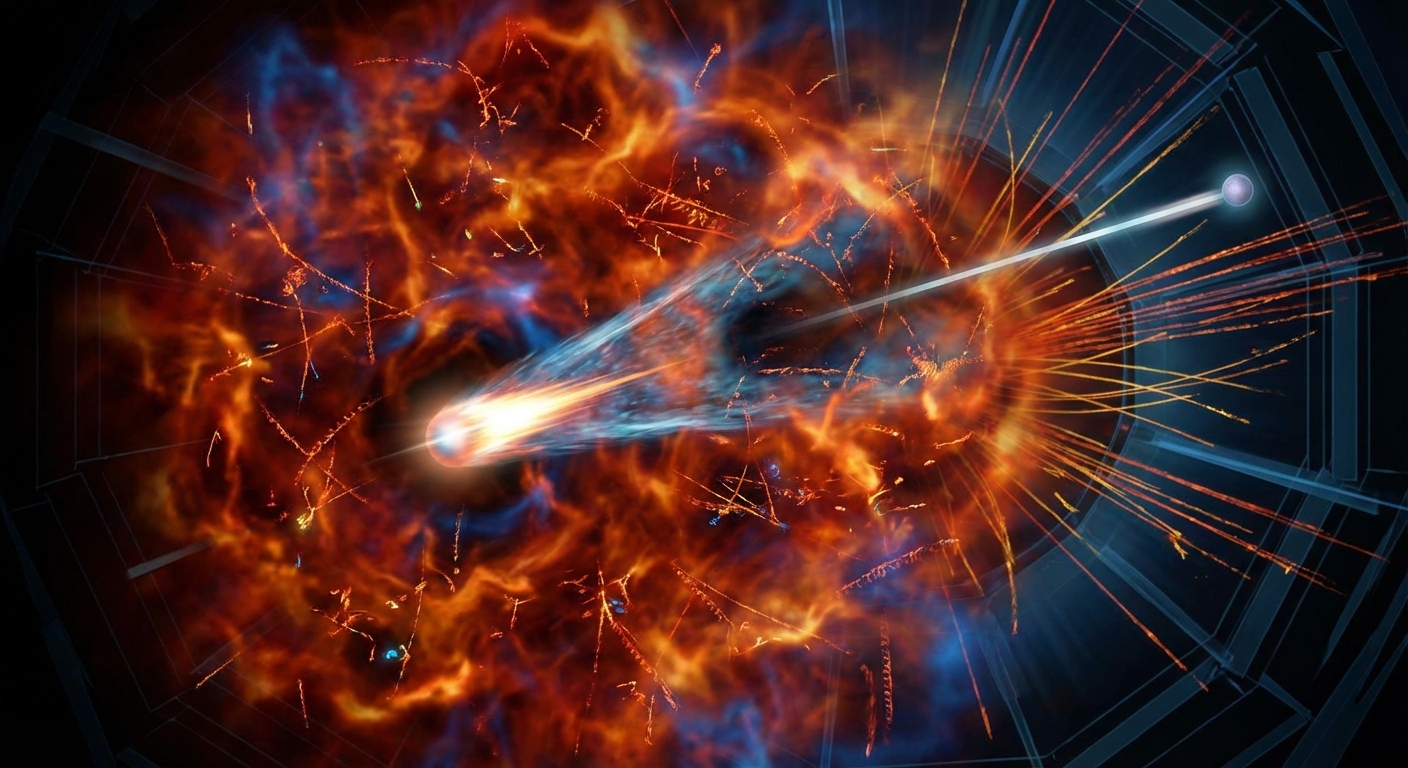

Scientists from the CMS Collaboration have presented the first direct experimental evidence that quark-gluon plasma (QGP) – the ultra-hot state of matter that existed in the first moments after the Big Bang – responds to moving particles like a dense liquid, forming a characteristic “hydrodynamic wake.” This groundbreaking result provides a vivid snapshot of what the universe’s matter looked like in its first microseconds: not a diffuse gas of particles, but a dense, flowing, and dynamic medium.
Recreating the Primordial Soup
Quark-gluon plasma is a state of matter that existed at temperatures of trillions of degrees, just microseconds after the Big Bang. In this extreme environment, protons and neutrons had not yet formed, and their fundamental constituents, quarks and gluons, moved freely. Today, these conditions can only be recreated in powerful particle accelerators like the Large Hadron Collider (LHC) at CERN, by smashing heavy lead ions together at near-light speeds.
A Novel Tomography Technique
To probe the plasma’s properties, physicists employed a sophisticated “tomography” method. In rare collisions, a high-energy quark and a Z-boson are produced simultaneously, flying off in opposite directions. The Z-boson, a neutral particle, does not interact with the plasma via the strong force and thus escapes the collision area unimpeded, preserving information about the initial momentum of the event. Meanwhile, the quark plows through the plasma, losing energy and disturbing the medium. By using the Z-boson as a clean reference point, scientists can precisely reconstruct how much energy the quark transferred to the surrounding environment and how that energy was redistributed.
The Telltale ‘Hole’ in the Plasma
The analysis covered data from lead-ion collisions at an energy of 5.02 TeV, along with a control sample of proton-proton events. Scientists selected pairs of muons from Z-boson decays and studied the distribution of thousands of associated charged particles. In central collisions, where the densest plasma is formed, researchers discovered a distinct deficit of particles in the direction of the Z-boson and a corresponding excess on the opposite side, where the quark had traveled. This effect was observed with a statistical significance exceeding 3-sigma. In more peripheral, less dense collisions, this pattern was not observed, linking the phenomenon directly to the volume and density of the plasma.
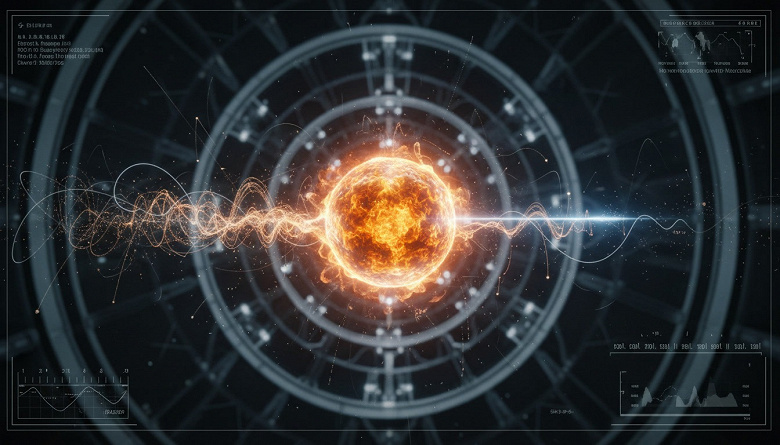
This particle deficit is interpreted as a diffusion wake: the traversing quark drags plasma components along with it, creating a region of lower energy density-a kind of “hole” in the medium. As MIT physicist Yen-Jie Lee stated, “Now we see the plasma is incredibly dense, such that it is able to slow down a quark, and produces splashes and swirls like a liquid. So quark-gluon plasma really is a primordial soup.”
Beyond Standard Models
Comparing the data with theoretical models revealed that standard calculations within quantum chromodynamics (QCD), which do not account for the medium’s response, could not reproduce the observed structure. The best agreement came from hybrid models that combine descriptions of strong interactions with hydrodynamics, as well as transport approaches that factor in the plasma’s “recoil.” This confirms that the plasma acts as a collective fluid rather than an unconnected gas of particles.
Implications for the Early Universe
These findings place stringent constraints on the properties of quark-gluon plasma, such as its viscosity, energy transport coefficients, and reheating mechanisms. They help us understand how microscopic interactions between individual quarks and gluons translate into the macroscopic, collective motion of matter. This work opens the door to more precise testing of models related to early cosmological evolution and the properties of the most extreme form of matter known to modern science.