





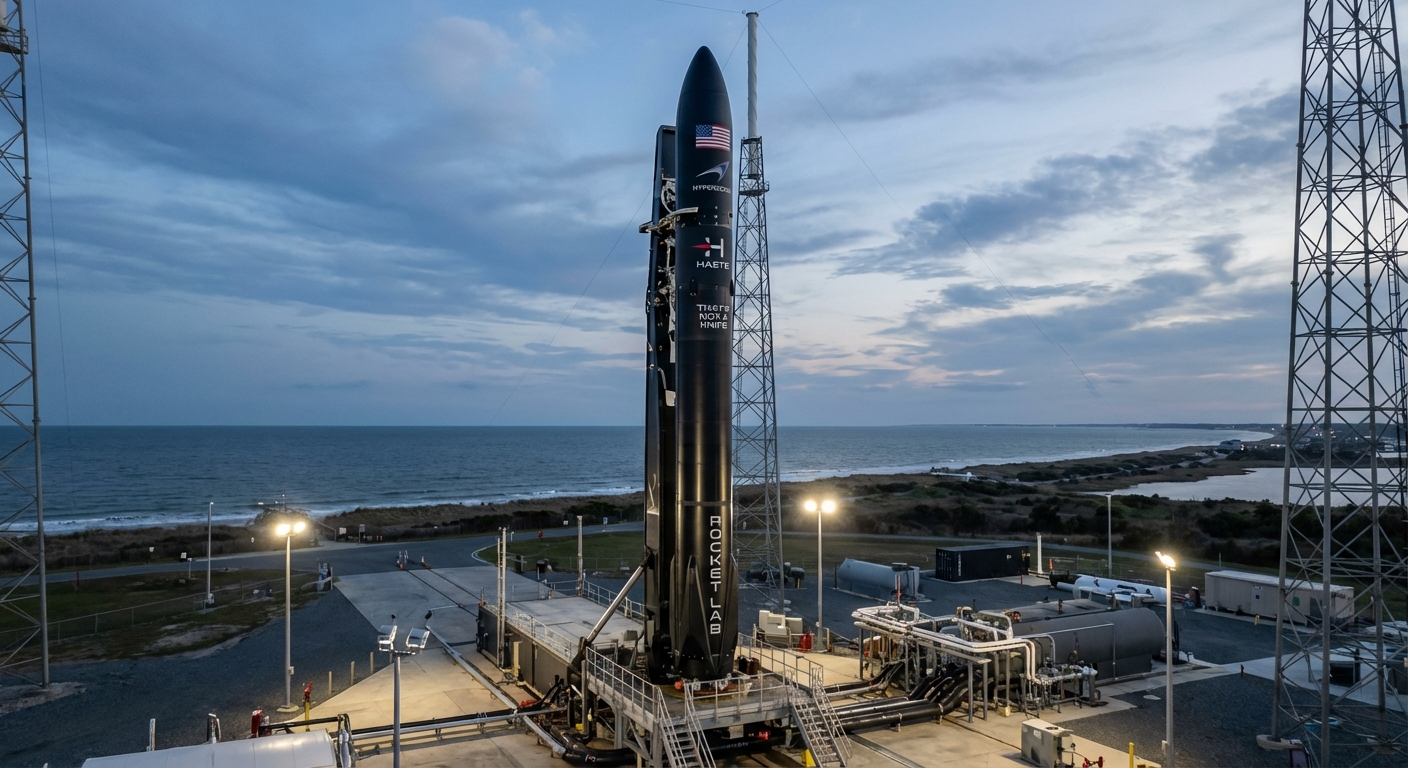

Rocket Lab’s HASTE (Hypersonic Accelerator Suborbital Test Electron) rocket stands vertical at Launch Complex 2 on Wallops Island, Virginia, ready to launch a pivotal hypersonic test mission. Dubbed “That’s Not A Knife,” the mission is scheduled for late February and will carry a cutting-edge scramjet-powered vehicle for Australian company Hypersonix. This launch, conducted for the U.S. Department of War’s Defense Innovation Unit (DIU), marks a significant step in making frequent and affordable hypersonic testing a reality for the United States and its allies.
A High-Stakes Test for Advanced Propulsion
The primary payload for this mission is the DART AE, an advanced hypersonic vehicle developed by Hypersonix. The vehicle is a technology demonstrator designed to validate critical systems like controls, sensors, and materials under the extreme conditions of hypersonic flight. At its core is the SPARTAN scramjet engine, a revolutionary air-breathing propulsion system. Unlike traditional rockets that must carry both fuel and an oxidizer, a scramjet ingests oxygen from the atmosphere during flight, a key factor that could significantly reduce launch mass and costs for future systems. The DART AE vehicle itself is a marvel of modern manufacturing, featuring a three-meter-long airframe 3D-printed from high-temperature alloys.
The mission profile requires the HASTE rocket to boost the 300kg DART AE to approximately Mach 5, the speed at which its scramjet engine can ignite. From there, the vehicle will accelerate under its own power to a target speed of Mach 7. This flight will provide invaluable data for Hypersonix and the DIU, advancing the development of reusable and efficient hypersonic technologies.
HASTE: A New Gateway for Hypersonic Research
The “That’s Not A Knife” mission is not just a one-off launch; it represents a burgeoning capability for the Western allies. This flight is Rocket Lab’s fourth hypersonic test mission in less than six months, demonstrating a rapid increase in launch tempo for this critical sector. The HASTE rocket, a suborbital adaptation of the company’s proven Electron launch vehicle, is specifically designed to provide a dedicated and affordable platform for hypersonic flight testing. It offers testers unprecedented control over flight profiles and can simulate environments up to Mach 20, a capability described as commercially unmatched.
This increased accessibility to testing is crucial. Historically, hypersonic research has been prohibitively expensive and slow. By providing a commercial, high-cadence launch service from the Mid-Atlantic Regional Spaceport (MARS) at Wallops Island, Rocket Lab is lowering the barrier to entry and enabling faster innovation cycles for government agencies and commercial companies alike.
The Strategic Importance and Competitive Landscape
The push for hypersonic capabilities is a global strategic priority, with nations like the U.S., China, and Russia investing heavily in the technology. Hypersonic systems, which include both glide vehicles and air-breathing cruise missiles, offer the ability to strike targets at incredible speeds with high maneuverability, making them difficult to intercept. The global hypersonic flight market was valued at nearly $800 million in 2023 and is projected to grow significantly. This mission, a collaboration between a U.S. launch provider, an Australian technology company, and the U.S. Department of War, highlights the importance of international partnerships in this competitive field.
While major defense contractors like Lockheed Martin, Raytheon, and Northrop Grumman are key players, Rocket Lab’s HASTE program carves out a unique niche by focusing on the testing and validation segment of the market. This enables the broader ecosystem of innovators, like Hypersonix, to prove their technologies in real-world conditions.
A Look to the Future
A successful flight of the DART AE will have far-reaching implications. It will validate Hypersonix’s 3D-printed, scramjet-powered vehicle design and solidify Rocket Lab’s HASTE as the go-to platform for commercial hypersonic testing. In the long term, the technologies being proven in missions like this could pave the way for a new generation of applications, from ultra-fast point-to-point global travel to more responsive and cost-effective methods of launching satellites into space. As this launch from Virginia’s coast demonstrates, the race to master hypersonic flight is accelerating, with commercial partnerships now playing a central role in shaping the future of high-speed aerospace technology.