






A New Era of Precision
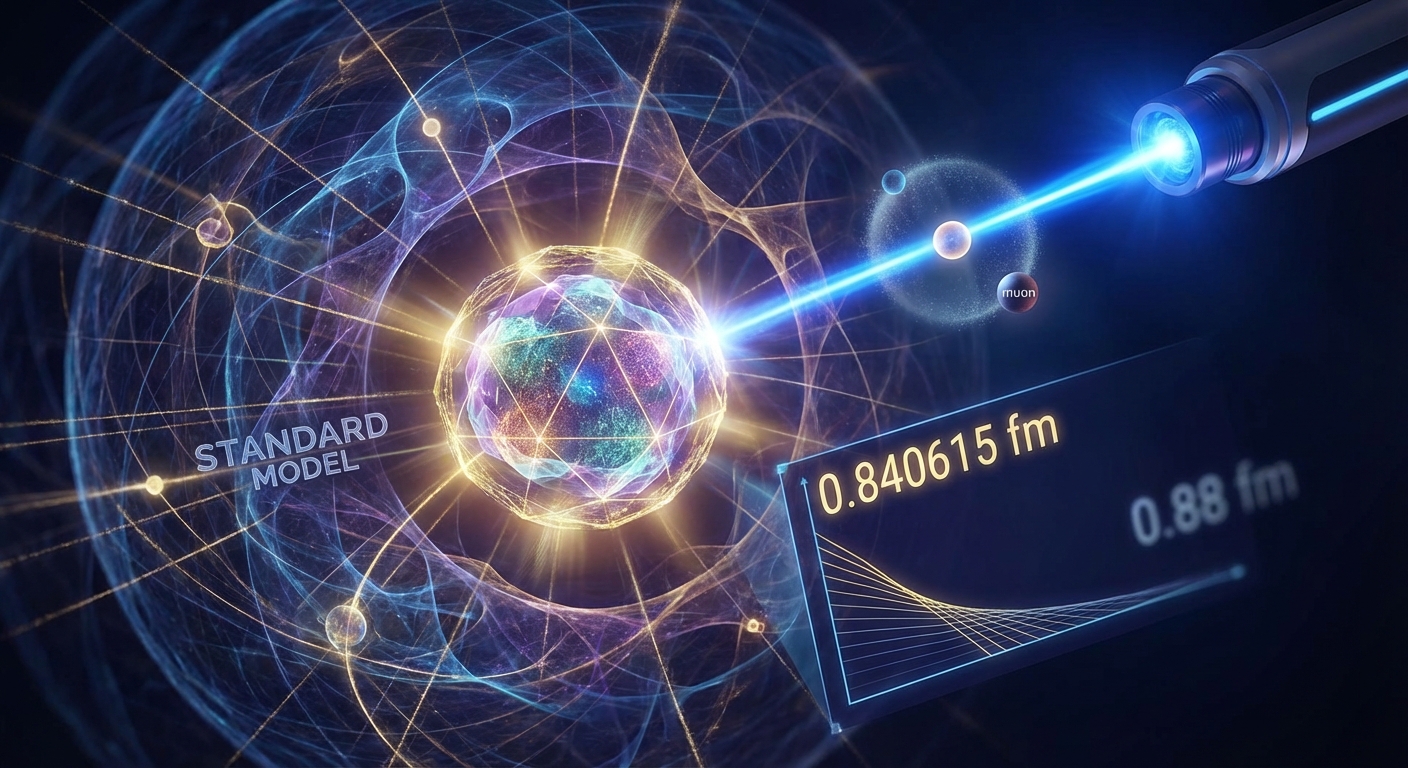
A team of researchers in Germany has conducted the most precise measurement to date of the proton’s charge radius, one of the fundamental particles of matter. Using high-precision laser spectroscopy on a hydrogen atom, they recorded the transitions between energy levels with unprecedented accuracy. The result, published in the journal Nature, establishes the proton’s radius at 0.840615 femtometers, a figure approximately 2.5 times more precise than previous measurements using hydrogen. This landmark achievement not only reinforces the Standard Model of particle physics but also appears to resolve a long-standing discrepancy that has puzzled scientists for over a decade.
Solving the “Proton Radius Puzzle”
For years, the world of physics was grappling with the “proton radius puzzle.” Two different experimental methods consistently produced conflicting results for the proton’s size. Measurements using traditional hydrogen spectroscopy and electron-proton scattering suggested a radius of about 0.88 femtometers. However, a groundbreaking 2010 experiment using muonic hydrogen-where the atom’s electron is replaced by a much heavier muon-yielded a value that was 4% smaller, around 0.84 femtometers. Because a muon orbits 200 times closer to the proton, it is far more sensitive to its size, making the muonic measurement highly precise. This discrepancy was significant enough to suggest the possibility of new, undiscovered physics beyond the Standard Model.
The new, ultra-precise measurement from the German team, conducted at the Max Planck Institute of Quantum Optics, aligns perfectly with the smaller value obtained from muonic hydrogen. This powerful confirmation from a different method provides strong evidence that the smaller value is correct, effectively resolving the puzzle that once challenged our understanding of fundamental interactions.
The Standard Model Stands Strong
The Standard Model is the cornerstone of modern physics, predicting the properties of elementary particles with incredible accuracy. Any verified deviation from its predictions could signal the existence of new forces or particles. The proton radius puzzle was one of the most persistent experimental challenges to the theory. By resolving this conflict, the latest findings serve as one of the most stringent tests of quantum electrodynamics (QED)-a key component of the Standard Model-in atomic systems, and the theory has passed with flying colors.
The Path Forward for Physics
While this result is a major victory for the Standard Model, the search for new physics is far from over. Scientists note that the increasing precision of experiments will continue to narrow the “space” available for alternative theories. If new physics does exist, it must be hiding in even more subtle effects that are yet to be discovered. With the proton’s size now firmly established, hydrogen spectroscopy can be used as a tool to hunt for these tiny anomalies with greater confidence. Any future deviations from QED’s predictions can no longer be attributed to uncertainty in the proton’s radius, opening a new, more sensitive window in the search for phenomena beyond our current understanding.