



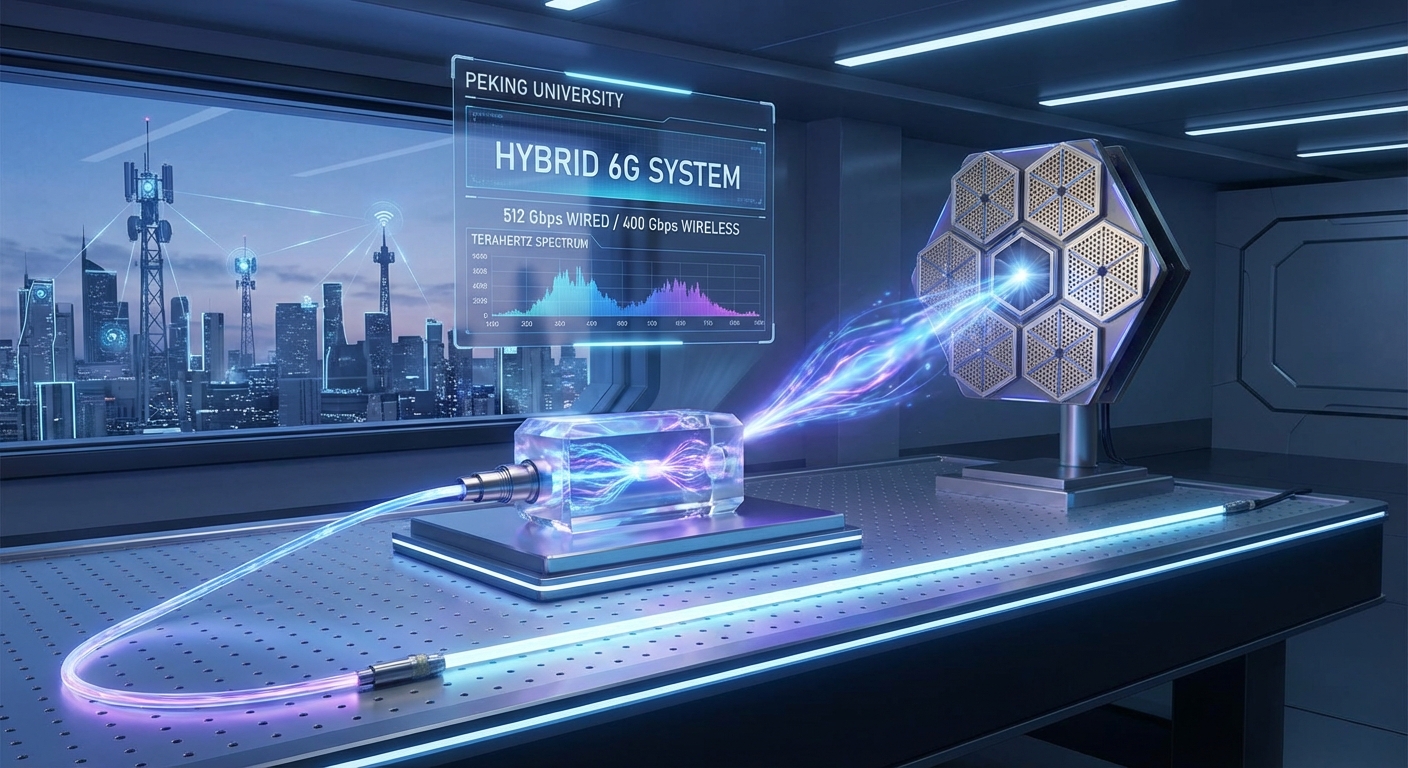

Scientists at Peking University have developed a pioneering hybrid communication system that seamlessly integrates fiber-optic and wireless data transmission, achieving world-record speeds and laying a crucial foundation for future 6G networks. By utilizing unique photonic devices operating at frequencies above 250 GHz in the terahertz (THz) spectrum, the system reached a staggering 512 Gbps over a wired connection and 400 Gbps wirelessly. This performance is more than ten times faster than current 5G technology and robust enough to transmit 86 separate channels of 8K video simultaneously with minimal delay.

The Terahertz Breakthrough
The core of this innovation lies in its use of photonic-electronic integration to manage the terahertz (THz) frequency band, which sits between microwave and infrared waves. This spectrum offers enormous bandwidth, essential for the terabit-per-second (Tbps) speeds envisioned for 6G. Traditional electronic hardware struggles to operate efficiently at these high frequencies, but by converting electronic signals to the optical domain, the researchers overcame these limitations. This hybrid approach creates a fluid bridge between the immense capacity of fiber optics and the flexibility of wireless, eliminating data bottlenecks and enabling unprecedented performance.
Real-World Potential: From 6G to Wireless Data Centers
The successful test, which involved streaming 86 channels of 8K video, showcases the system’s capacity to handle the massive data loads required by future technologies. The development is a critical step toward the commercial rollout of 6G, which is expected around 2030 and will enable applications like holographic telepresence and the tactile internet. Beyond mobile networks, this technology could revolutionize data center architecture. By enabling servers to communicate wirelessly at fiber-optic speeds, it could drastically reduce complex cabling, improve cooling efficiency, and allow for more dynamic and scalable data center designs.
The Global Race for 6G Supremacy
This achievement from Peking University places it at the forefront of the global race to define the next generation of wireless technology. Major technology companies and research institutions worldwide, including Samsung, Nokia, Ericsson, and Huawei, are heavily invested in 6G research. Many are focused on similar challenges, such as harnessing the THz spectrum and integrating artificial intelligence to manage network resources. While this breakthrough is significant, it represents one milestone in a highly competitive field pushing the boundaries of connectivity.
Challenges on the Road to 6G
Despite the promising results, the transition from a laboratory prototype to a widespread commercial technology faces several hurdles. Terahertz waves are susceptible to atmospheric absorption and require a near-direct line of sight, which can limit their range and reliability. Furthermore, the cost and complexity of manufacturing the necessary photonic and semiconductor components at scale remain significant challenges. Overcoming these obstacles through innovations in materials science, antenna design, and signal processing will be crucial for making the ultra-fast promise of 6G a global reality.