

Today at the CES 2026 exhibition, Nvidia officially unveiled the flagship Rubin platform for artificial intelligence. It will replace Blackwell and deliver significantly greater performance.
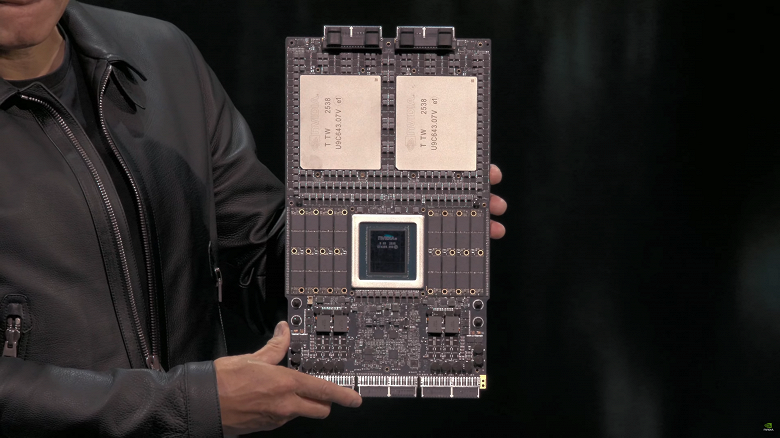
The Rubin platform consists of a total of six chips. Among them: Rubin GPU (336 billion transistors); Vera CPU (227 billion transistors); NVLink 6 bus; Spectrum-X – an Ethernet solution using silicon photonics (102.4 Tbps); ConnectX-9 network adapters (1.6 TB/s) and BlueField-4 DPU processors.
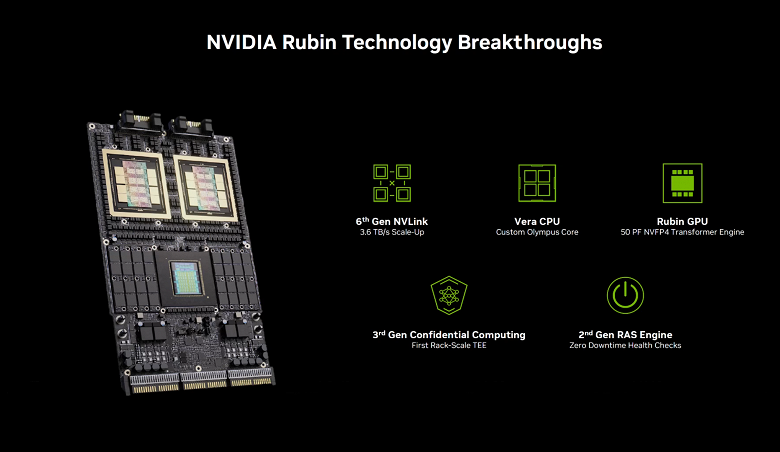
Nvidia reports that the Rubin GPU offers a 40% improvement in inference efficiency compared to its predecessor.
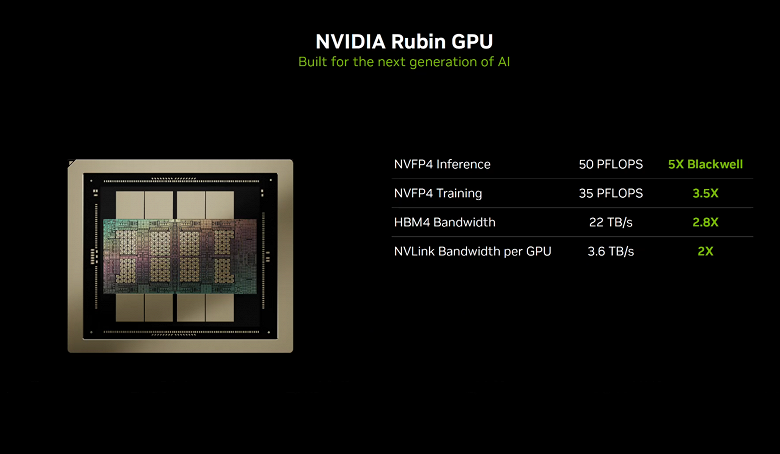
The Rubin GPU is a specialized chip for AI tasks, consisting of two dies. Its performance reaches 50 PFLOPS for model inference and 35 PFLOPS in training (NVFP4 format). This is 5 times and 3.5 times faster than Blackwell, respectively. To provide such computing power, each Rubin GPU is equipped with eight stacks of HBM4 memory, totaling 288 GB with a bandwidth of up to 22 TB/s.
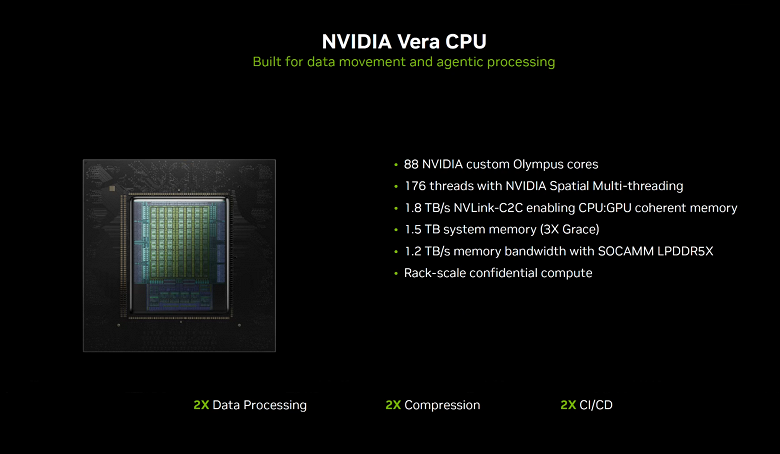
The Vera CPU is built on a custom Arm architecture codenamed Olympus. The central processor has 88 cores and supports 176 threads (Spatial Multi-Threading technology). CPU Vera exceeds CPU Grace in data processing and compression by 2 times.
The foundation of data centers will be the Vera Rubin superchip, combining one Vera central processor and two Rubin graphics processors. The NVL72 Vera Rubin rack provides a total capacity of 3.6 EFLOPS and is equipped with 54 TB of LPDDR5x RAM and 20.7 TB of HBM4 memory. Nvidia claims the transition to Rubin will reduce the cost of token generation (inference) by 10 times, and training complex models will require 4 times fewer GPUs compared to the Blackwell GB200-based system. According to Nvidia, this promises a step forward in AI efficiency by enabling quicker training cycles, ultimately spurring advancements in various sectors reliant on AI innovation.
First customers will receive Nvidia Rubin at the end of 2026, with mass production of Rubin starting in the first quarter of 2026. As the anticipation builds, the tech industry watches closely, expecting a significant impact on AI-centric applications more broadly.