





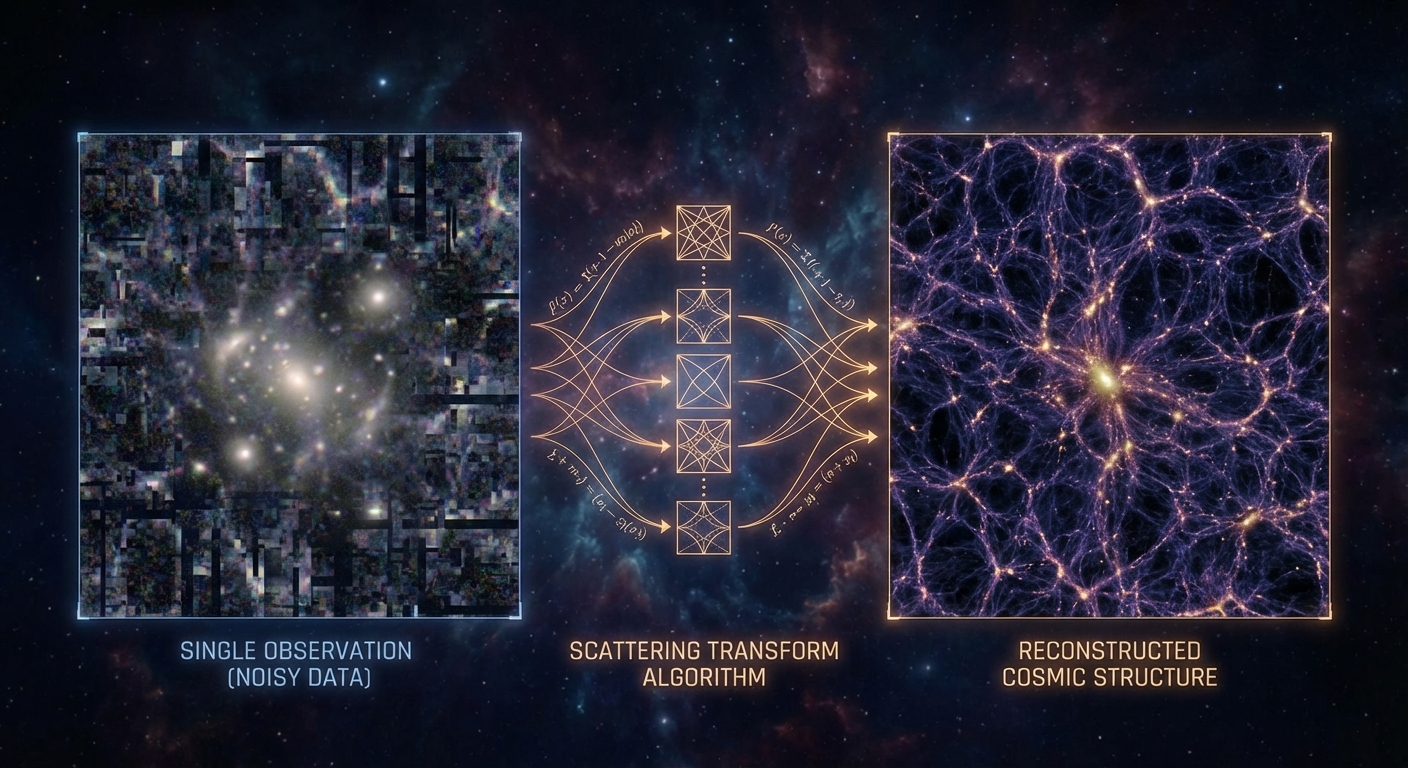

In astrophysics and cosmology, scientists often face “inverse problems”: reconstructing hidden physical fields, such as the distribution of matter in the universe, from observational data. Typically, Bayesian methods are used for this, where prior information about the signal’s structure plays a crucial role. However, for complex, non-Gaussian processes-like the distribution of galactic dust or the large-scale structure of the cosmos-such prior models are either non-existent or unreliable, especially when only a single observation is available.
The Challenge of a Single Snapshot
Traditional statistical tools often fail when analyzing complex cosmic phenomena because they rely on having robust pre-existing models, or “priors.” This is a significant hurdle in cosmology, where researchers often deal with unique objects or datasets. The large-scale structure of the universe, for instance, is a one-of-a-kind observation, making it impossible to build reliable prior models from multiple examples. This limitation has made it difficult to accurately map the intricate web of galaxies and dark matter from noisy and incomplete observational data.
A Universal Approach Without Priors
In a new work, an international team of scientists has proposed a universal approach that allows for the reconstruction of the statistical properties of complex fields even with a severe lack of data and without external physical assumptions. The key idea is to shift from working in pixel space to a compact description of signals using the Scattering Transform (ST)-a set of statistics sensitive to non-Gaussian features and interactions across different scales. The ST functions similarly to a convolutional neural network but does not require training, making it a powerful tool for generating robust summary statistics from complex fields.
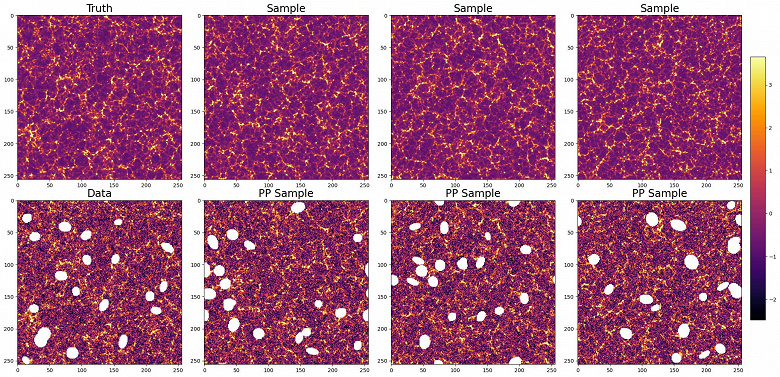
The authors developed an iterative algorithm that constructs a posterior distribution of signal models in the space of ST statistics. This allows for obtaining not just a single solution, but a whole family of maps that are statistically compatible with the observation. To validate the method, density maps from simulations were used, with added noise and masks to mimic real observational constraints. The results showed that even with a single observation and no external models, the new approach can recover not only the visual but also the statistical characteristics of the original field: the power spectrum, value distribution, and topological properties.
Future Implications for Cosmology
This new methodology is particularly useful for analyzing non-Gaussian signals where traditional approaches fall short. It opens the way for new applications in astrophysics and cosmology, especially when dealing with unique or poorly understood objects. For instance, it can be used to create generative models of complex non-linear fields from a limited amount of data, which is crucial for upcoming cosmological surveys like the Euclid space telescope. Furthermore, the output can be used to train a neural network for reconstructing the map in pixel space, enhancing the capabilities of machine learning applications in the field.
The proposed Bayesian approach allows for solving complex inverse problems even in the most unfavorable conditions-when data is scarce and prior knowledge is virtually absent. This marks a significant step towards a more accurate and universal analysis of cosmic images, promising to unlock new insights from the vast datasets of current and future astronomical surveys.