





Physicists working on the MicroBooNE experiment at the Fermilab National Accelerator Laboratory have presented new data that do not confirm the existence of so-called sterile neutrinos-hypothetical particles previously considered a possible explanation for anomalous results in past experiments. Neutrinos are among the most abundant particles in the universe: by current estimates, tens of trillions of neutrinos pass through the human body every second. They hardly interact with matter at all, since they only follow weak and gravitational interactions. It is this “ghostly” nature that makes neutrinos both fundamentally important and extremely difficult to study. According to the Standard Model of elementary particle physics, there are three types, or “flavors,” of neutrinos. One of their key features is the ability to transform into each other in the process of motion-a phenomenon known as neutrino oscillations. However, in the early 2000s, the LSND and MiniBooNE experiments recorded deviations that did not fit well into this picture. One of the most popular explanations was the hypothesis of the existence of a fourth type of neutrino-the sterile one, which does not even participate in weak interactions.
Advancements and Analyses
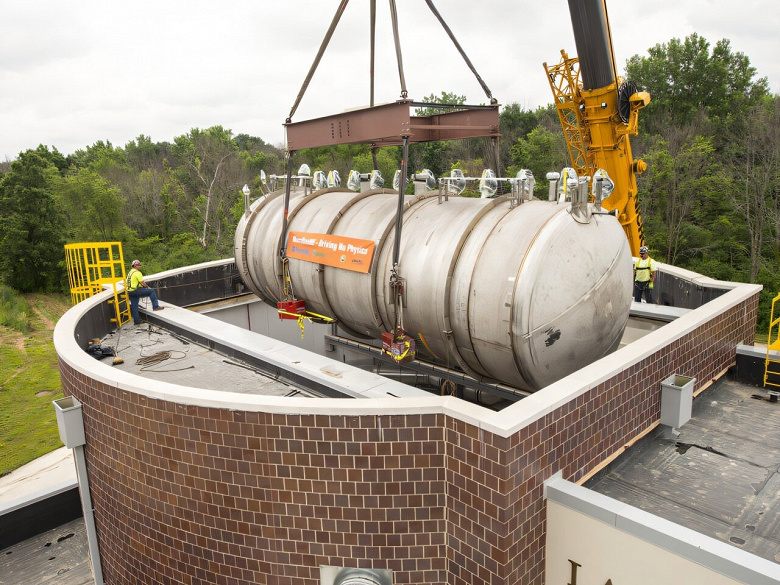
The MicroBooNE experiment was specifically designed to test this hypothesis. It uses a liquid argon detector-the so-called time projection chamber (LArTPC), which allows for highly accurate “photographs” of neutrino interactions with argon atoms. When a neutrino collides with an atom, charged particles emerge, knocking electrons out of atoms. Under the influence of an electric field, these electrons drift to the readout elements, forming a detailed three-dimensional image of the event. The data analysis showed that the signals recorded by MicroBooNE do not show signs of oscillations into sterile neutrinos. Moreover, the experiment did not confirm the anomalies previously observed, thereby ruling out a number of possible interpretations, including the scenario involving sterile neutrinos.
According to participants in the work, this does not mean that the mystery of past results is completely solved. However, the new data significantly narrow the range of possible explanations and allow for more precise directions for further research. In particular, they show that if the anomalies are indeed caused by new physics, it must be of a different nature.
Future Directions and the DUNE Project
The MicroBooNE work is part of a broader neutrino research program at Fermilab-the Short-Baseline Neutrino (SBN). In parallel, physicists are preparing for the next major phase of research-the DUNE (Deep Underground Neutrino Experiment). In it, neutrinos will cover a distance of about 1300 kilometers (807 miles)-from Illinois to an underground detector in South Dakota. The DUNE project has been using cutting-edge technologies and updated methods to improve the accuracy of neutrino detection and understanding. Recent advancements have included enhancements in detector sensitivity and methodologies, allowing researchers to refine models of neutrino properties and behaviors more precisely.
DUNE will employ significantly larger and more sensitive LArTPC detectors and a neutrino beam with a wide range of energies. This will allow scientists to study oscillations with unprecedented accuracy, determine the hierarchy of neutrino masses, and verify whether neutrinos and antineutrinos behave the same-a question with direct implications for understanding the origin of matter in the universe.
Thus, the results of MicroBooNE do not close neutrino physics, but rather make it more focused. By excluding one of the most discussed explanations of past anomalies, physicists have obtained a clearer map of exactly where to look for new physics beyond the Standard Model.