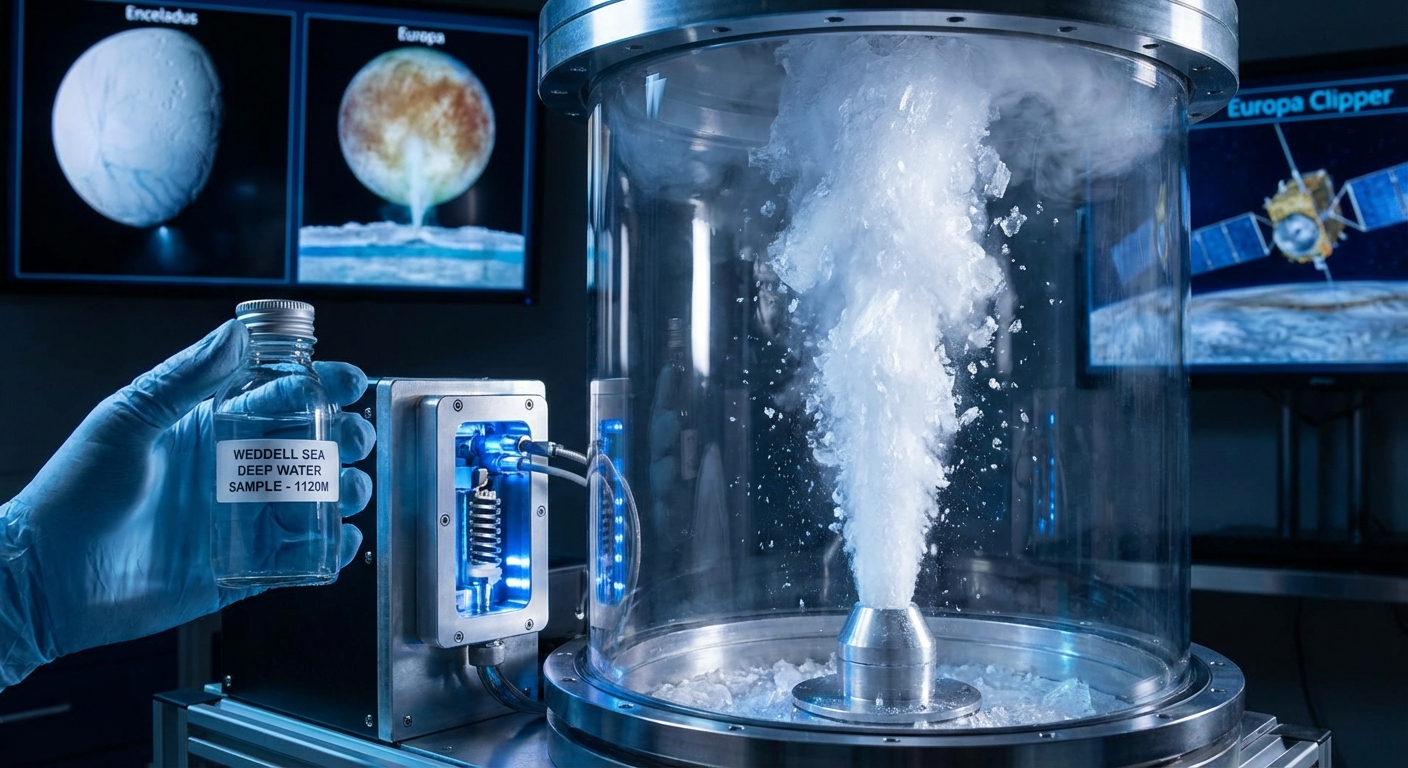

Astrobiologists and physicists have initiated a groundbreaking experiment designed to prepare future space missions for the search for life on icy worlds such as Pluto, Enceladus, and Europa. These celestial bodies are believed to hide vast oceans of liquid water beneath ice shells that are miles thick, containing key elements for the emergence of life. Instead of the monumental task of drilling through the ice, scientists plan to study the emissions from cryovolcanoes-giant geysers that eject ocean water directly into space.

The Challenge: Deciphering Cosmic Clues
The primary challenge is that during the journey from a warm ocean, through a frozen crust, and into the vacuum of space, the water’s chemical composition and any potential biological markers can be radically altered. A team of NASA researchers, led by Mariam Naseem and Marc Neveu, has undertaken the task of determining exactly how the process of cryovolcanism transforms organic molecules. This understanding will enable scientists on Earth to correctly interpret data collected by space probes, distinguishing between genuine signs of life and chemical artifacts created by the eruption process.
From the Bottom of the Earth to the Outer Solar System
To conduct their tests, the scientists needed water that closely mimics the conditions of extraterrestrial oceans. They sourced samples from the Weddell Sea, east of the Antarctic Peninsula, from a depth of 1120 meters (3675 feet). At this depth, the water is completely isolated from sunlight and under immense pressure, simulating the environment where hypothetical microbes might exist in the depths of Europa or Enceladus.
These deep-sea samples will be placed in a specialized simulator called the Simulator of Ocean World Cryovolcanism, which recreates the extreme environment of outer space by injecting the water into a vacuum chamber. Researchers will observe what happens to minerals and complex organic matter upon instantaneous freezing and exposure to a vacuum. The results will serve as a crucial “instruction manual” for upcoming missions like NASA’s Europa Clipper, which is designed to perform dozens of close flybys of Europa to investigate its potential for life.
A Look to the Future: Enhancing the Search for Life
The Europa Clipper mission, which launched in October 2024 and is expected to reach the Jupiter system in 2030, is equipped with a suite of advanced instruments to analyze Europa’s surface and any plumes it might be venting. The data gathered by this experiment will be vital for interpreting the findings of instruments like the MAss Spectrometer for Planetary EXploration (MASPEX), which will analyze the chemical composition of particles in space around the moon. This research significantly increases humanity’s chances of discovering extraterrestrial organisms during planned flights to the moons of Jupiter and Saturn, bringing us closer to answering the question of whether we are alone in the universe.