
NASA and Boeing’s Wing Design Experiments
NASA and Boeing have successfully completed a series of wind tunnel tests on elongated wing models designed to enhance the fuel efficiency of future aircraft. The challenge lies in the fact that such wings, being more susceptible to bending and vibration, demand innovative engineering solutions.
Jennifer Pinkerton, an engineer from NASA’s Langley Research Center, noted that these extended wings are more sensitive to gusts of wind and maneuvers, which can cause undesirable oscillations. The wing’s design uniqueness amplifies these vibrations, potentially leading to structural failure.
To mitigate the effects of wind gusts, reduce turning loads, and suppress flutter, scientists from NASA and Boeing tested a 4-meter wing model in NASA Langley’s wind tunnel. This tunnel, with a working section of 4.8 by 4.8 meters, has been used for over 60 years in the design of civilian and military aircraft.
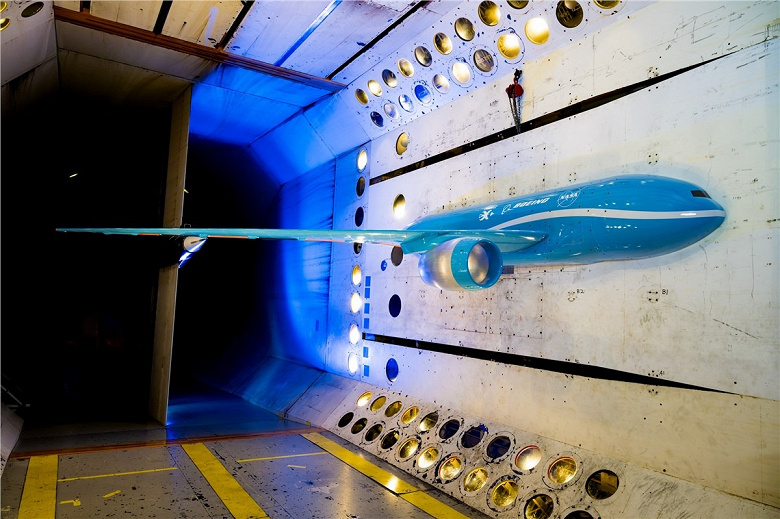
The model, developed by NextGen Aeronautics, was equipped with ten movable panels along the trailing edge of the wing. By adjusting the positions of these panels, researchers controlled the airflow and reduced the forces causing vibration. Sensors within the model measured the acting forces and the structure’s response.
The first phase of testing conducted in 2024 provided baseline indicators for comparison with NASA’s computer simulations. The second phase this past year used additional panels in new configurations. The most noticeable effect was the reduction in wing vibration due to wind gusts.
Patrick Heaney from NASA emphasized that the new model is significantly more complex than the previous one; the earlier model had two control panels, whereas the current one has ten. Experts from NASA and Boeing are analyzing the obtained data and preparing to share the results with the aviation community.
Implications and Future Perspectives
Airlines and equipment manufacturers will be able to use this knowledge to develop next-generation aircraft. The push towards such advancements aligns with the growing demand for sustainable and environmentally friendly aviation practices. Innovations like these are crucial not only for fuel efficiency but also for achieving industry-wide sustainability goals.
Experts suggest that embracing such technology could mark a significant step towards reducing carbon footprints in aviation, contributing to a greener planet.