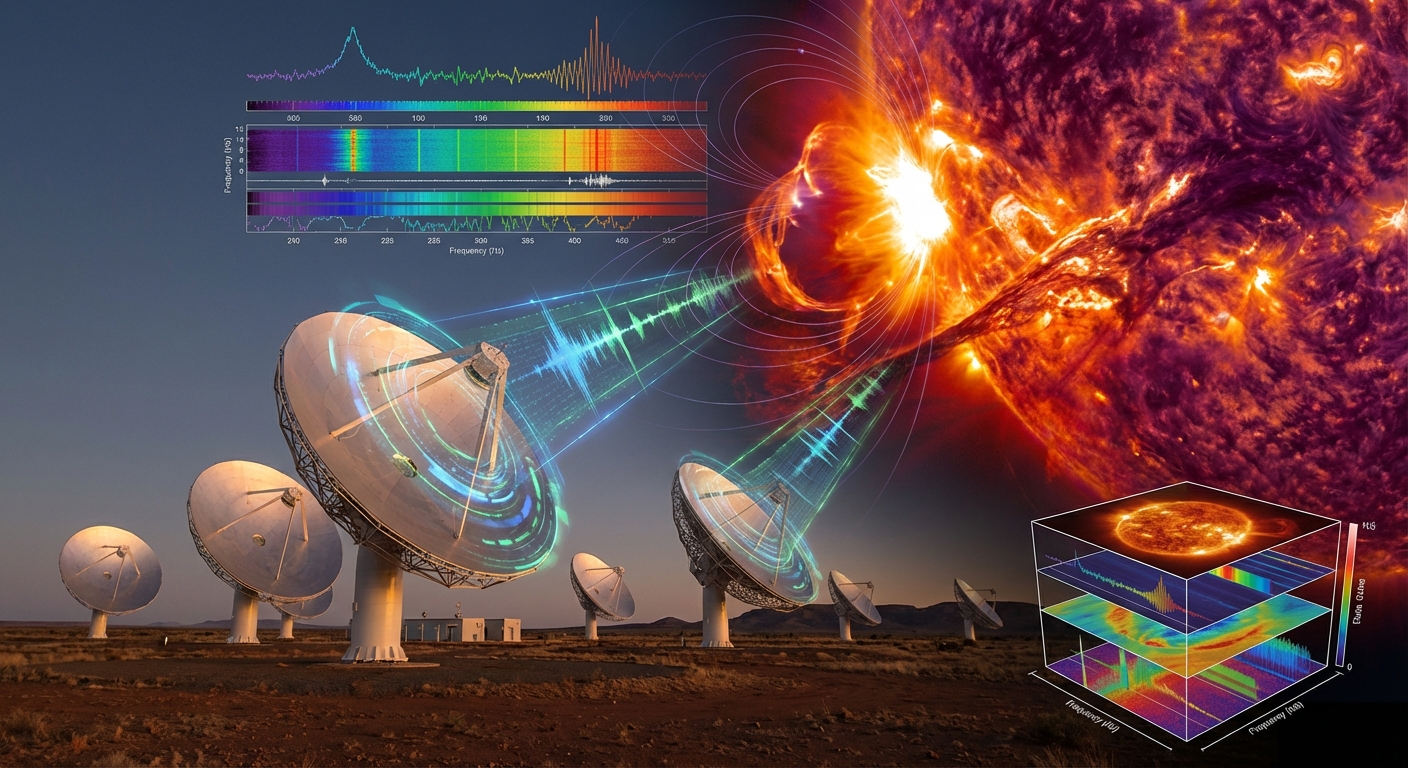

In a landmark achievement for solar physics, astronomers have used the MeerKAT radio interferometer for the first time to capture highly detailed spectroscopic images of an M1.3-class solar flare. The observation, which took place on December 29, 2024, provides an unparalleled view into the complex processes of particle acceleration and energy release on the Sun, heralding new possibilities for understanding and predicting space weather.
A New Eye on the Sun’s Fury
MeerKAT, a precursor to the future Square Kilometre Array’s mid-frequency telescope (SKA-Mid), leveraged its exceptional sensitivity and high dynamic range to simultaneously observe two distinct types of radio signals from the flare’s active region. Scientists were able to distinguish between the intensely bright, coherent radio bursts-produced when electrons are accelerated in phase and act together-and the much fainter, incoherent background radiation that comes from the independent jiggling of individual particles. This dual capability is a significant step forward, as current instruments often struggle with the vast differences in intensity, limiting detailed study of flaring regions.
Mapping the Flare’s Complex Anatomy
The high-fidelity images revealed several spatially separate sources of radio bursts, suggesting they originated from different populations of accelerated electrons within distinct magnetic loops. This confirms that solar flares are not monolithic events but have a complex, multi-zoned structure. Furthermore, MeerKAT detected a sprawling area of incoherent radiation that was invisible in the extreme ultraviolet (EUV) spectrum. This faint glow is evidence of a hot, rarefied plasma in the solar corona that other instruments typically miss, showcasing MeerKAT’s power to detect previously hidden solar features.
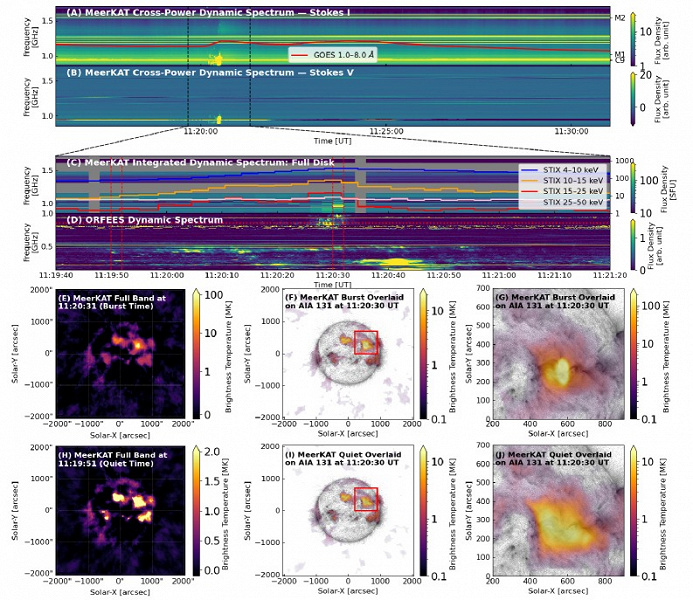
By combining the radio data with co-temporal hard X-ray images and magnetic field models, the research team was able to link the different radio sources to specific magnetic structures and acceleration mechanisms. This multi-pronged approach confirms that various processes work in concert to power these immense solar eruptions.
Paving the Way for the SKA and Better Forecasts
These groundbreaking results serve as a powerful demonstration of MeerKAT’s diagnostic capabilities and set the stage for future investigations with the even more powerful SKA-Mid array. The SKA telescopes are expected to revolutionize solar physics by providing unprecedented insights into the Sun’s magnetic fields, which are the primary drivers of space weather. A deeper understanding of the physics behind particle acceleration and the dynamics of solar storms is crucial. It will not only unravel fundamental astrophysical questions but also significantly improve the accuracy of space weather forecasts. Such advancements are vital for protecting our increasingly technology-dependent society, safeguarding everything from satellites and communication systems to power grids on Earth.