







Scientists from Imperial College London have presented evidence of an ancient beach in the Jezero Crater on Mars, where the Perseverance rover is currently operating. The analysis of Margin Unit rocks surrounding the crater has shown that part of these formations are the result of shore processes, namely wave action in the lake. This research is based on the data collected by Perseverance over nearly five years of work in Jezero Crater, which is thought to have once been filled with water.
The Dual Nature of Margin Unit
The Margin Unit valley is divided into two parts: the Western Margin Unit (WMU) and the Eastern Margin Unit (EMU). WMU, located closer to the edge of the crater, consists of igneous rocks formed likely as a result of volcanic activity. An abundance of carbonates and silica in these rocks indicates interaction with a carbon dioxide-rich liquid, possibly water from hydrothermal sources.
Hydrothermal sources are considered potential sites for the origin of life, making WMU a fascinating subject for astrobiological studies.
Unveiling the Eastern Margin Unit
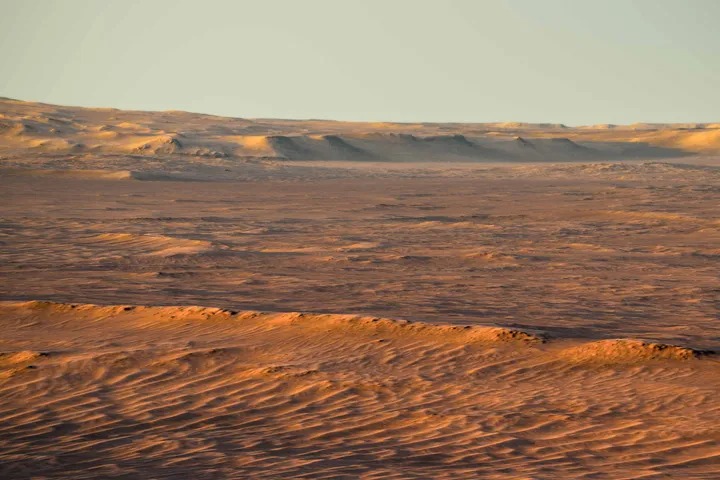
The greatest interest lies in EMU, which features signs of stratified structure with inclined layers, indicating deposits formed by liquid flows. The rounded grains and erosion marks suggest the influence of waves. The study authors concluded that EMU is a “shore zone of the lake that was formed when Jezero Crater was filled with water.”
The presence of waves implies that the water in the crater was not frozen, contradicting some theories about the Martian climate. Moreover, the formation of waves requires wind, and the current thin Martian atmosphere cannot create strong winds. This means Mars’ atmosphere was considerably denser in the past. The modern atmospheric pressure on Mars is less than 1% of Earth’s.
The Potential for Ancient Life
Minerals found in these regions (carbonates and silica) can trap and preserve bacteria in the form of microscopic fossils. Of particular interest is the Comet Geyser sample, taken by Perseverance in WMU, which NASA says has the greatest potential for finding preserved signs of ancient life.
However, the prospects of returning these samples to Earth for further study are in question. NASA has canceled the Mars Sample Return mission due to budget overruns. The mission was supposed to bring back soil samples collected by Perseverance. Earlier reports indicated that the total cost of the mission could exceed $10 billion.
What’s Next for Martian Exploration?
The unique samples collected by the rover will remain on Mars for now, awaiting future missions. There’s a possibility of private investments, as seen with support for telescope projects, to help achieve this goal. Meanwhile, the scientific community continues to analyze the data sent back by Perseverance, hoping to unlock more secrets about our planetary neighbor.