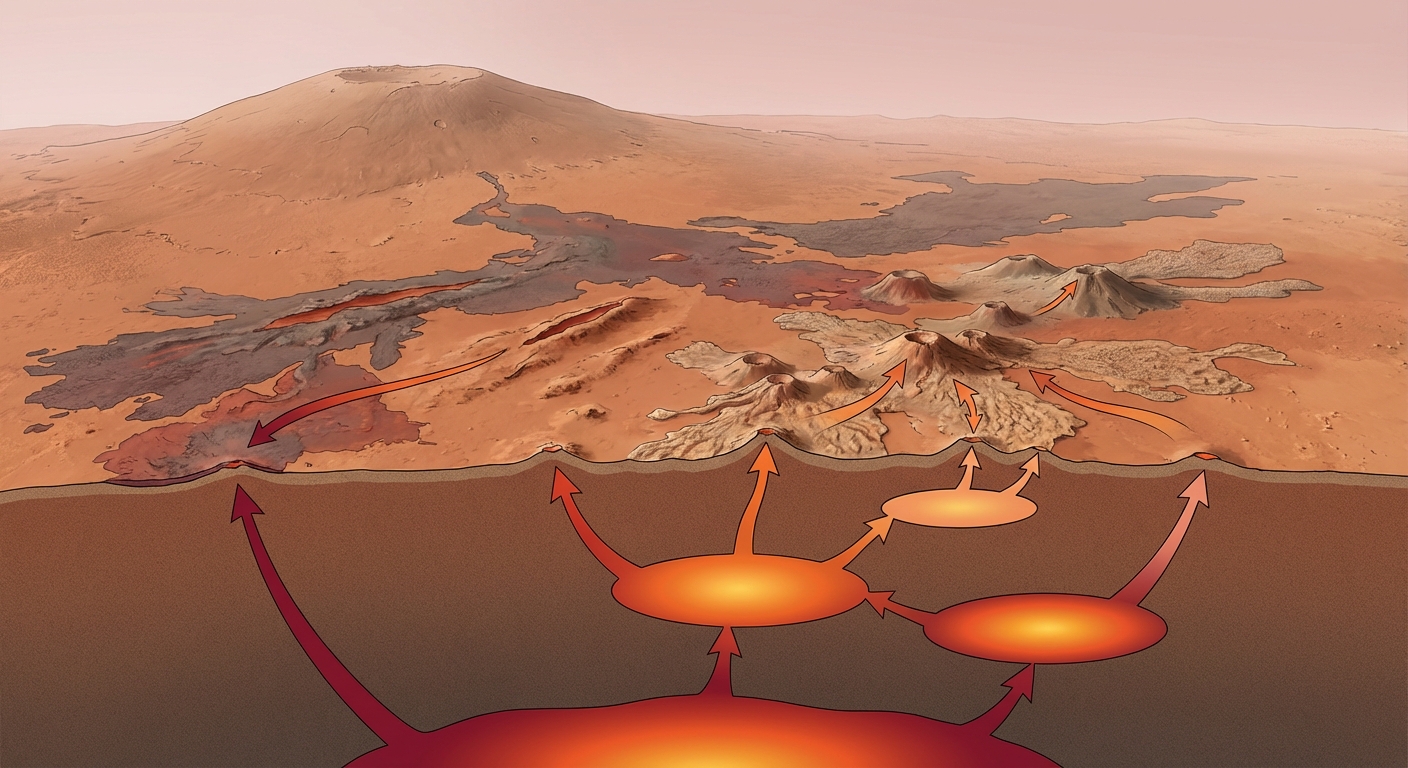

Even a single volcanic eruption is often the result of long and complex processes occurring deep beneath a planet’s surface. Magma can slowly move, change, and accumulate over thousands or even millions of years before it breaks through. To understand how volcanoes work, scientists study the products of these eruptions, which help reconstruct the hidden structure of magmatic systems. A new study published in the journal Geology shows this complexity is also characteristic of Mars. High-resolution orbital images and mineralogical data have revealed that some of the planet’s youngest volcanic systems were not formed in a single, brief episode but through prolonged and evolving magma activity below the surface.
A Deeper Look at Pavonis Mons
An international team of scientists studied an extensive volcanic system south of Pavonis Mons, one of the largest volcanoes on Mars. Using detailed surface mapping and data from orbital spectroscopy, the team reconstructed its developmental history with unprecedented precision. This research challenges the previous notion that Mars’s later volcanic history consisted mainly of short, isolated outbursts. Instead, it points to a much more dynamic and sustained process.
“Our results show that even during Mars’ most recent volcanic period, magma systems beneath the surface remained active and complex,” noted Bartosz Pieterek of Adam Mickiewicz University, the study’s lead author. “The volcano did not erupt just once-it evolved over time as conditions in the subsurface changed.”
Deciphering Mineral Fingerprints
The analysis revealed that the system developed in several stages. Initially, eruptions occurred along fissures, forming extensive lava flows. Later, the activity shifted to individual vents, creating cone-shaped volcanic structures. Despite the differences on the surface, all these flows were fed by the same underlying magmatic system. Each stage left its own “mineral fingerprint,” allowing scientists to trace how the magma’s composition changed over time.
“These mineral differences tell us that the magma itself was evolving,” explains Pieterek. This evolution was likely related to changes in the depth of its origin and the amount of time it was stored beneath the surface before erupting. For example, the transition from olivine-rich to pyroxene-rich lava suggests that the magma feeding later eruptions likely cooled within the crust before reaching the surface.
A Window into the Martian Interior
As direct sampling on Mars is not yet possible, such studies remain one of the few ways to peer into the planet’s internal structure. This work demonstrates that even remote orbital observations can uncover the hidden complexity of volcanic systems-not only on Mars but also on other rocky planets. The findings suggest that even the more recent volcanic activity on the Red Planet was more intricate than it first appears, providing a more nuanced view of its geological past.