

Scientists from the University of Copenhagen have created the first complete map showing the number of neutrinos generated by all the stars in the Milky Way and their origins. The results integrate advanced stellar models with data from the European Space Agency’s (ESA) Gaia telescope. The map reveals which areas of the galaxy produce the most intense neutrino signals. The main concentration of neutrinos comes from the galactic center, where star density is at its highest within a few thousand light years from Earth. Most of these particles are produced by massive stars larger than the Sun.
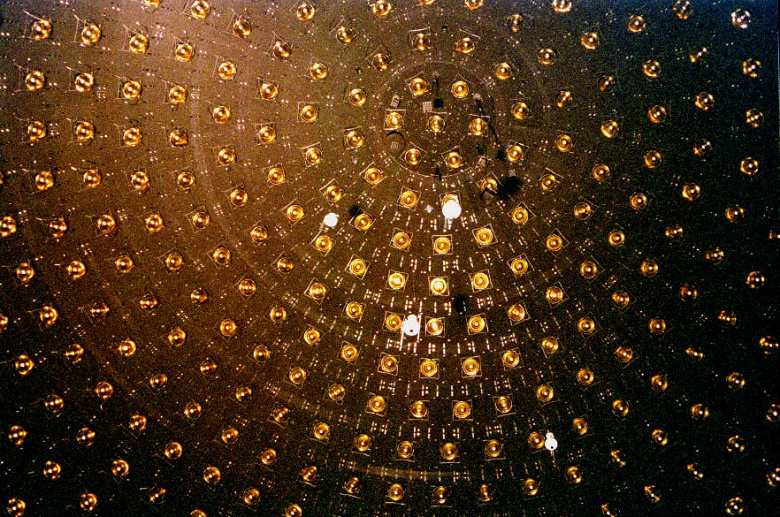
“We now know more precisely where to look for galactic neutrinos. The map shows that young stars more massive than the Sun produce the most neutrinos, and production varies significantly depending on the age and mass of the star,” says leading author Pablo Martinez-Mirave, a postdoc at the Niels Bohr Institute. The data will aid neutrino observatories, located deep underground to shield from cosmic ray interference, in more accurately targeting their instruments. By focusing on areas with the most robust neutrino signals, scientists can increase their chances of detecting these particles.
Neutrinos are elementary particles that barely interact with matter. They form as a result of nuclear reactions occurring in the stars’ cores. Unlike photons, neutrinos interact negligibly with matter, allowing them to carry information about processes within stars, almost without distortion. Studying neutrinos provides insight into processes that are otherwise inaccessible through traditional astronomy based on electromagnetic radiation observation.
Advancements in Neutrino Detection Technology
Recent developments in neutrino detection have focused on innovative materials and computing methods to more effectively analyze data. Techniques such as using novel detection materials and enhancing computational algorithms have allowed scientists to better track these elusive particles. This aligns with the studies using telescopes like Gaia, providing exceptional precision in mapping galactic components that are sources of neutrinos.
Future Developments and Expert Insights
Experts predict that the future of neutrino research will involve collaborative worldwide experiments aiming to solve some of physics’ most intriguing questions. Upcoming projects are set to enhance the capacity for capturing and analyzing neutrino data, propelling new understandings in particle physics and cosmology. As this research progresses, breakthroughs are expected to illuminate the processes hidden within stars, potentially transforming our comprehension of galactic dynamics.