







Innovative Use of Lunar Regolith
Engineers from Purdue University have developed a new concept for constructing a lunar launch pad designed to withstand the take-offs and landings of heavy rockets by utilizing lunar regolith as the primary building material. The need for such platforms arises because the rocket engine’s exhaust plume can lift a significant amount of dust and rocks, potentially damaging the rocket itself and nearby lunar base structures.
Transporting concrete from Earth to build a traditional platform is economically impractical. The primary challenge lies in the limited understanding of the mechanical and thermal properties of lunar regolith, especially after it undergoes sintering-a process intended to create a durable structure. Using terrestrial simulants of regolith provides an incomplete picture, as they only approximately reproduce the properties of the lunar material.
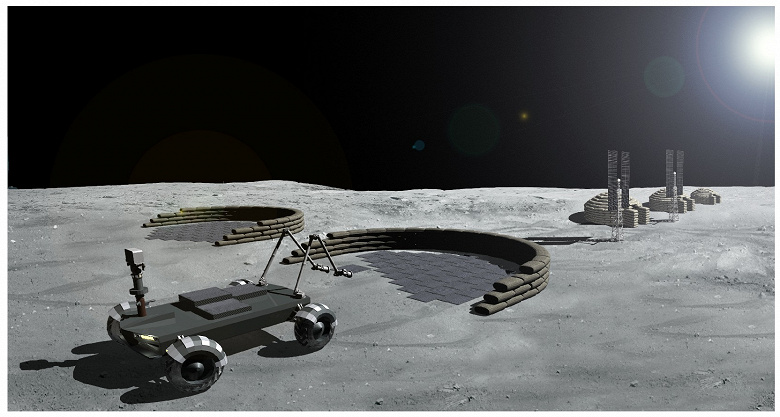
Nonetheless, the authors of the study have proposed a method based on minimal known data about regolith. They considered that sintered regolith will likely be brittle and weaker in tension than in compression while also possessing good thermal insulation properties. It is estimated that even direct exposure to Starship’s exhaust plume would heat the platform’s slab by only up to 8 inches.
Design Considerations and Challenges
Scientists recommend constructing the platform about 0.3 meters thick for a 50-ton landing module. Increasing the thickness could lead to quicker destruction due to thermal stresses occurring in the 28-day lunar cycle with sharp temperature fluctuations. One expected type of damage is the chipping of small fragments due to the expansion and contraction of the material.
The authors emphasize the importance of conducting tests directly on the Moon to gain accurate data about regolith properties and optimize the platform design. Construction and maintenance are likely to be carried out using remotely operated robots. The data obtained about platform deformation under load and extreme temperature conditions will help develop strategies to prevent crack formation and enhance the structure’s reliability.
Advancements in Robotics for Lunar Construction
In recent developments, space agencies are advancing robotic technologies capable of operating autonomously in harsh lunar environments. These robots are designed to handle regolith in its raw and processed forms, including sintering it on-site to form durable structures. With advancements in AI and machine learning, these robots are expected to conduct complex tasks previously performed manually by astronauts.