
Astrophysicists have delved into the enigmatic formation of 3Cem3Efascinating3C/em3E lambda Bo3Cathy Bo3Obtis stars, a rare subclass of spectral class A stars with unparalleled chemical peculiarities. These stars captivate researchers due to their atmospheric compositions; where levels of carbon, nitrogen, oxygen, and sulfur closely mirror those of our Sun, iron group elements remain substantially scarcer. For years, the cause of such anomalies puzzled scientists.
Continuing Mystery of Stellar Genesis
The primary theory attributes the peculiar compositions to 3Cstrong3Eaccretion,3C/strong3E the absorption of gas low in heavy metals from surrounding interstellar media. However, observations of lambda Bo3Cathy Bo3Obtis within star clusters challenge this model slightly. One must ponder how massive stars would hamper material accumulation through intense ultraviolet light, destroying gas disks.
To investigate, researchers conducted simulations accounting for dynamics within star clusters featuring anything between 300 and 3000 members. Factors considered included gravitational interactions, initial mass distributions, and the clusters’ gradual expansion. These factors allowed tracking orbital changes over the first tens of millions of years. In doing so, special focus was given to class A stars, believed temporarily leaving their clusters’ core, only to return significantly transformed. Recent research underscores prolonged exposure to these environments, with studies simulating their evolutions. The mystery continues, ensnaring community interest.
Dynamics of Star Cluster Movements
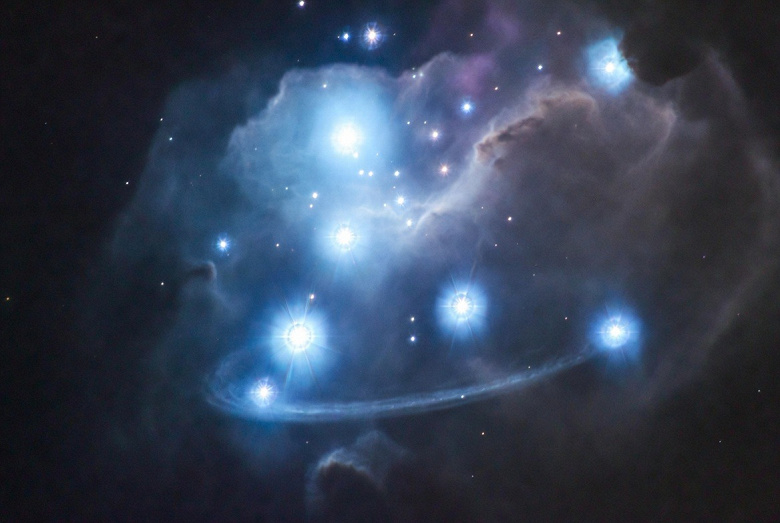
As dynamics unfold, certain stars venture beyond the Jacobi radius, where cluster gravity diminishes significantly. Here, stars encounter calmer, less enriched gas environments, conducive to efficient accretion. Ultimately, capture rates hinge fundamentally on the velocity differential between star and gas: slower speeds mean faster materials are captured.
Simulations revealed that these ‘slow-departing’ stars witnessed their accretion rates climbing to between 10-14 to 10-9 solar masses annually. Such a rate is pivotal for altering their atmospheres significantly. Conversely, ‘swift’ or ‘runaway’ stars hardly accumulated an iota of substance, as their rates slid to 10-12-10-10. Nevertheless, some stars make their central cluster return, profiles altered.
Radiation’s Restrictive Role
Massive stars within dense clusters pose yet another accretion restriction due to ultraviolet emissions, perhaps exceeding interstellar conditions by 100-1000 times-prompting disks’ demise in under a million years. Meanwhile, less dense assemblies fare better, surviving 5-10 million years, allowing crucial accretion to complete.
Iron Enrichment and Cosmic Marvels
This picture becomes yet more complex when considering supernovae type Ia explosions, dispersing elements like iron, enriching immediate environments. Scientists now propose an up to 40-million-year timeline of iron enrichment significantly influencing surrounding star compositions.
Double Star Systems and Chemical Diversity
Authors additionally analyzed binary systems with disparate compositions, such as HD 87304 and CD-33 6615B. Previously perceived as problematic, new calculations indicate wide-binary formations occur when stars capture one another post-peculiar profile acquirements. This view contrasts previous accretion models, favoring dynamic melding of clusters.
These findings, positing class A stars’ temporary cluster alternations, support realistic lambda Bo3Cathy Bo3Obtis formation scenarios. Yet, a contradiction remains: required accretions of approximately 10-14 solar masses annually clash with white dwarfs’ 10-17 cap, accentuating absorption physics variances across star evolution stages, calling for more investigation.”