





Scientists, using the James Webb Space Telescope (JWST), have obtained the most accurate map to date of mass distribution in the Bullet Cluster-one of the pivotal cosmic systems for dark matter study. The new model significantly reduces uncertainties, tightening constraints on possible dark matter self-interactions.
The Bullet Cluster (1E 0657–56), located at redshift z = 0.296, is renowned as a result of two galaxy clusters colliding. In this system, hot gas visible in the X-ray range is spatially separated from the main mass, reconstructed through gravitational lensing effects. This discrepancy remains one of the most compelling observational arguments for the existence of dark matter.
Until recently, models of the Bullet Cluster relied only on six reliably confirmed systems of multiple images of background galaxies. This was insufficient for constructing a precision gravitational potential map. With the arrival of JWST data, the situation has changed.
Observations made with the NIRCam camera across eight infrared filters and NIRSpec spectroscopy revealed 135 reliable lensed images formed by 27 distant galaxies. All these entries are part of the so-called Gold catalog, consisting only of spectroscopically confirmed objects. This approach allowed for the elimination of errors associated with incorrect image identification.
The range of redshifts for background sources from z = 0.9 to 6.7 made it possible to “scan” the cluster’s gravitational field at varying distances from the center, turning it into a distinctive tool for testing cosmological models. Recently, the precision of JWST’s measurements has enabled exploration beyond traditional bounds, influencing our understanding of dark matter and its interactions.
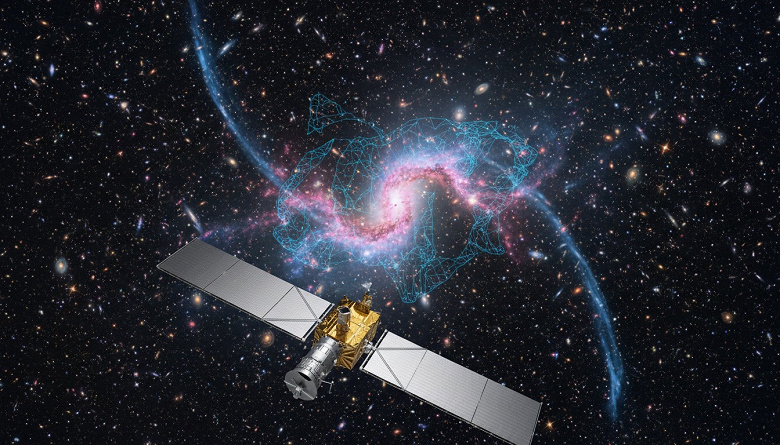
For mass reconstruction, the model included large dark matter halos, individual galaxy cluster halos, and the hot gas distribution data from the Chandra Observatory. Moreover, scientists considered seven external galaxy groups located along the main directions of the cluster, allowing them to abandon simplified approximations and render the model more physically realistic.
Analysis showed the system possesses a complex dual-peaked structure, with the Bullet subcluster surrounded by a compact dark matter halo. A key outcome was refining the position of the mass center relative to the subcluster’s brightest galaxy with uncertainty reduced by approximately three times to 4 (+4/–2) kiloparsecs. Such accuracy has significantly tightened constraints on dark matter’s self-interactions. Previous upper limits were estimated below 1.25 cm²/g, whereas new data indicate a value lower than 0.2 cm²/g.
The absence of significant displacement between the stellar component and dark matter in high-velocity collision conditions corroborates standard cold dark matter model predictions. Also, spectroscopy eliminated the so-called “mass-redshift degeneracy” that long limited similar studies. Rigid fixation of distances to background galaxies severed the link between lens mass estimation and source remoteness.
Comparison with prior works indicated good agreement of mass profiles on scales around 60 kiloparsecs despite different modeling methods. This confirms the reliability of gravitational lensing as a tool for measuring the universe’s largest structures. The authors emphasize that the obtained mass distribution map is the most precise for the Bullet Cluster to date, ending a period of high modeling uncertainty.
Beyond dark matter properties verification, it will be used to search for and study extremely distant galaxies, including epoch objects of first star system formation at redshifts up to z ≈ 11. Thus, the Bullet Cluster remains a “benchmark laboratory” linking particle physics with observational cosmology, while JWST data propel its investigation to almost metrological precision.