
Discovery of MoM-z14: A Cosmic Marvel
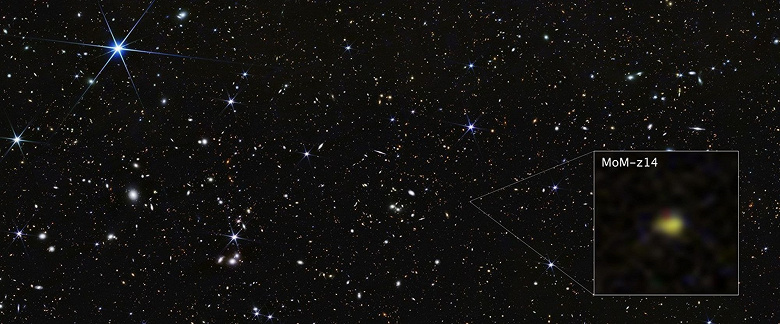
Astronomers using the James Webb Space Telescope (JWST) have discovered the farthest known galaxy to date – the object MoM-z14. Light from this distant galaxy has traveled approximately 13.5 billion years to reach Earth, with the galaxy itself existing a mere 280 million years post-Big Bang. For comparison, the Milky Way only began forming around 800 million years after the universe’s inception.
The age and distance to MoM-z14 were accurately determined using the NIRSpec near-infrared spectrograph. Analysis of its spectrum revealed a record-breaking redshift of z = 14.44, indicating that the galaxy is observed during the Cosmic Dawn era. This is when the earliest stars ignited, and galaxies began to form in the universe. An unexpected aspect for scientists is the galaxy’s overwhelming brightness. MoM-z14’s absolute ultraviolet luminosity is about −20.2 magnitude, making it unusually bright for its era in the universe’s evolution.
Research estimates show a density of such bright objects at this distance that is 182 times greater than previously predicted by models designed before the JWST’s launch, challenging existing theories that galaxies during the first few hundred million years should be low-mass and underdeveloped.
Intense Star Formation Unveiled
Spectroscopic data reveals extremely intense star formation within MoM-z14. In the past 5 million years, the rate of star formation has increased nearly tenfold compared to prior epochs. The ultraviolet spectrum indicates a dominance of massive young stars and an almost complete absence of dust, allowing light to escape the galaxy freely and making it conspicuously observable.
Additionally intriguing is the object’s chemical composition. The spectrum shows surprisingly high nitrogen lines relative to carbon, pointing to potential supermassive stars in the early universe capable of synthesizing heavy elements rapidly.
Rohan Naidu of the Massachusetts Institute of Technology, the lead author of the study, states, “MoM-z14 shows that the early universe was much more active and complex than previously expected.”
Similar chemical anomalies are found in the oldest stars within the Milky Way.
Unprecedented Insight into Early Universe
Observations indicate MoM-z14 boasts a very compact structure, with an effective radius of about 70 parsecs and a noticeably elongated shape. This structure rules out dominant influences from an active core, suggesting that the primary source of light is a dense cluster of young stars. The nature of this galaxy might resemble prototypes of future globular clusters.
Moreover, there is now an ionized gas region around the galaxy, and the spectrum’s lack of characteristic neutral hydrogen absorption signals the onset of reionization-a transition of the early universe from a “foggy” to a transparent state. This evidence suggests that reionization might have started earlier and proceeded more unevenly than previously thought.
The implications of such findings could significantly alter our understanding of the universe’s formative periods.