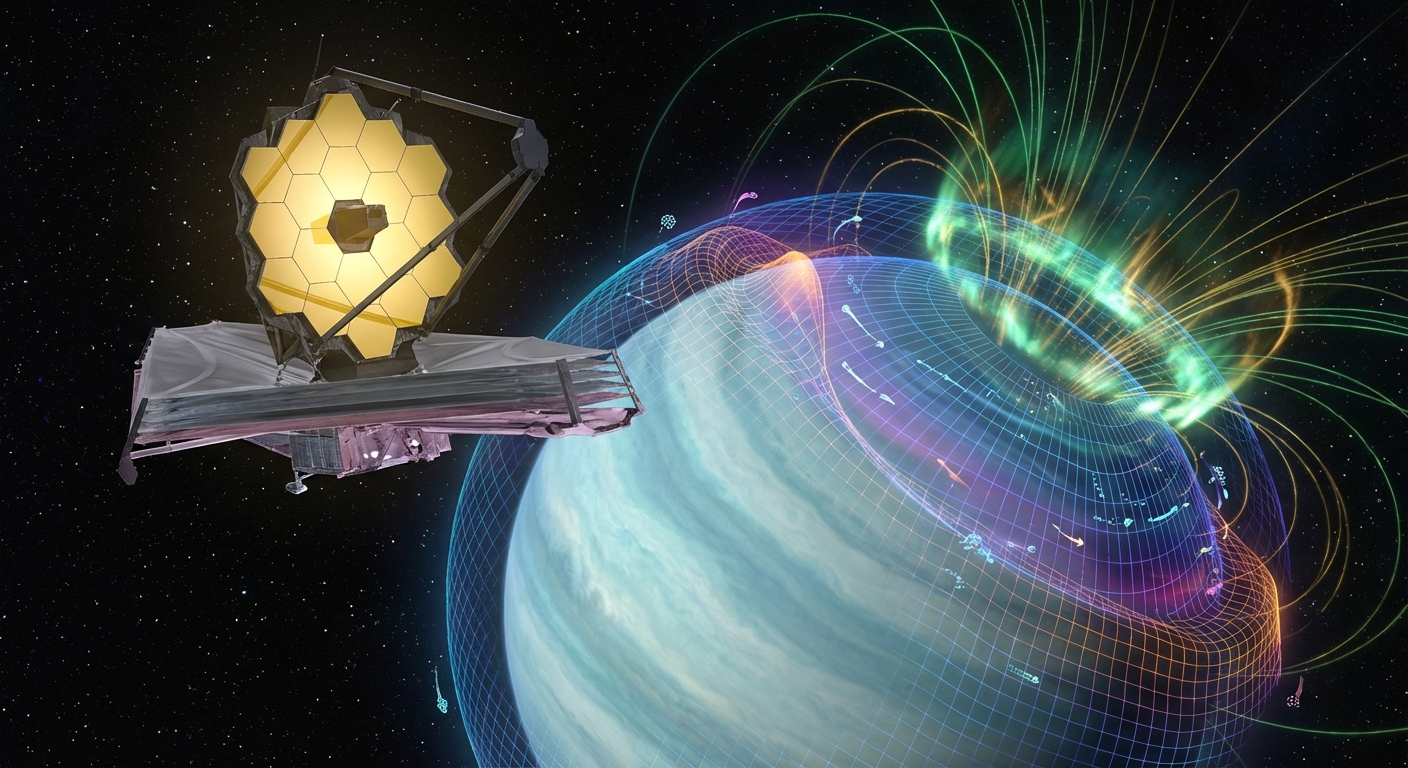

An international team of astronomers, led by PhD student Paola Tiranti from Northumbria University, has created the first-ever three-dimensional map of Uranus’s upper atmosphere using data from the James Webb Space Telescope (JWST). This breakthrough reveals how the planet’s uniquely tilted magnetic field shapes its complex auroras and influences energy distribution, offering unprecedented insights into the physics of ice giants. The observations, conducted over a 15-hour period, tracked the faint infrared glow of molecules up to 5,000 km (about 3,107 miles) above the planet’s cloud tops.
Mapping the Invisible with Unprecedented Detail
Using the Near-Infrared Spectrograph (NIRSpec) instrument aboard the JWST, the team was able to measure the temperature and density of ions in the planet’s ionosphere for the first time with such detail. The data showed that temperatures peak at an altitude between 3,000 and 4,000 km (about 1,864 to 2,485 miles), while the maximum ion density occurs much lower, at around 1,000 km (about 621 miles). These findings provide a clear vertical profile of the upper atmosphere, a feat that had eluded scientists for decades.
“This is the first time we’ve been able to see Uranus’s upper atmosphere in three dimensions,” said Paola Tiranti. “With Webb’s sensitivity, we can trace how energy moves upward through the planet’s atmosphere and even see the influence of its lopsided magnetic field.”
A World of Strange Auroras
Uranus’s magnetic field is one of the strangest in the Solar System. It is tilted by nearly 60 degrees from its rotational axis and is offset from the planet’s center, causing its auroras to follow complex and chaotic paths across the surface rather than forming neat rings at the poles like on Earth. The JWST observations detected two bright auroral bands near the magnetic poles and, notably, a zone of depleted emission between them. This structure is similar to darkened regions previously observed on Jupiter, suggesting that the magnetic field’s geometry is the primary force guiding the flow of charged particles.

The Enduring Mystery of a Cooling Planet
A significant result from this study is the confirmation that Uranus’s upper atmosphere is continuing a cooling trend that began in the 1990s. The team measured an average temperature of 426 K (about 150°C or 302°F), which is lower than previous measurements. While the exact causes of this phenomenon are still debated, some theories link it to long-term changes in the solar wind. Understanding this cooling is crucial for solving what scientists call the “giant planet energy crisis”-the puzzle of why the upper atmospheres of giant planets are far hotter than solar radiation alone can explain.
A Glimpse into the Future
These detailed observations of Uranus are a vital step toward understanding the dynamics of ice giants, which are believed to be among the most common types of planets in our galaxy. By studying the intricate interplay between the atmosphere and the magnetic field of Uranus, scientists can build better models for characterizing exoplanets. As Paola Tiranti noted, this research is a “crucial step towards characterizing giant planets beyond our Solar System.” The findings will also help define the scientific goals for a potential future NASA mission to Uranus, planned for the 2030s.