




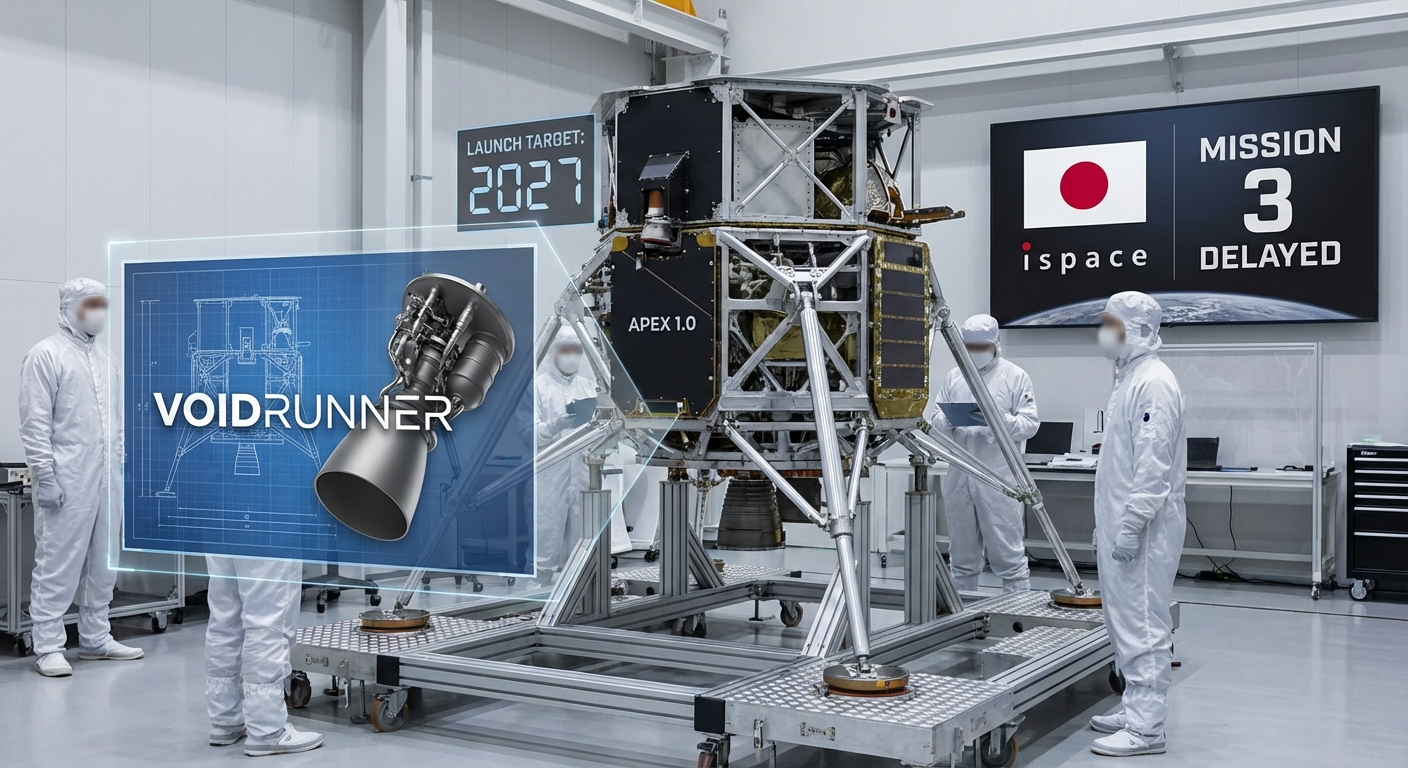

Japanese lunar exploration company ispace, inc. has announced a significant delay for its upcoming Mission 3, pushing the launch to 2027. The decision stems from a strategic pivot to a new, jointly developed rocket engine named VoidRunner, a move intended to reduce long-term technical risk but one that has already impacted the company’s financial forecasts. This development adds another challenge for ispace as it navigates the highly competitive commercial lunar delivery market.
A Strategic Pivot to a Simpler Engine
The delay is a direct result of changing the main engine for the company’s next-generation Apex 1.0 lunar lander. Originally, the lander was slated to use the A2200 engine from American partner Agile Space Industries. However, a joint review concluded that the A2200 engine would not be delivered within the planned schedule. To mitigate technical and schedule risks, ispace and Agile opted to co-develop the VoidRunner engine. According to the companies, this new engine has a much simpler architecture, requiring only a quarter of the parts of a traditional system. While this change is expected to increase mission confidence, it necessitates redesigns of the Apex 1.0 lander, leading to the launch postponement from 2026 to 2027.
Financial Consequences and Revised Forecasts
The engine development delay has had immediate financial repercussions. ispace has revised its project revenue forecast for the fiscal year ending March 2026, reducing it by 40% from approximately 10 billion JPY (about $64 million) to 6 billion JPY (about $38 million). The company clarified that this is primarily due to the postponement of customer payments and grant income tied to development milestones for both Mission 3 and Mission 4. Officials emphasized that this is a deferral of revenue to subsequent fiscal years, not a loss of contracts or a decline in demand.
Navigating a Challenging Landscape
This setback comes at a critical time for ispace. The company is still dealing with the consequences of its Mission 2 failure in 2025, which followed a similar crash during its first landing attempt. The delays with Mission 3, a NASA-funded flight under the Commercial Lunar Payload Services (CLPS) program, could impact its standing with its most important client. The lack of a new NASA contract for a subsequent Mission 5 highlights the intense pressure in a market where competitors like Intuitive Machines have already achieved successful lunar landings.
A Look to the Future: New Technologies and European Collaboration
Despite the current difficulties, ispace is pushing forward with its long-term ambitions. The company is proceeding with Mission 6, which involves a collaboration with the European Space Agency (ESA) to deliver a rover named MAGPIE to the lunar south pole. Furthermore, ispace plans to enhance its future landers by integrating high-precision landing technology demonstrated by the Japan Aerospace Exploration Agency’s (JAXA) successful SLIM mission. This focus on advanced capabilities and international partnerships remains central to the company’s strategy for securing a foothold in the emerging lunar economy.