

Intel has rolled out a significant update enabling multi-frame generation for all its Arc GPU generations, breathing new life into older cards like the Arc A770, which was originally released in the fall of 2022. A recent analysis by PC Games Hardware reveals that this new feature provides a massive performance uplift, effectively giving the GPU a “second spring.” The tests focused solely on the performance gains from frame generation on the A770, without direct comparisons to competing cards.
A Performance Renaissance for Older Hardware
The introduction of XeSS (Xe Super Sampling) with multi-frame generation (MFG) is a game-changer for owners of first-generation Alchemist cards. This technology, enabled through a recent driver update, allows the GPU to insert generated frames between rendered ones, dramatically increasing the perceived framerate and smoothness of gameplay. This software enhancement allows a card released in 2022 to deliver performance metrics that make it highly competitive in today’s market, particularly for budget-conscious gamers.
Gains of Over 200% at 1440p
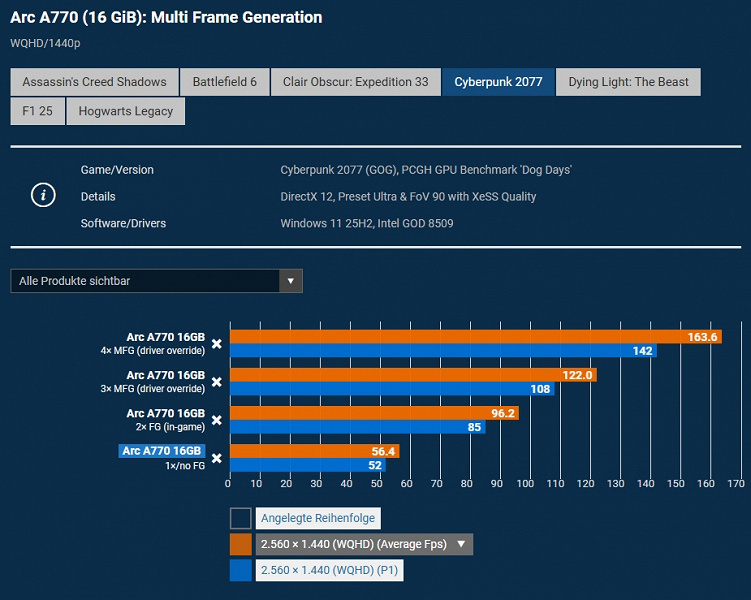
The results from PC Games Hardware are striking. In supported games at 1440p resolution, the Arc A770 saw a performance increase ranging from 183% to 219%-essentially tripling the frame rate. For instance, in Assassin’s Creed Shadows, the A770’s performance jumped by as much as 219% when using the 4x MFG driver override. A similar test on the newer Arc B580 showed slightly higher gains but remained within the same impressive range, confirming the effectiveness of the technology across different hardware tiers.
Tackling Latency with XeLL
A primary concern with any frame generation technology is the introduction of input latency. Because the system has to generate an intermediate frame, there’s an inherent delay between a player’s action and the on-screen response. Intel addresses this with its own latency reduction technology, Xe Low Latency (XeLL). Similar to solutions from Nvidia and AMD, XeLL aims to minimize this lag.
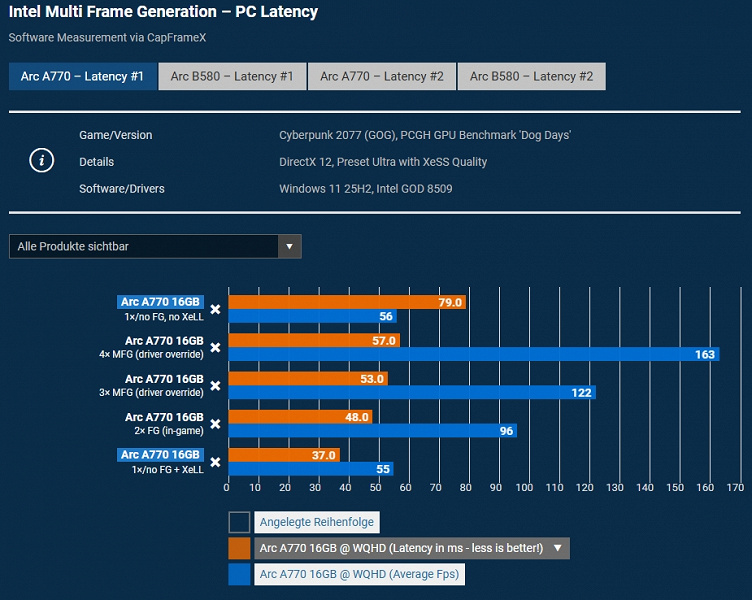
While latency does increase with frame generation enabled, tests show that XeLL is highly effective at mitigating much of the negative impact. According to the analysis, the technology can sometimes neutralize almost the entire adverse effect, making the gaming experience feel responsive despite the artificially boosted frame rates. The authors note that while native frames still provide the best experience in terms of responsiveness, the trade-off for such a massive performance boost is often worthwhile.
A Look to the Future
By extending cutting-edge features like multi-frame generation to its entire GPU lineup, including older models, Intel is making a strong statement about long-term product support. This move not only extends the viable lifespan of the Arc A770 but also enhances the value proposition of the entire Arc ecosystem. For gamers, this means that a card once considered a mid-range option now has the capability to deliver high-frame-rate 1440p gaming, putting it back in contention and offering a compelling upgrade path through a simple software update.