



Intel Unveils the Wildcat Lake Core 300 Series
Company Intel has finally revealed more details about the Core 3 (or Core 300) processors from the Wildcat Lake line, which were scarcely mentioned at CES 2026. Although Intel did not list models, it was previously reported that there would be at least two. According to Intel’s document, the Core 300 line will have processors with up to six cores in a 2+0+4 configuration. Given this phrasing, it seems there will also be CPUs with fewer cores. Perhaps in a 2+0+2 setup.
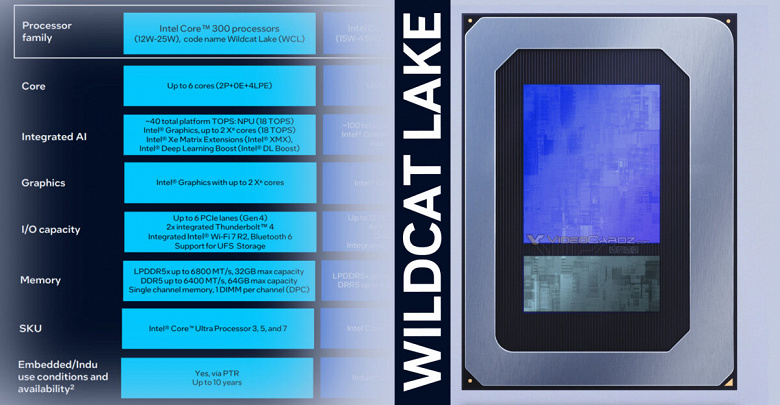
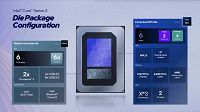
The architecture here is exactly the same as Panther Lake, yet it is a separate small crystal created to make these CPUs cheaper. Previously, it was suggested that these CPUs would replace the current ‘atom’ line, but that is definitely not the case, considering Intel speaks of a TDP of 12-25 watts. Intel’s ‘atom’ processors have a 6-watt rating. The iGPU in the new processors contains only two Xe3 cores. Also included is an NPU with a performance of 18 TOPS, and the total processor performance in AI tasks is around 40 TOPS.
Technological Advancements in the Core 300 Series
Intel has also integrated LPDDR5X-6800 memory support in the new processors, along with six PCIe 4.0 lanes, a Wi-Fi 7 adapter, and a Thunderbolt 4 controller. The document also mentions that this line will include Core 3, Core 5, and Core 7 processors. In some places, they are referred to as Core Ultra, but that is a mistake. It is also worth noting that Intel itself refers to these new Core Ultras as both Core Ultra 3 and Core Ultra 300.
Exploration of Future Prospects
Industry experts suggest that Intel’s development of highly integrated, energy-efficient processors could significantly influence global markets by meeting the increasing demand for compact and powerful computing solutions. While the Core 300 series is positioned distinctly from Intel’s ‘atom’ line, its advanced features cater to a diverse range of applications, including ultra-portable computers and embedded devices. With the upcoming implementation of these processors in consumer electronics, a notable shift in market dynamics is anticipated, potentially setting a new standard for miniaturization and performance in CPU technology.