




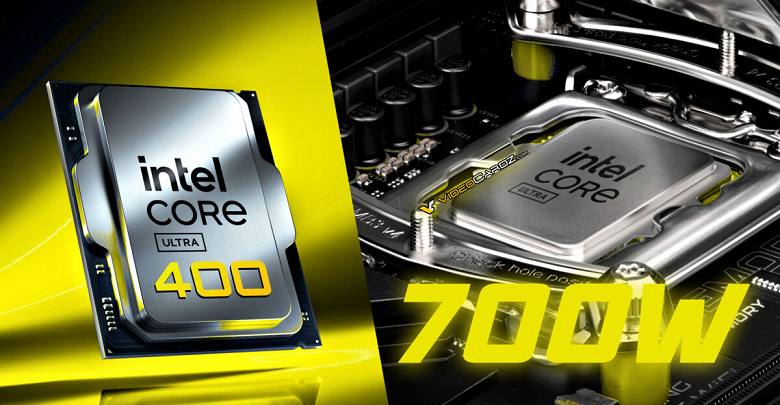
By the end of this year, unless Intel delays the launch, the brand-new Core Ultra 400 processors from the Nova Lake series will be released, bringing a substantial increase in the number of cores. According to recent data, at least peak consumption for these CPUs will be monstrous compared to modern models. Reportedly, the PL4 value, that is, the maximum possible short-term power spikes, for the new CPUs will be 700 W. More precisely, this will be the indicator for top configurations with 52 cores (16+32+4).
For comparison, for the Core Ultra 285K, this indicator is 490 W, and in the Raptor Lake lineup, it was 314 W. What the typical power consumption under load will be in this case can only be guessed. However, it is very likely that despite new processes, it will be noticeably higher than the 125 W of the company’s current CPUs.
Redefining Performance Benchmarks
The Core Ultra 400 series is anticipated to set a new standard in processing power, offering significant performance gains for both personal and professional computing. This substantial increase in core count primarily aims to enhance multi-threaded performance, positioning the series as a formidable contender in high-performance computing and data-intensive tasks.
Implications for Energy Consumption
While the peak energy consumption reaches new heights, the implications for consumers and businesses are profound. For data centers and professional environments where maximum computational power is prized, the trade-off may well be worth the additional energy cost. However, individual consumers, particularly those concerned with energy efficiency, may find this increase challenging.
Positioning Against Competitors
The introduction of the Core Ultra 400 series places Intel in a competitive position to counter AMD’s advancements in CPU technology. With AMD’s Ryzen series consistently pushing boundaries, Intel’s response with its Core Ultra line reflects a strategic effort to capture a broader share of the high-performance market. This release is poised to not only compete but potentially leapfrog existing offerings in processing speed and core efficiency.