



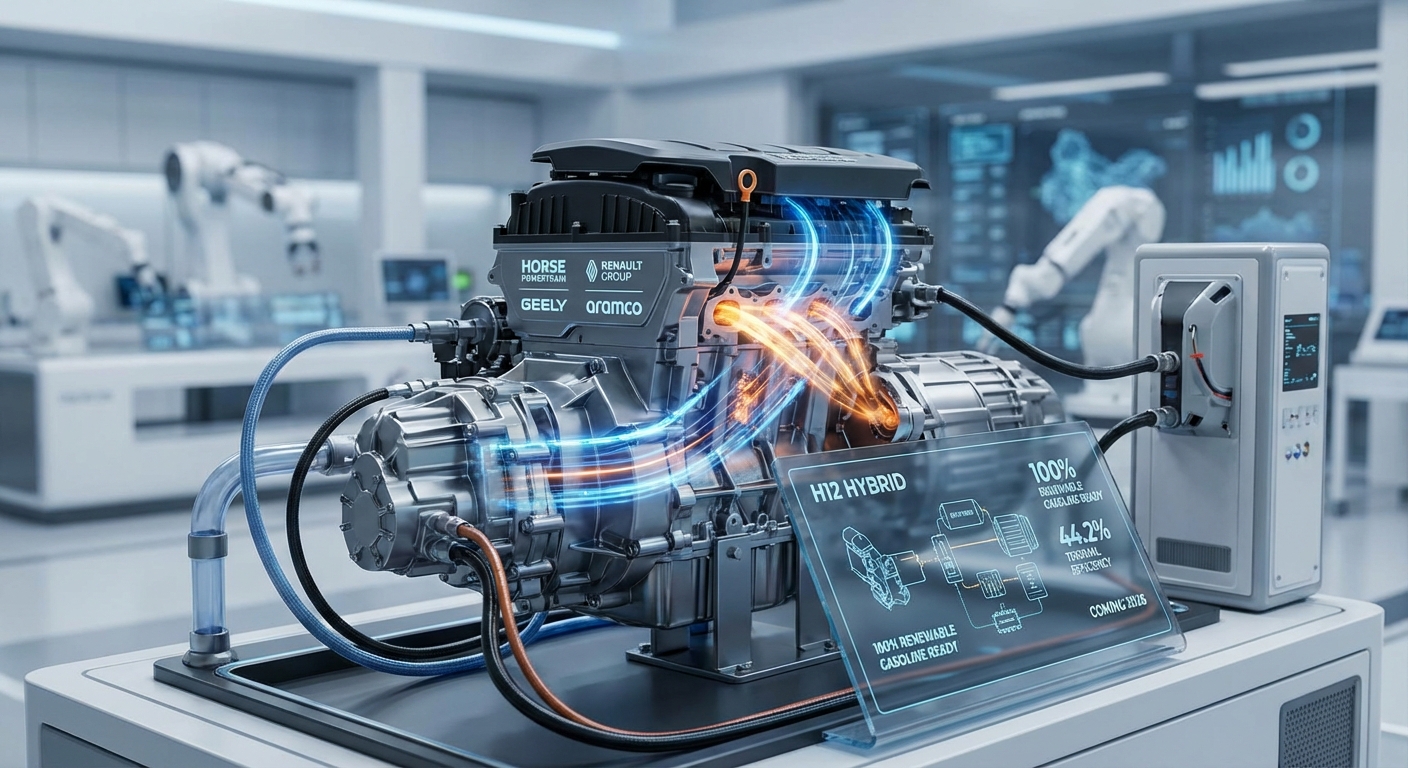

Horse Powertrain, the global powertrain joint venture of Geely, Renault Group, and oil giant Aramco, has unveiled a new hybrid powertrain engineered to run on 100% renewable gasoline. The first demonstration vehicle featuring this technology is scheduled for release in early 2026. The announcement signals a significant strategic push by major automotive and energy players to create a viable, low-carbon future for the internal combustion engine (ICE) in an era increasingly dominated by electrification.
A Strategic Alliance of Industry Giants
Established in 2024, Horse Powertrain is a standalone supplier that merged the ICE and hybrid divisions of Geely and Renault. The company is a formidable force in the industry, with ownership split between Geely (45%), Renault Group (45%), and Saudi Arabia’s Aramco (10%). It already supplies engines and hybrid systems to a wide range of brands, including Renault, Geely Auto, Volvo Cars, Nissan, Mitsubishi Motors, and Proton. Aramco’s involvement is particularly strategic, as its investment aims to foster research and development in synthetic fuels and next-generation hydrogen technologies, securing a long-term market for advanced liquid fuels.
Under the Hood: The H12’s Technical Prowess
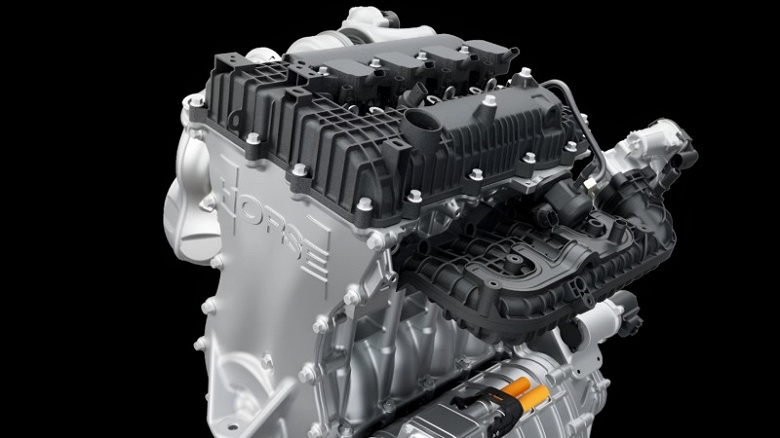
The new system is built around the Horse H12 hybrid engine concept, developed in partnership with Spanish energy company Repsol. The engine achieves a peak thermal efficiency of 44.2%, an exceptionally high figure for a production gasoline engine. In WLTP cycle testing, it boasts a fuel consumption of less than 3.3 liters per 100 km (71 mpg), which is approximately 40% lower than the 2023 European average for new passenger cars. This efficiency is achieved through several key innovations, including an extremely high compression ratio of 17:1, a redesigned exhaust gas recirculation (EGR) system, optimized turbocharging, and a transmission calibration specifically tailored for hybrid vehicle energy management. These advancements are designed to maximize combustion efficiency and energy recovery within the hybrid system.
The Bigger Picture: A Lifeline for the Combustion Engine?
The H12 powertrain is designed to operate on Repsol’s fully renewable gasoline, which is produced from renewable raw materials. According to the companies, a mid-size vehicle equipped with this hybrid system could reduce its annual CO2 emissions by approximately 1.77 tons compared to a conventional gasoline car, assuming a yearly mileage of 12,500 km (7,767 miles). This project represents a pragmatic approach to decarbonization, offering a way to significantly cut emissions in the near term. As Patrice Haettel, an executive at Horse Powertrain, noted, the H12 concept demonstrates how highly efficient engines and renewable fuels can reduce emissions today, without waiting for future solutions. This strategy is not unique to Horse Powertrain; other legacy automakers like General Motors are also continuing to invest in advanced V8 engine technology, signaling a belief in the continued relevance of ICE.
Looking Ahead: The Road to 2026 and Beyond
With a demonstration vehicle expected in early 2026, the H12 engine represents more than just an engineering exercise. It is a cornerstone of a technology-neutral strategy that argues for a diverse mix of powertrain solutions-including efficient ICEs, e-fuels, and hydrogen-rather than a single-minded focus on battery-electric vehicles. If successful, this technology could provide a crucial pathway for automakers to meet stringent emissions regulations without abandoning decades of investment in ICE manufacturing and supply chains. For consumers, it could offer a more affordable and practical low-emission alternative, particularly in regions where EV charging infrastructure is still developing. Ultimately, the H12 is a bold statement that the final chapter for the internal combustion engine has not yet been written.