





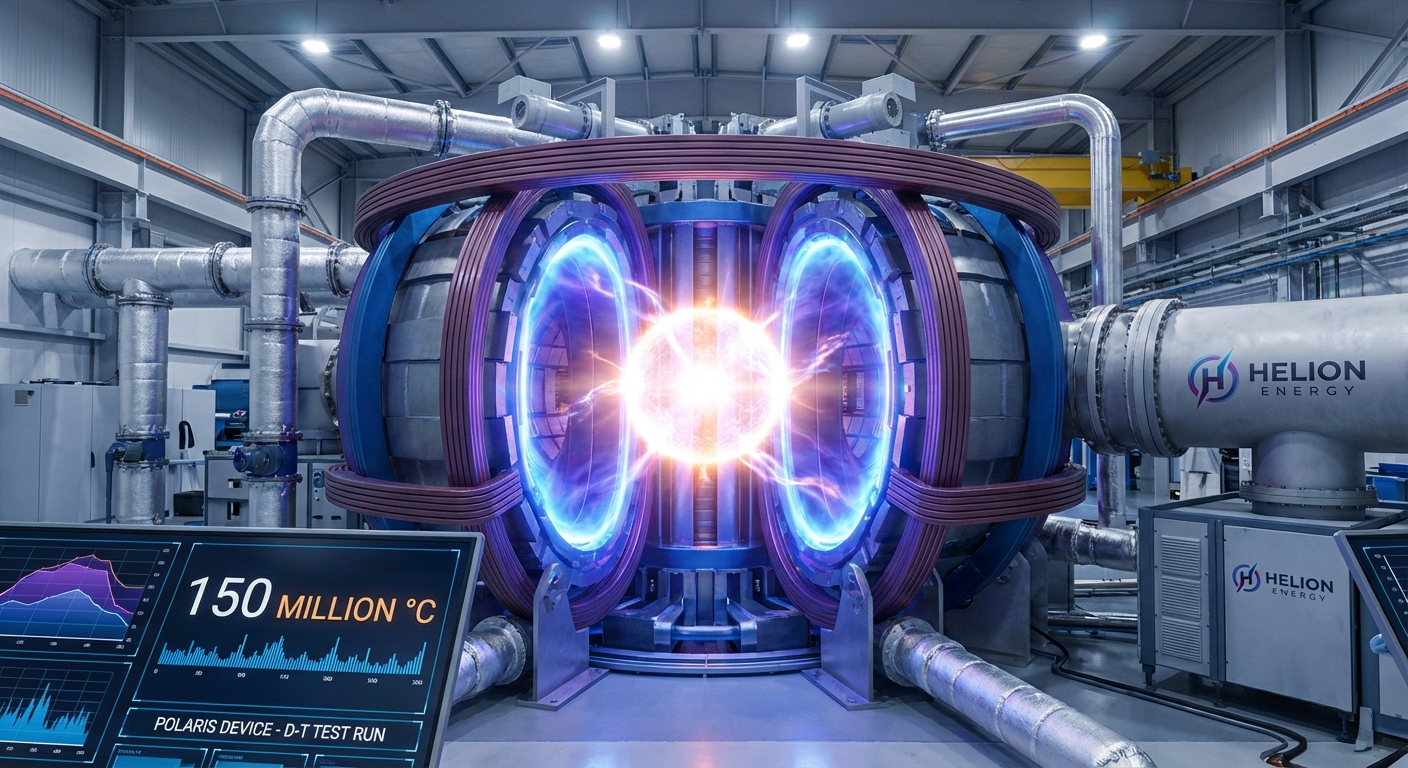

Helion Energy has announced two major breakthroughs in the quest for commercial fusion power: its seventh-generation Polaris device has reached a plasma temperature of 150 million degrees Celsius, and it has become the first private company to test its reactor with tritium, a radioactive fuel. These achievements mark a significant step forward for the Everett, Washington-based company, which is racing to build the world’s first commercial fusion power plant, aiming for a 2028 launch.
Technical Milestones on the Path to Clean Energy
The new temperature record of 150 million degrees Celsius surpasses Helion’s previous milestone of 100 million degrees, a temperature widely considered the threshold for a commercially viable fusion machine. The ultimate goal for the Polaris prototype is to reach 200 million degrees, the temperature required for its planned commercial fuel cycle. While the company has not yet reached this target, CEO David Kirtley expressed strong optimism based on recent results.
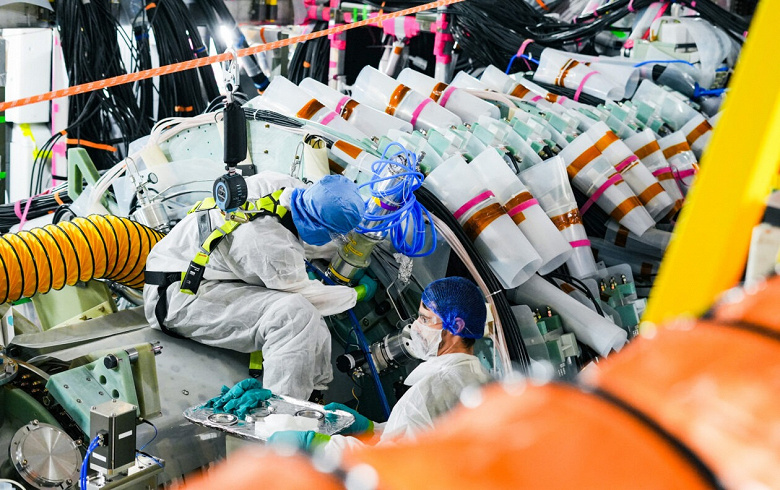
Helion’s technology is based on magneto-inertial fusion (MIF), a hybrid approach that uses magnetic fields to confine plasma, which is then rapidly compressed to trigger fusion. A key feature of its field-reversed configuration is the ability to recapture a portion of the energy from the fusion reaction directly as electricity, bypassing the need for conventional steam turbines and potentially increasing efficiency.
The Strategic Importance of Tritium and Helium-3
The successful tests using a deuterium-tritium (D-T) fuel mix are a crucial step, even though Helion’s commercial plants will use a different fuel: deuterium and helium-3 (D-He3). D-T fusion is easier to achieve at lower temperatures, making it a valuable tool for validating the system’s performance. However, the D-He3 fuel cycle, while requiring higher temperatures, is more efficient for electricity production and significantly reduces the output of high-energy neutrons, which can make reactor components radioactive. The tritium experiments provided essential data on how the D-He3 fuel will behave and demonstrated the company’s capability to handle the entire fuel lifecycle.
The Race to Commercialization
Helion is aggressively pushing toward its commercial goals, having already broken ground on its first power plant, named Orion, in Everett, Washington. The company has a landmark agreement with Microsoft to begin supplying electricity from the facility by 2028, the first-ever power purchase agreement for fusion energy. This ambitious timeline has its skeptics, but Helion’s iterative approach of building and testing successive prototypes underpins its strategy.
“We believe the surest path to commercializing fusion is building, learning and iterating as quickly as possible,” said David Kirtley, co-founder and CEO of Helion. “The historic results from our deuterium-tritium testing campaign on Polaris validate our approach.”
The achievements have been positively received by experts in the field. Professor Ryan McBride of the University of Michigan, who reviewed Helion’s data, called the milestones impressive and exciting.
A Surging Industry and a Look to the Future
The entire fusion industry is experiencing a surge in investment and interest, driven by the increasing demand for clean, reliable energy, particularly from the tech sector for powering data centers. Startups like Commonwealth Fusion Systems and General Fusion are also making significant strides, attracting billions in funding. General Fusion recently announced plans to go public, which would make it the first pure-play fusion company on the stock market. This competitive landscape is accelerating research and development across the board.
According to CEO David Kirtley, the current high demand for electricity and technological advancements have created a favorable environment for fusion’s development, which was previously hindered by low energy prices. As Helion pushes toward its 2028 goal, its progress will be a critical indicator of whether private-sector speed and innovation can finally unlock the promise of clean, virtually limitless energy from nuclear fusion.