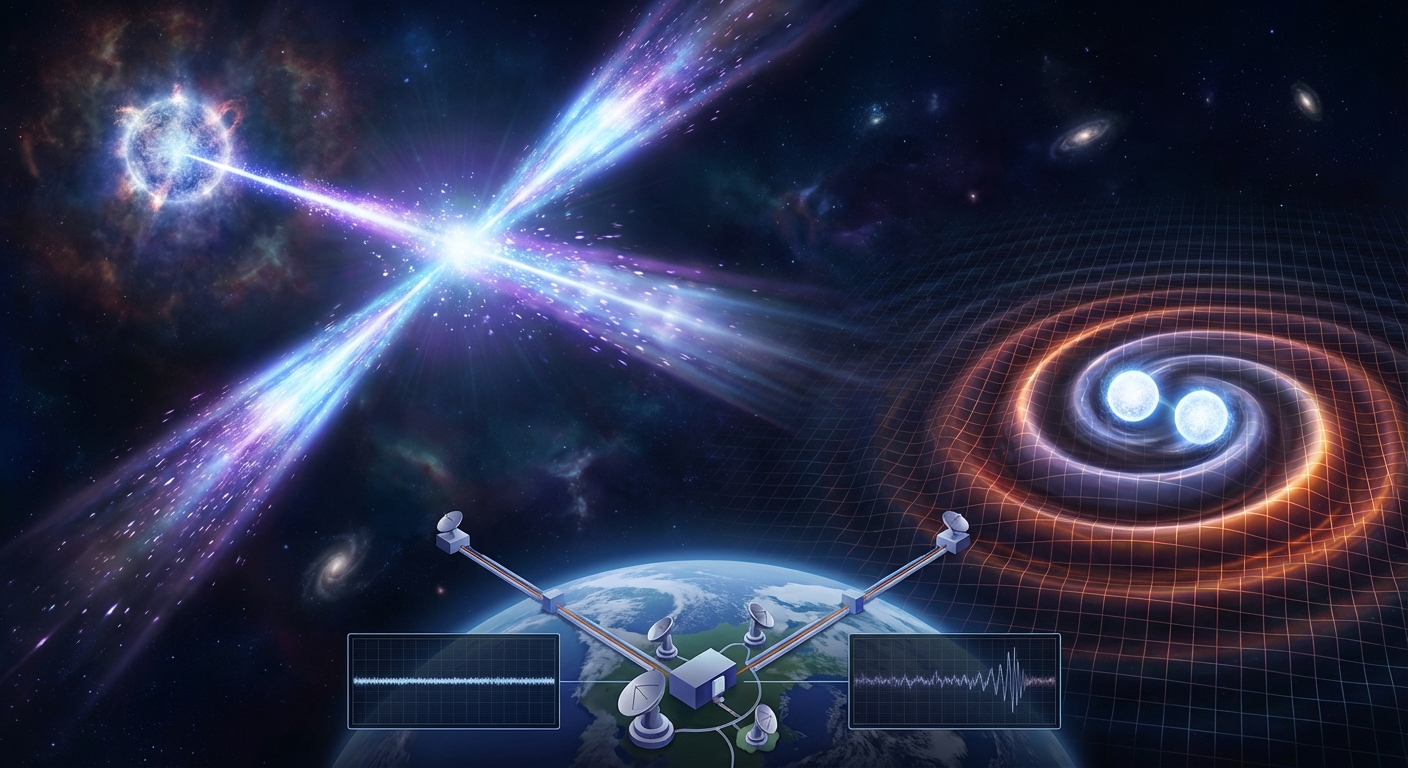

A comprehensive search for gravitational waves associated with some of the universe’s most powerful explosions has come up empty, deepening the mystery of their origins. An international team of scientists analyzed 70 long-duration gamma-ray bursts (GRBs) using data from the LIGO, Virgo, and KAGRA gravitational-wave observatories, but found no convincing evidence of the spacetime ripples expected from the violent merger of compact objects like neutron stars. This null result challenges the increasingly complex picture of how these cosmic blasts are produced.
Blurring the Lines: A Cosmic Identity Crisis
For decades, astronomers have sorted gamma-ray bursts into two main categories based on their duration. Short GRBs, lasting less than two seconds, are confidently linked to the mergers of two neutron stars or a neutron star and a black hole. Long GRBs, which can last from seconds to several minutes, were thought to originate exclusively from the collapse of massive, rapidly rotating stars in an event known as a “collapsar” or hypernova.
However, recent discoveries have begun to blur this clear-cut distinction. In December 2021, an unusually long GRB lasting over 50 seconds, named GRB 211211A, was followed by an optical and infrared signal characteristic of a kilonova-an explosion powered by the radioactive decay of heavy elements forged in a neutron star merger. This surprising finding suggested that at least some long GRBs might also be produced by mergers, directly contradicting the established model. This paradigm shift motivated the new, dedicated search for gravitational-wave counterparts to a large sample of long GRBs.
Listening for Cosmic Chirps
The research team focused on 70 long GRBs detected by NASA’s Swift/BAT and Fermi/GBM space telescopes during the third observing run of the LIGO-Virgo-KAGRA (LVK) detector network. To be included, the event had to occur when at least two of the three gravitational-wave observatories were operational, ensuring the data could be cross-checked to rule out terrestrial noise.
Scientists employed a sophisticated Bayesian analysis, scanning the data for signals matching theoretical templates of gravitational waves from merging neutron stars and neutron star-black hole binaries. A key metric, the Bayesian coherence ratio (BCR), was calculated for each event. This statistical tool helps distinguish a genuine, coherent astrophysical signal detected across the network from random, incoherent noise glitches in individual detectors. A detection threshold was set at a BCR value greater than 2.8, corresponding to a false alarm probability of less than 0.2%.
A Resounding Silence and Its Implications
Despite the sensitive search, the results were conclusive: not one of the 70 long GRBs had an associated gravitational-wave signal that crossed the detection threshold. While this doesn’t definitively rule out a merger origin for all long GRBs, it allows scientists to place important constraints. Based on the sensitivity of the detectors at the time of each burst, the team established upper limits on the distance to any potential merger, ranging from 50 to 801 megaparsecs.
The authors conclude that with the current volume of observations, it’s not yet possible to place strict limits on what fraction of long GRBs might come from compact object mergers. The analysis suggests that the search’s sensitive volume would need to be increased by a factor of at least 500 to yield more definitive results. Even this null result is scientifically valuable, however, as it refines the parameters for future searches and helps astrophysicists better understand the enigmatic nature of GRBs.
The Future is Louder: Next-Generation Detectors
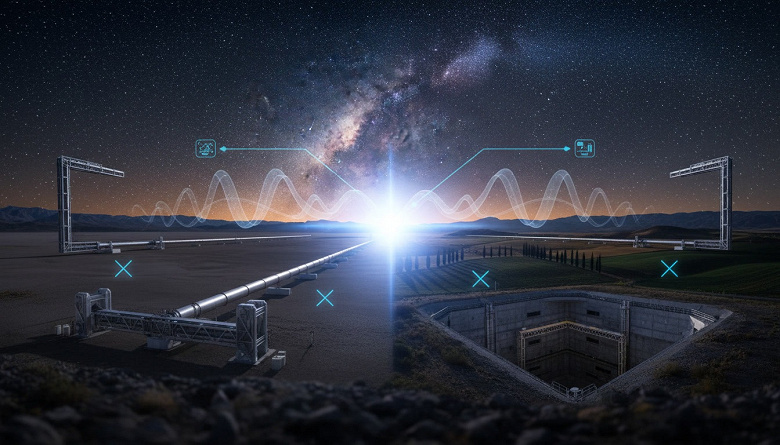
The definitive answer to the long GRB puzzle will likely have to wait for the next generation of gravitational-wave observatories. Projects like the Cosmic Explorer in the United States and the Einstein Telescope in Europe are designed to be at least an order of magnitude more sensitive than the current LVK network. This dramatic leap in sensitivity will allow them to detect fainter and more distant mergers, potentially capturing millions of events per year.
With these future instruments, astronomers will be able to probe the universe’s population of black holes and neutron stars throughout cosmic history. Researchers plan to continue their work with data from upcoming LVK observing runs, hoping to either make the first-ever joint detection of a long GRB and a gravitational wave or further narrow the possibilities for their origins, finally solving one of high-energy astronomy’s most compelling mysteries.