



Optera’s Landmark Prototype in 2026
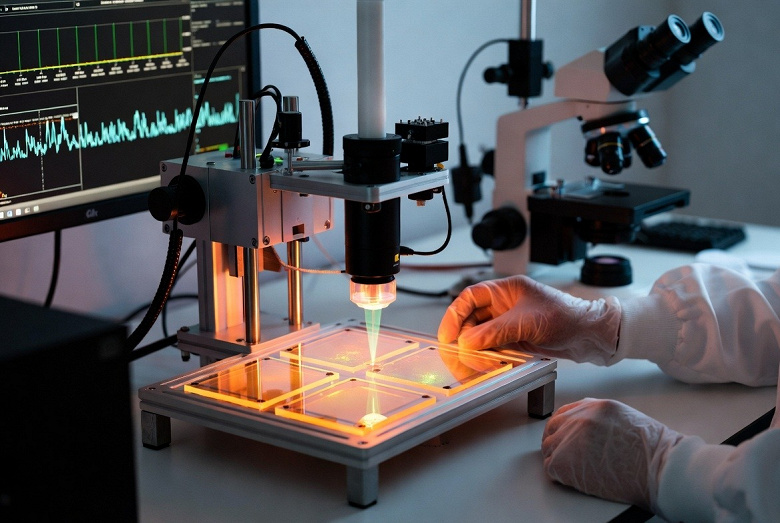
In 2026, a prototype glass data carrier with a volume of 500 GB is expected to be demonstrated, developed by Optera with the support of experts from the University of South Australia. Unlike Microsoft’s Project Silica, which uses laser engraving, the new technology is based on photoluminescence. The technology is based on the principle of spectral burning, in which data is encoded by manipulating nanoscale defects in the crystal lattice of the phosphor. Halide bromide or chloride fluorides doped with samarium ions are used as the recording medium. This material is well known in computed radiography, where photostimulated luminescence is widely used.
Technology and Method
When recording, the laser changes the properties of the material in narrow spectral ranges. During readout, the laser scans these areas, and the presence or absence of photoluminescence indicates information. This method avoids physical changes to the medium but requires high stability of the optical system and precision reading.
Increasing Storage Density
Developers plan to increase storage density by encoding information using various radiation intensities, not just binary “on/off” states. This approach, similar to SLC, MLC, and TLC in NAND memory, will allow multiple bits of information to be stored in each physical cell. According to the project’s documentation, a capacity of 1 TB is planned by 2027.
Economic and Practical Considerations
However, practical write and read speeds, durability with repeated use, and the real cost of production remain unknown. The technology works at room temperature and uses relatively inexpensive lasers, unlike femtosecond systems. Optera aims to provide long-term data storage with lower energy costs, but the project is still in the experimental stage. Further commercialization of the technology depends on attracting manufacturing partners and economic feasibility.