




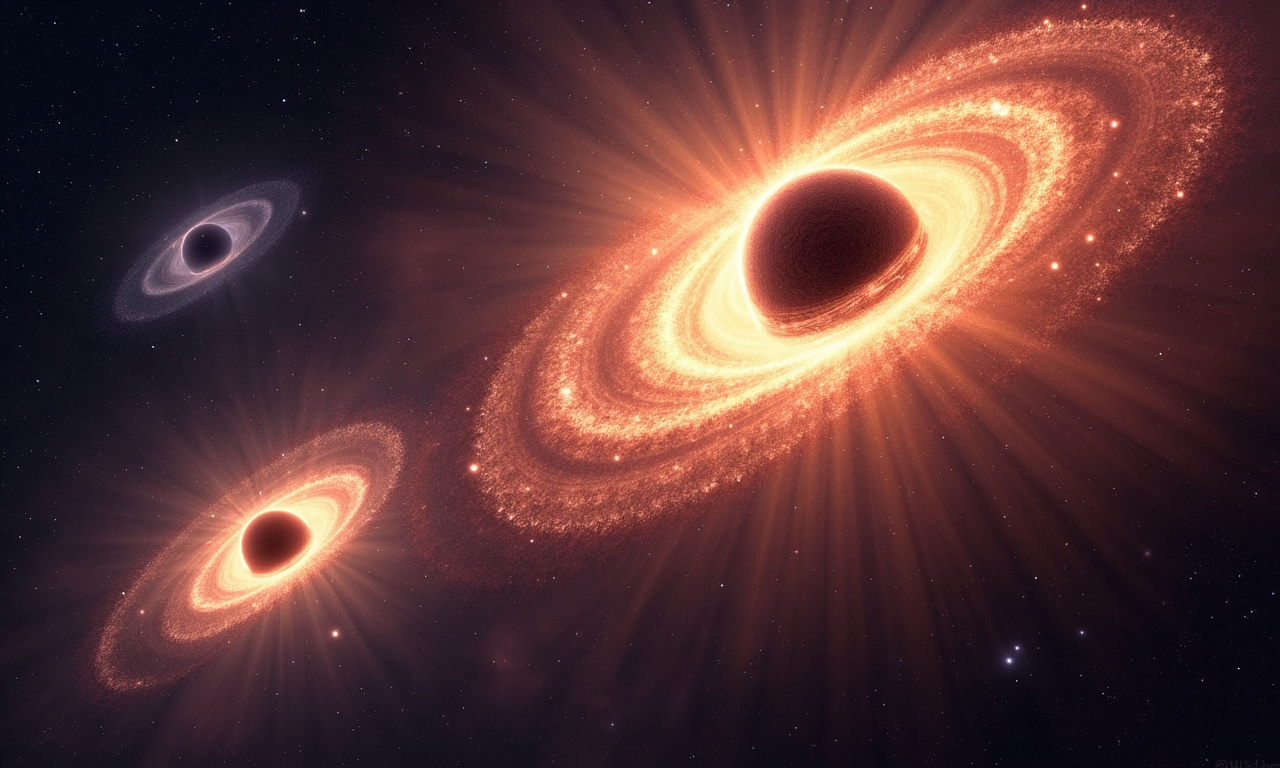

Astronomers have confirmed the existence of the first triple system where all three galaxies host actively feeding supermassive black holes emitting brightly in the radio range. The discovered system, named J1218/1219+1035, is located about 1.2 billion light-years from Earth and consists of three interacting galaxies. The high-precision observations performed using the Very Large Array (VLA) and the Very Long Baseline Array (VLBA) of the U.S. National Science Foundation revealed compact radio cores emitting synchrotron radiation in each galaxy. This confirms that all three galaxies contain active galactic nuclei (AGN), powered by growing black holes. J1218/1219+1035 is the first confirmed “triple radio-AGN” and only the third known triple AGN system in the nearest part of the Universe.
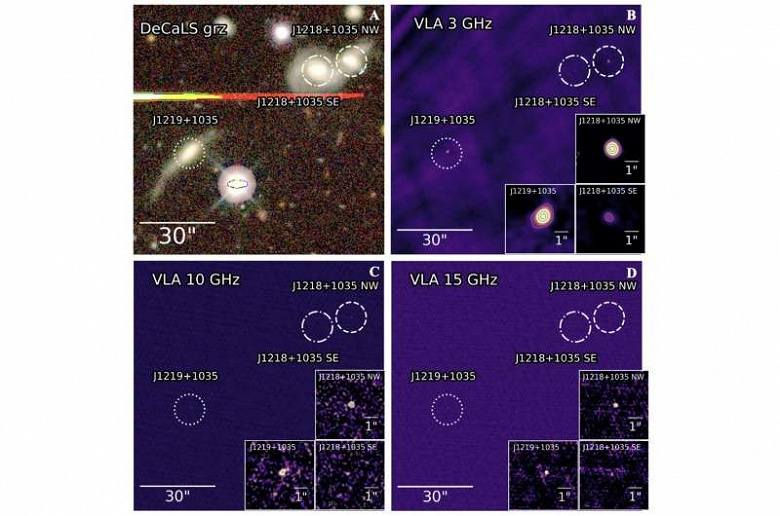
The galaxies are currently undergoing a merger, and the distances between the cores are about 22,000 and 97,000 light-years. The system forms a dynamically bound group, with tidal interactions reflecting their mutual influence. Such triple systems are a key yet rarely observed prediction of hierarchical galaxy evolution, where large galaxies like the Milky Way grow through multiple collisions and mergers with smaller companions.
Originally, J1218/1219+1035 was noted as an unusual system using mid-infrared data from NASA’s Wide-field Infrared Survey Explorer (WISE), which suggested the presence of at least two hidden AGN within an interacting pair of galaxies. Subsequent optical spectroscopy confirmed an AGN in one core and revealed a “composite” signal in another, leaving the true nature of the third galaxy ambiguous, as its emissions could also arise from star formation or shock waves. Only new, ultra-clear radio images from VLA at 3, 10, and 15 GHz allowed astronomers to detect compact radio cores perfectly matching all three optical galaxies, demonstrating that each houses a radio luminous AGN likely ejecting small jets.
“Triple active galaxies like this one are incredibly rare, and observing one in the process of merging provides us with the opportunity to explore how massive galaxies and their black holes grow together,” noted Dr. Emma Schwarzman from the U.S. Naval Research Laboratory, lead author of the study. To characterize J1218/1219+1035, the team used the VLA in its highest resolution configuration, achieving sub-second imaging at several frequencies to pinpoint the radio core of each galaxy. Additional VLBA observations at 4.9 GHz provided millisecond-scale constraints on the compactness and brightness temperature of the central source.
Future observations in the near-infrared and X-ray ranges are planned to more detailedly map the tidal structures of the galaxies and analyze the high-energy output of each AGN, creating a more complete picture of this rare triple system. In the broader field of high-resolution radio astronomy, the discovery of systems like J1218/1219+1035 stimulates technological and scientific advancements as researchers seek to uncover the dynamics of galaxy evolution in far-flung cosmic locales.