
Astronomers working with the multi-object spectrograph at the Keck Observatory have discovered that the galaxy cluster RXC J0032.1+1808 is experiencing a massive merger. The DEIMOS Spectrograph enables the simultaneous measurement of spectra from over 130 objects, making it a powerful tool for investigating the large-scale structure of the universe. Galaxy clusters, containing up to several thousand galaxies bound by gravity, are formed through mergers and accretion of smaller clusters. This makes them excellent laboratories for cosmology and the study of galaxy evolution. Mergers of clusters provide better understanding of the physics of shock waves and cold fronts in the intracluster medium, cosmic ray acceleration, and properties of self-interacting dark matter.
RXC J0032.1+1808, first identified in 1965, represents a rich cluster of galaxies with an estimated mass of 1.1 quadrillion solar masses.
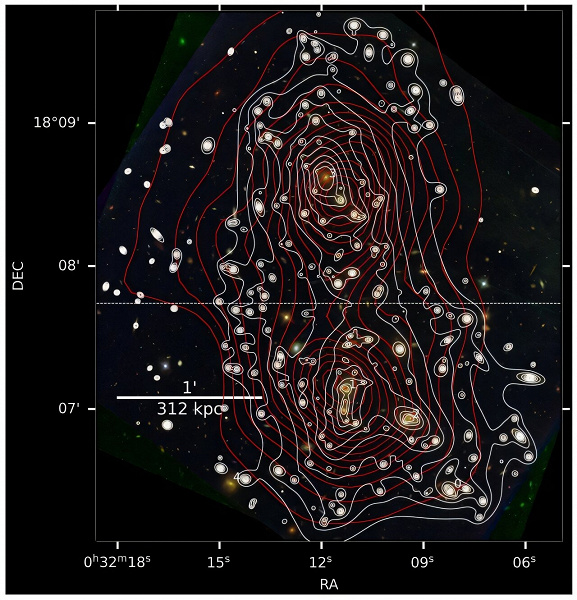
Overlaid onto it are contours of surface brightness of X-ray emission after subtraction of point sources (red lines), as well as contours of gravitational lensing convergence (white lines). Candidates for the brightest galaxies in the cluster are marked by numbers. The dashed line shows the boundary between the northern and southern subclusters. Led by David Wittman from the University of California, Davis (UC Davis), a group of astronomers conducted more detailed study of RXC J0032.1+1808 using the DEIMOS Spectrograph (DEep Imaging Multi-Object Spectrograph).
The data obtained indicate that the cluster is in the process of merging. DEIMOS revealed two distinct peaks in the cluster structure, unlike the single elongated structure observed in the optical range. The peaks are separated by a distance of about 1.3 million light-years and are almost strictly located to the north. Furthermore, the data, combined with a previously discovered radio relic, suggest that RXC J0032.1+1808 is observed after the first pericenter (moment of closest approach). Scientists estimate that the merger takes place approximately 395-560 million years after pericenter. Analysis of the merger’s properties showed that the relative speed between the two subclusters of RXC J0032.1+1808 is very small – around 76 km/s (47 mph). Authors of the work conclude that RXC J0032.1+1808 represents a large, rich, and bimodal merger. This makes it an excellent platform for exploring the physics of cluster mergers and the behavior of dark matter during high-speed collisions.
Recently, the use of DEIMOS and similar technologies has been instrumental in expanding our understanding of galaxy cluster dynamics, including the effects of dark matter and gravitational lensing. The findings from RXC J0032.1+1808 are contributing to ongoing debates in cosmology regarding the nature of dark matter. By probing such cluster interactions, researchers are piecing together how gravitational forces shape the universe, potentially unveiling new insights into the evolution of galaxies on a cosmic scale.