





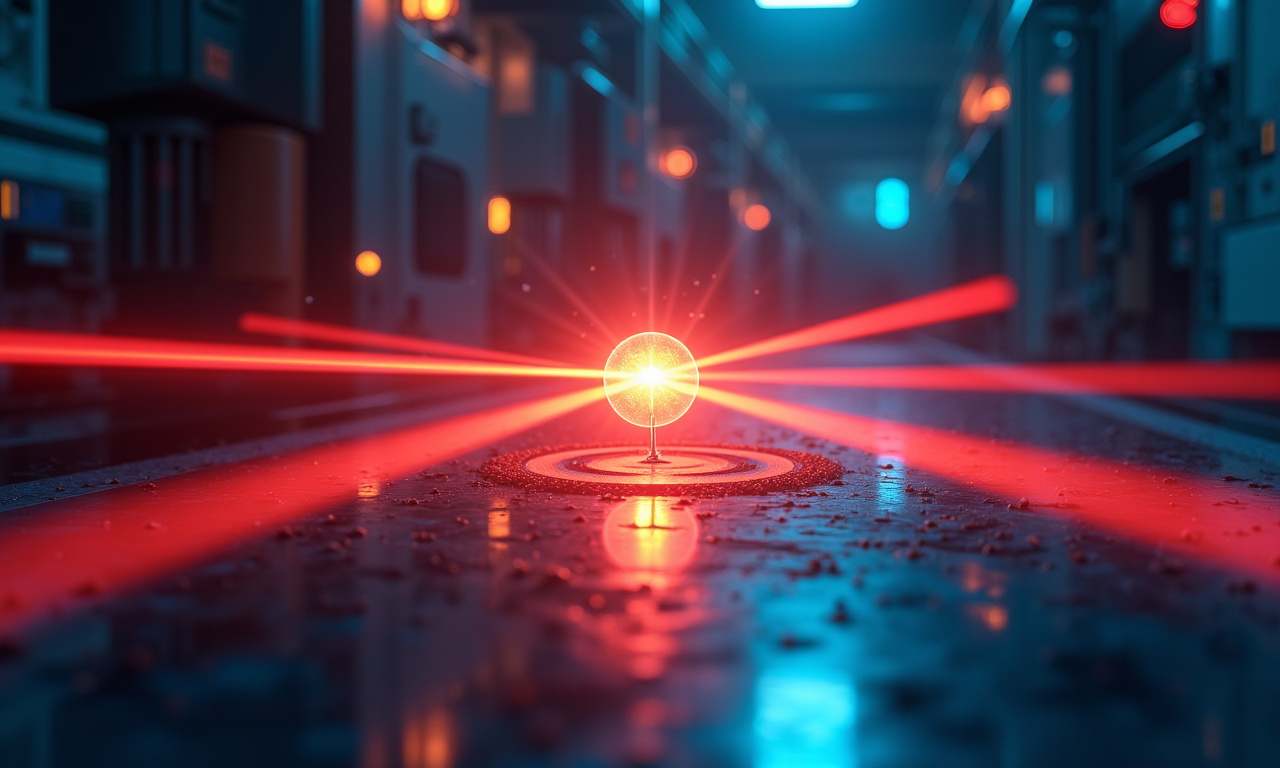

At the Lawrence Livermore National Laboratory (LLNL) in the United States, nuclear reactions were experimentally measured in high-energy density plasma, akin to the conditions within stars and during thermonuclear explosions. John Despotopoulos, a radiochemist at LLNL and head of the research team, emphasized that obtaining experimental data in such hot and dense plasma will refine existing nuclear reaction models used in astrophysics and for maintaining nuclear arsenals. A crucial component in conducting these measurements was access to the world’s most powerful laser complex, located at the LLNL National Ignition Facility (NIF). The NIF enables the creation of plasma with temperatures and pressures comparable to those of stars. This is the world’s largest laser installation aimed at thermonuclear ignition.
In 2022, NIF achieved the first-ever positive energy yield thermonuclear fusion. Today, NIF is the only place where some measurements can be conducted under conditions simulating underground nuclear tests. In the ensuing years, NIF has built upon this milestone, advancing its capabilities in simulating stellar nucleosynthesis processes more accurately, thereby aiding both scientific understanding and national security objectives. 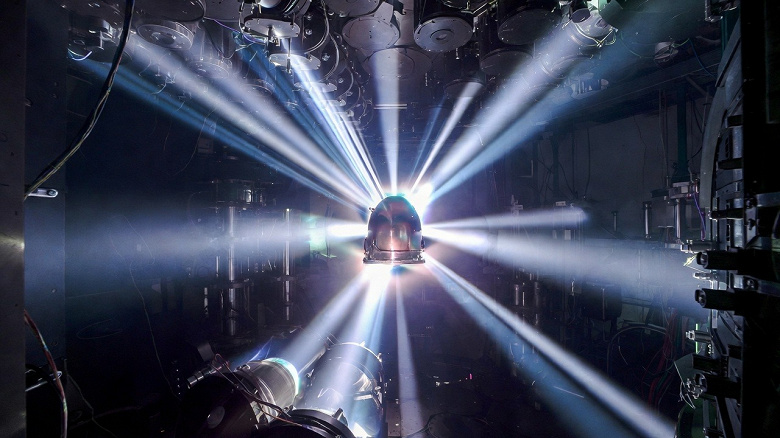 Illustration: Grok
Methodology and Experimentation
The researchers’ primary task was developing methods to introduce radioactive isotopes into NIF target capsules. These capsules, no larger than a pencil eraser, are filled through a tiny hole the size of a grain of salt. The chemical composition must be extremely pure for optimal results. Despotopoulos and his colleague Kelly Kmak devised radiochemical purification techniques for the target material. They utilized vacuum or microinjection methods to add sub-nanogram quantities of dopant material to the inner surface of each capsule, careful not to clog the opening.
During the experiments at NIF, lasers heated the capsules to extremely high temperatures, triggering thermonuclear reactions that generated neutrons. Post-experiment, the team analyzed the remnants using various diagnostic tools, including the LLNL Nuclear Counting Facility, providing highly sensitive radiation measurements. This meticulous approach ensures clearer data for refining fusion models.
Future Directions
The team plans to test a new approach for measuring nuclear reactions with other radionuclides. Additionally, they hope to measure neutron capture reactions, crucial for studying stellar nucleosynthesis-the process of forming chemical elements in stars through nuclear reactions. Recent technological advancements and collaborations might enhance this research direction even further, potentially leading to breakthroughs in isotopic synthesis capabilities.
Moreover, possibilities for obtaining radionuclides for future experiments at NIF on the Rare Isotope Beam Facility are being explored. This could open new avenues for experimentation, providing unprecedented insights into high-energy physics and expanding our understanding of fundamental processes underlying the universe.