





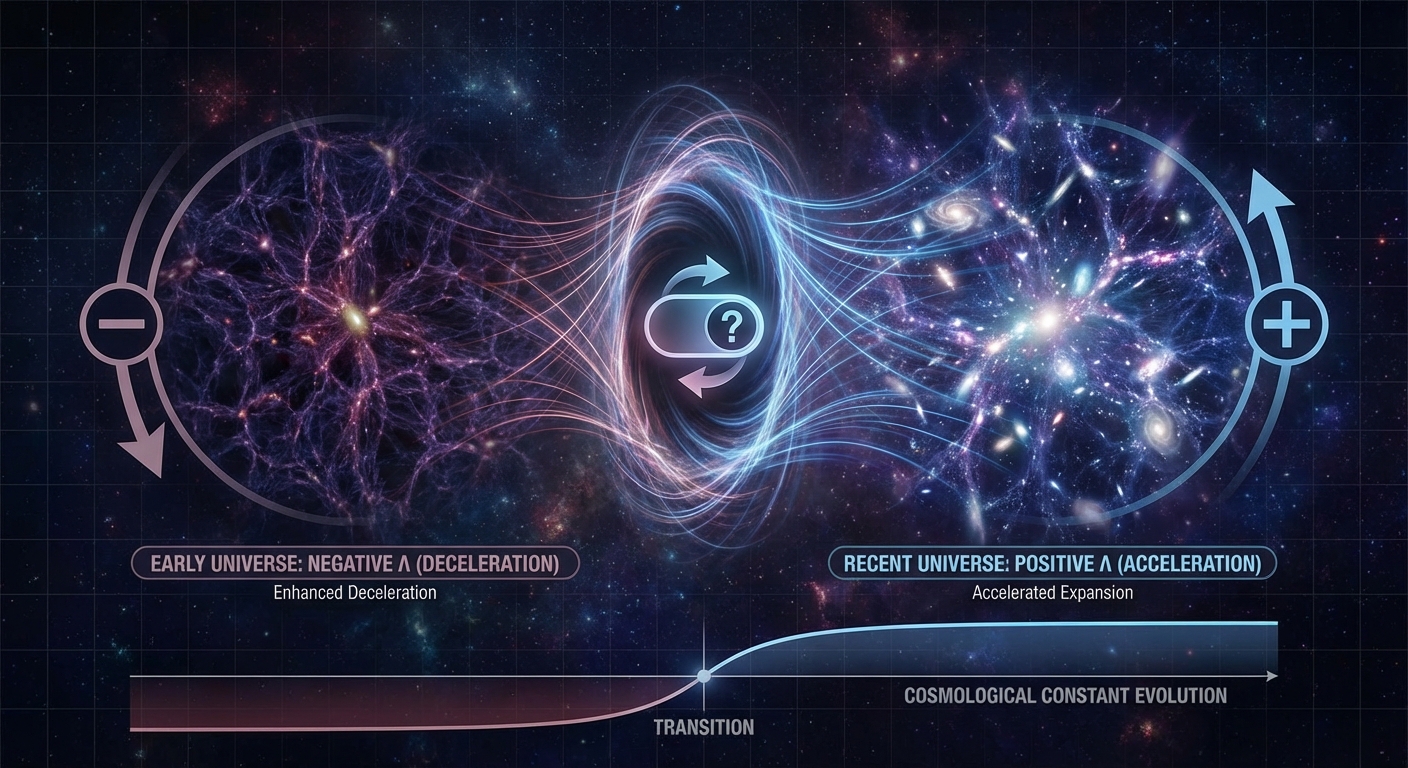

A team of theorists, led by Mariam Bouhmadi-López and Beñat Ibarra-Uriondo, has developed a class of dark energy models where the cosmological constant-a key parameter in the accelerated expansion of the universe-can change its sign during cosmic evolution. In standard cosmology, known as the ΛCDM model, this value is always positive. However, these new scenarios allow for a transition from a negative value in the early universe to a positive one at more recent times (low redshifts). This radical idea could offer a solution to some of the most significant tensions in modern cosmology.
A New Twist on a Fundamental Constant
The standard ΛCDM model, while successful, faces challenges in explaining certain observational discrepancies, such as the Hubble tension-the disagreement in measurements of the universe’s expansion rate-and the S8 parameter, which relates to the clumpiness of matter. The new research proposes that dark energy is not constant but dynamic. The authors explored both sharp and smooth transitions for this sign-switch, using step-like and continuous functions to model the change.
From Deceleration to Acceleration
The results of the team’s analysis are fascinating. Before the sign change, when the cosmological constant is negative, the dark energy exerts a kind of negative pressure that enhances the deceleration of the universe’s expansion. After the transition to a positive value, the universe enters a phase of accelerated expansion, similar to what we observe today. In scenarios with a smooth, continuous transition, an intermediate phase of extra acceleration emerges.
Impact on Cosmic Structure and Future Observations
This sign-switching behavior also leaves subtle fingerprints on the formation of large-scale structures in the cosmos. The models show slight deviations from the standard ΛCDM predictions, particularly in the growth of matter density perturbations and the evolution of the gravitational potential around the time of the transition. These differences are key, as they offer a way to test the theory.
Crucially, the models with a changing cosmological constant align well with current observational data and could partially resolve the Hubble and S8 tensions. The authors emphasize that these scenarios provide unique predictions that can be tested by future cosmological surveys, such as the Dark Energy Spectroscopic Instrument (DESI) and the Vera C. Rubin Observatory. By searching for these subtle features in data on the universe’s large-scale structure, scientists may be able to verify or rule out this innovative idea. This work opens a new avenue in dark energy research, suggesting a physically grounded mechanism for the cosmological constant’s sign change that could explain some of cosmology’s most pressing anomalies without completely overhauling the standard model.