







In 2025, the foldable smartphone market showed a growth of 10% compared to 2024, but a 30% increase in shipments is expected in 2026. According to IDC, a key factor will be the market entry of Apple’s foldable iPhone. Besides Apple, Samsung and Huawei provide active competition in the market. Samsung, already known for its Flip and Fold models, is developing new form factors TriFold and Wide Fold. Huawei, in turn, has introduced its own solutions, including the TriFold Huawei Mate XT and the widescreen Huawei Pura X. In the third quarter of 2025, Huawei captured 68.9% of the foldable smartphone market in China.
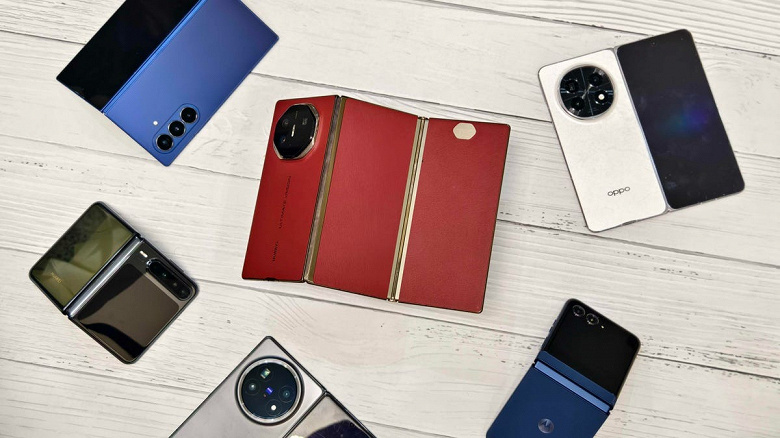
It is expected that in 2026, there will be four main types of foldable smartphones on the market:
- Flip phones: Compact devices that unfold into full-sized smartphones (e.g., Galaxy Z Flip 7, Motorola Razr).
- Book-style: Devices that unfold into mini-tablets (e.g., Samsung Galaxy Z Fold 7, Google Pixel 10 Pro Fold, Oppo Find N5, Honor Magic V5). Optimized for reading and web browsing due to their unfolded aspect ratio.
- TriFold: Devices with three sections, offering different usage modes (phone, mini-tablet, widescreen tablet) – for example, Samsung Galaxy Z TriFold and Huawei Mate XT.
- Widescreen foldables: Smartphones with wide screens, designed for content consumption and reading (e.g., Huawei Pura X). The 16:10 aspect ratio ensures minimal black bars when watching videos.
Rumor has it, Apple plans to release the iPhone Fold in a widescreen foldable format with an enlarged external screen. Samsung is also developing a similar Wide Fold device with a 4:3 format internal screen. Samsung is expected to unveil the Galaxy Z Fold 8 and Flip 8 along with the new Wide Fold in July, ahead of Apple, whose foldable smartphone is rumored to be released in the fall. Despite the high cost, new form factors of foldable smartphones promise to bring variety to a market dominated by classic monoblocks.