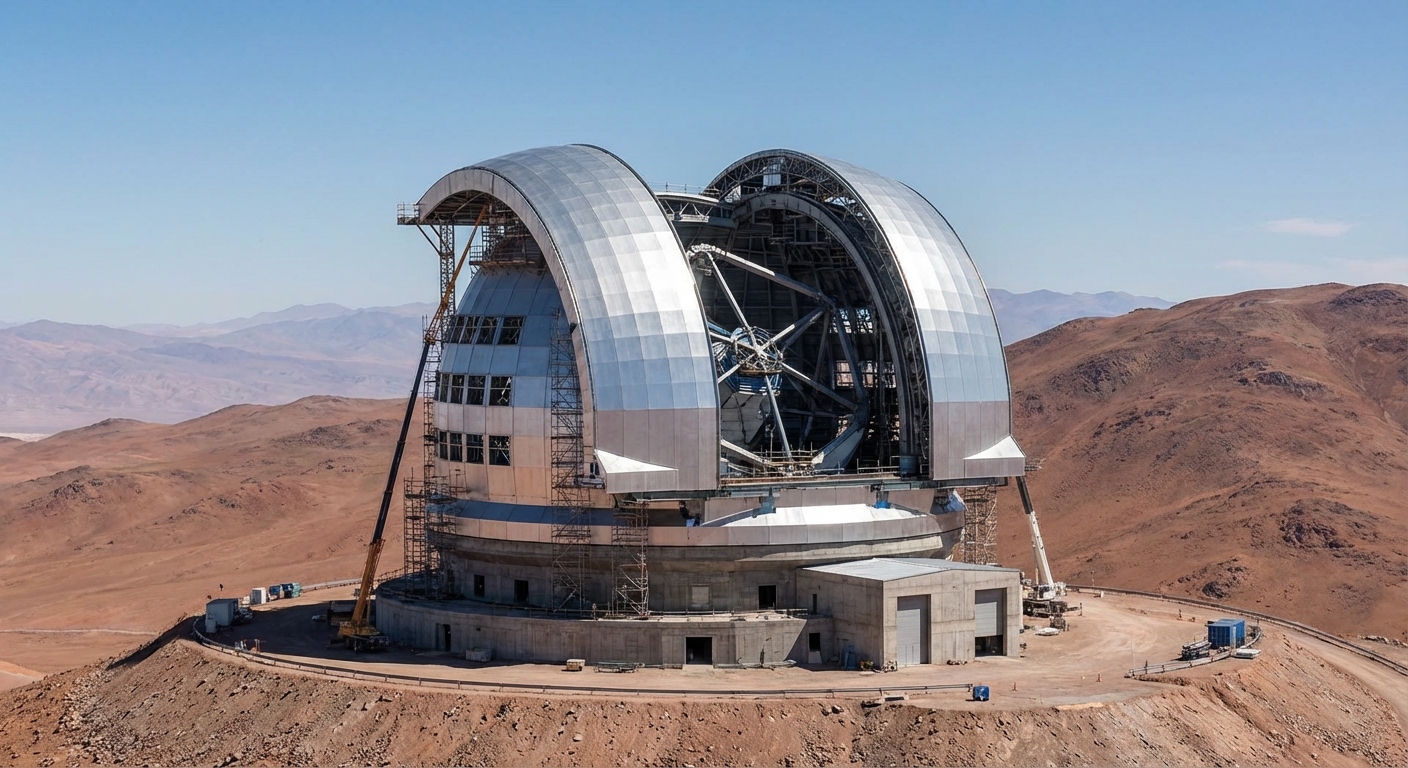

The European Southern Observatory (ESO) has released a striking new photograph showcasing the significant construction progress on the dome of the Extremely Large Telescope (ELT), located atop Cerro Armazones in Chile’s Atacama Desert. The image, taken in December and published on February 11, reveals the ongoing work on the massive, 80-meter rotating dome that will house the telescope’s revolutionary 39-meter primary mirror-a light-collecting area vastly larger than any of its predecessors. This milestone brings humanity one step closer to unlocking some of the deepest secrets of the cosmos.
A Dome Built for Discovery
The new photo highlights the installation of aluminum panels on the dome’s massive motorized doors. This external cladding is crucial for protecting the telescope’s sensitive optics from the harsh desert environment, shielding them from daytime heat and minimizing thermal fluctuations at night. The entire structure rests on a series of seismic dampers designed to safeguard the instrument from the region’s frequent seismic activity. Once finished, the upper portion of the dome will rotate on a concrete base, allowing the telescope to access the entire sky while its state-of-the-art equipment remains protected. The total cost of the project is estimated at around €1.3 billion ($1.4 billion).
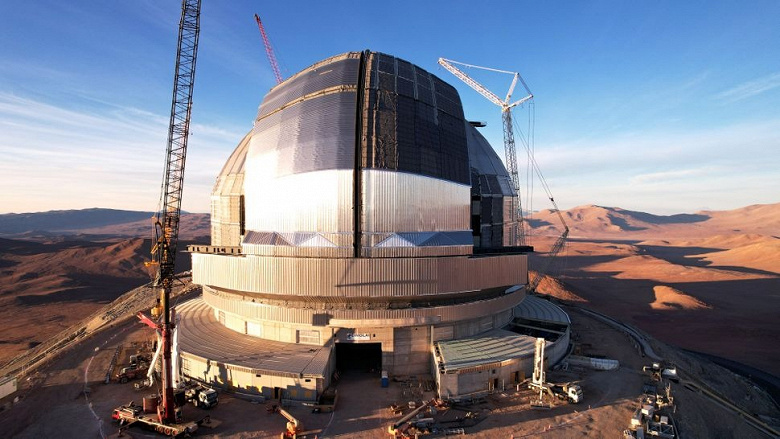
Inside the World’s Biggest Eye on the Sky
The ELT’s power lies in its unique five-mirror optical design, anchored by the 39-meter segmented primary mirror (M1). This main mirror is composed of 798 individual hexagonal segments, each 1.4 meters across, which work in concert to gather 100 million times more light than the human eye. This light-gathering capability will produce images 15 times sharper than those from the Hubble Space Telescope, thanks to an advanced adaptive optics system that corrects for atmospheric distortion in real-time.
Unveiling the Universe’s Secrets
Operating in both optical and near-infrared wavelengths, the ELT is poised to revolutionize multiple fields of astronomy. Scientists plan to use its unprecedented power to tackle some of the most profound questions in science. Key objectives include:
- Discovering and Characterizing Exoplanets: The ELT will be capable of directly imaging Earth-like exoplanets and analyzing their atmospheres for biosignatures, such as water and organic molecules.
- Cosmic Archaeology: By peering back to the dawn of time, the telescope will study the first stars and galaxies to form after the Big Bang, providing insights into the universe’s origins.
- Probing Dark Matter and Dark Energy: The ELT will investigate the nature of the universe’s mysterious dark sector, which is believed to govern its expansion and structure.
- Fundamental Physics: The telescope’s high-precision observations may even allow scientists to test for possible variations in the fundamental constants of physics.
The Global Race of Giant Telescopes
The ELT is the largest of three next-generation giant telescopes currently under development. Its main counterparts are the Giant Magellan Telescope (GMT), also in Chile with a 24.5-meter mirror, and the Thirty Meter Telescope (TMT), planned for Hawaii, which will have a 30-meter mirror. Together, these observatories will provide complementary views of the cosmos and usher in a new golden age of ground-based astronomy, working alongside space-based facilities like the James Webb Space Telescope.
A Revised Timeline for First Light
While construction is advancing steadily, the ambitious project has faced delays typical for endeavors of this scale. According to the latest official schedule from ESO, the dome’s construction is slated for completion in 2027. Following the installation and calibration of the five mirrors and its initial suite of scientific instruments, the telescope’s technical “first light” is now anticipated in early 2029. The commencement of full scientific operations is planned for December 2030, when the ELT will finally open its giant eye to the universe and begin its quest for discovery.