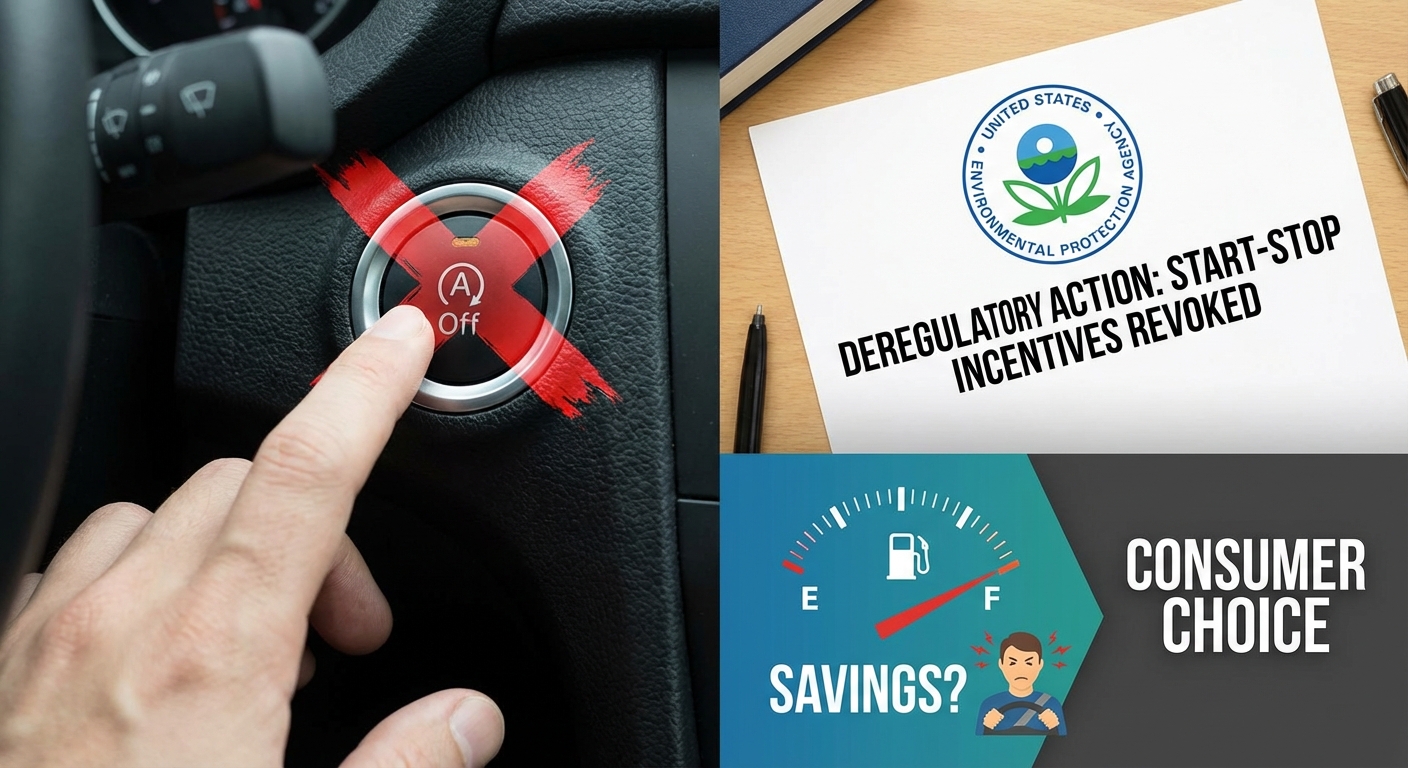

The Donald Trump administration has taken aim at one of the most contentious features in modern automobiles. On February 12, 2026, the head of the U.S. Environmental Protection Agency (EPA), Lee Zeldin, signed a decree for a large-scale revision of environmental standards, which effectively cancels government incentives for the start-stop system that shuts off the engine during brief stops. The agency called the move the “single largest deregulatory action in U.S. history,” claiming the technology annoys drivers and its real contribution to the environment is questionable.

How Regulation Birthed the Technology
Technically, the decision lies in the complete elimination of so-called “off-cycle credits.” This program allowed automakers to receive bonus points from the government for installing technologies whose effectiveness in reducing emissions is not fully captured in standard laboratory tests. Start-stop systems were one of the most popular such technologies, helping companies formally comply with strict federal norms on fuel consumption and greenhouse gas emissions.
Deregulation in the Name of Choice
The EPA stated that previous climate restrictions artificially narrowed consumer choice and imposed hidden costs on Americans. According to Lee Zeldin, the start-stop system is an “almost universally hated” feature, and eliminating its incentives will restore consumer choice and make cars more affordable. The administration claims this step, along with other measures, will save consumers an average of over $2,400 on the purchase of a new vehicle. Although there is no formal ban on start-stop systems, it is clear that without government subsidization through “credits,” automakers lose the main incentive for its mass installation.
Real Savings vs. Real Annoyance
Despite sharp criticism from the regulator, numerous studies confirm the technology’s effectiveness. For instance, tests by the American Automobile Association (AAA) back in 2014 showed that start-stop improves fuel economy by 5-7%. A more recent study by the Society of Automotive Engineers (SAE) found that in dense urban traffic, such as in New York City, savings can reach as high as 26.4%. However, user dissatisfaction is also well-founded. Early versions of the system, in particular, were known for their sluggishness and noticeable vibration upon engine restart, which annoyed many drivers and led them to disable the function on every trip.
What’s Next for Start-Stop?
Experts and auto industry representatives agree that start-stop will not disappear overnight. Firstly, automakers build cars for a global market, and in many other countries, environmental standards remain strict, making the removal of the system impractical. Secondly, the technology is constantly improving. In modern cars, especially those with mild-hybrid and full-hybrid systems, the process of stopping and starting the engine is much smoother and almost imperceptible to the driver. In essence, start-stop is evolving from a separate, annoying feature into an integral part of a more efficient powertrain. Therefore, the current EPA decision is likely not to kill the technology but rather to accelerate its evolution and integration into more advanced hybrid systems, which will eventually give way to fully electric vehicles.