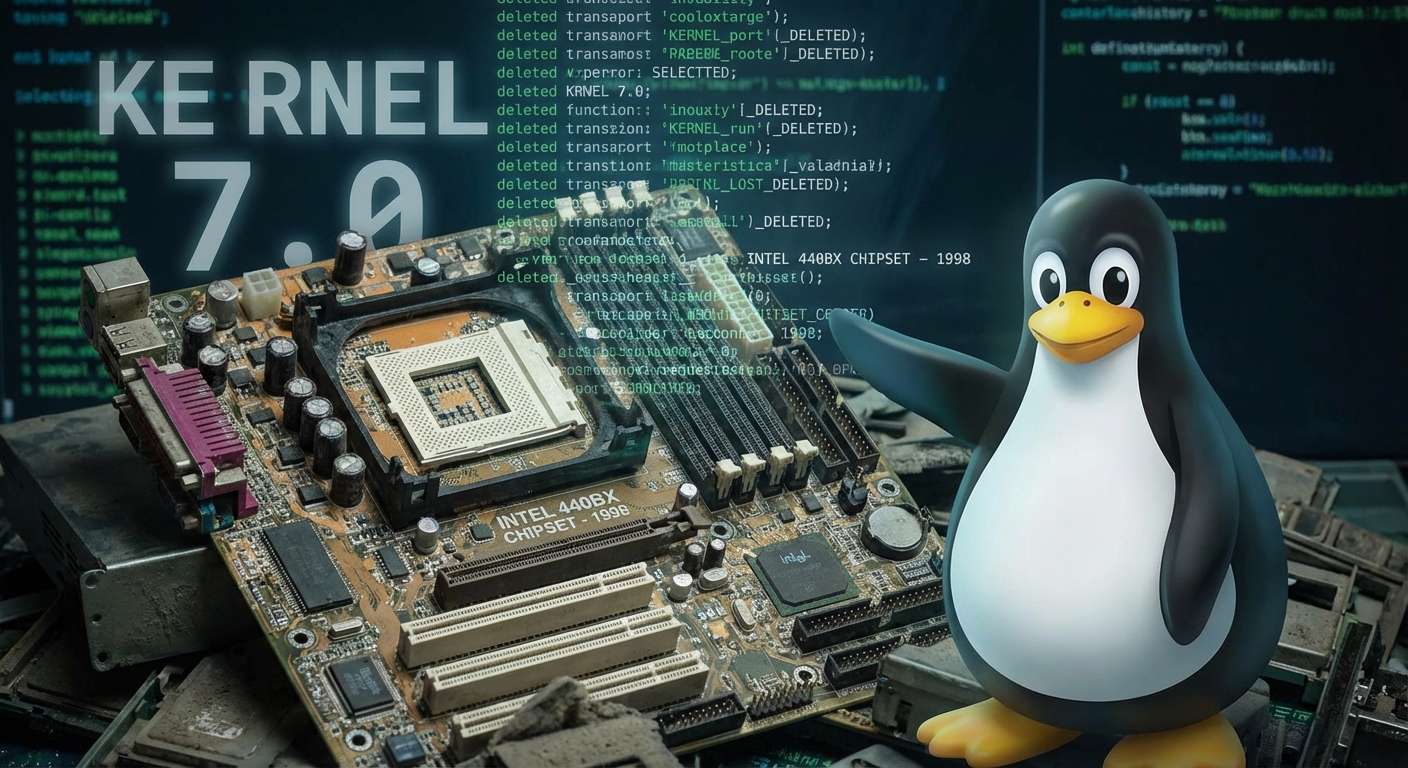

In a move that signals the end of an era for vintage hardware enthusiasts, the upcoming Linux 7.0 kernel is officially removing support for the iconic Intel 440BX chipset. Specifically, the Error Detection and Correction (EDAC) driver for the chipset, first released in 1998 to support Pentium II and III processors, is being purged from the source code. While this marks a formal conclusion, the driver has effectively been non-functional for nearly two decades.
A Feature Broken for Over a Decade
The core of the issue lies with the EDAC driver, which is responsible for monitoring and reporting memory errors on systems equipped with ECC RAM. However, since 2007, the driver for the 440BX has been incompatible with the more common Intel AGP driver, rendering it broken. This meant that while the ECC memory in 440BX-based machines would still correct single-bit errors, the operating system received no software-level notifications about these events. The problem was acknowledged but never fixed, and after 19 years of being marked as broken, the decision was made to remove the code entirely rather than let it remain.
Why Now? The Rationale Behind the Code Cleanup
The removal of the 440BX EDAC driver is part of a broader, ongoing effort by Linux kernel developers to modernize the codebase and reduce maintenance burdens. By eliminating the driver, nearly 500 lines of obsolete and non-functional code have been dropped from the Linux source tree. Maintaining support for legacy hardware, especially with broken drivers, consumes valuable developer resources that could be better spent on current and emerging technologies. This strategic removal enhances code clarity, reduces potential security vulnerabilities associated with unmaintained code, and simplifies the kernel’s overall structure.
A Look Back: The Legacy of the Intel 440BX
Released in April 1998 and codenamed “Seattle,” the Intel 440BX chipset is widely regarded as one of the most stable and popular chipsets of its time. It was a cornerstone of the Pentium II, Pentium III, and Celeron processor era. Its main claim to fame was being the first Intel chipset to officially support a 100 MHz front-side bus (FSB), a significant step up from the previous 66 MHz bottleneck. This innovation, combined with its remarkable stability and overclocking potential, made it a favorite among tech enthusiasts and system builders.
Looking Ahead: A Broader Trend in Linux Development
The removal of 440BX support is not an isolated event but rather indicative of a larger trend. The Linux community is continuously evaluating the relevance of supporting ancient hardware. In recent years, there have been similar moves to drop support for i486 and early i586 CPUs, with developers like Ingo Molnar arguing that it reduces maintenance and lightens the kernel by thousands of lines of code. This process of pruning legacy code is essential for the operating system’s evolution, allowing developers to focus on ensuring robust support for modern hardware and advancing performance and security for the vast majority of users.