
Unveiling the Mysteries of EP J1711–3332
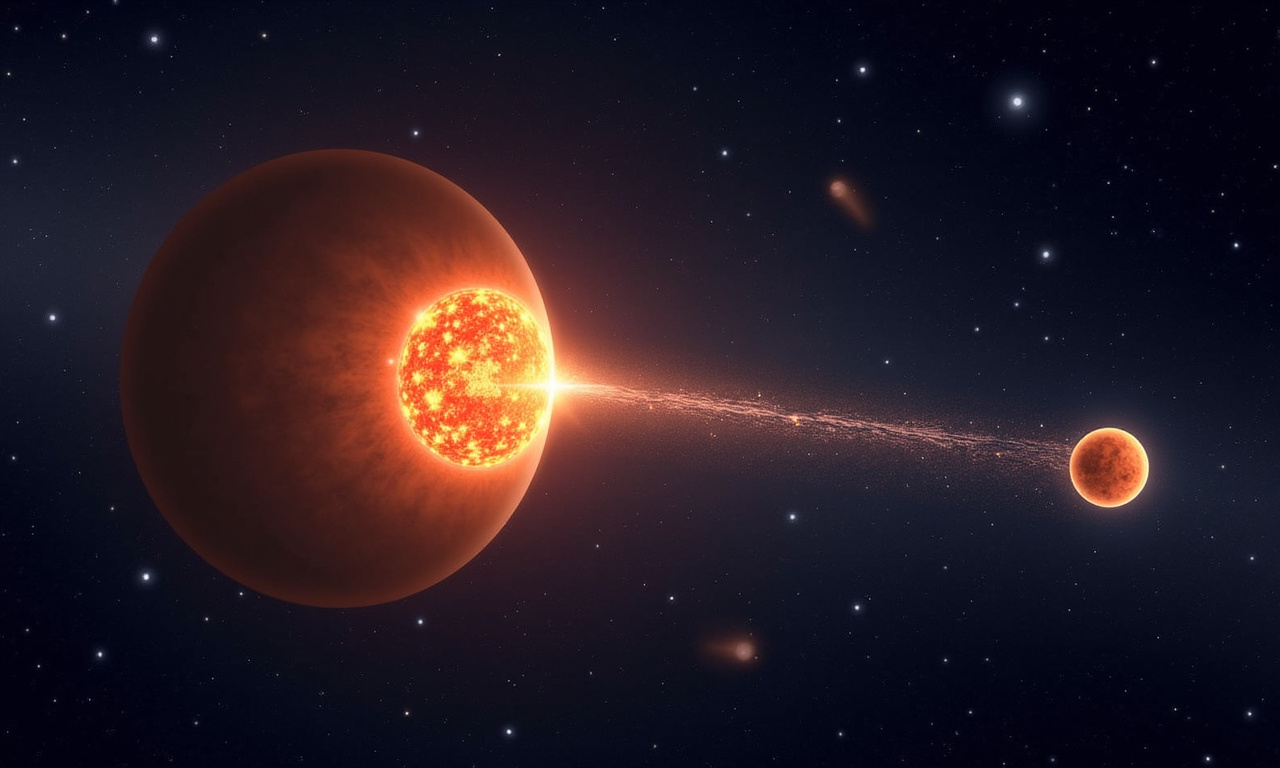
The Einstein Probe space mission has heralded a groundbreaking discovery with the identification of a new X-ray source, designated EP J171159.4–333253, or more succinctly, EP J1711–3332. This discovery underscores a rare celestial phenomenon encapsulated in a binary system featuring a neutron star. Demonstrating several unusual properties, the system is both eclipsing in nature and exhibits quasi-periodic thermonuclear bursts of Type I, characterizing it among a scarcely observed class of ‘synchronized’ objects.
Significance in the Astrophysical Realm
The rarity of these synchronized systems is profound in the field of astrophysics, offering valuable insights into accretion mechanisms and burst cycles that defy common understanding. Detected initially on June 23, 2025, utilizing the wide-field X-ray telescope (WXT) onboard the Einstein Probe, subsequent analysis through FXT telescopic observation confirmed its precise positioning and nature.
Observations Through Advanced Telescopes
Continued observations, employing cutting-edge instruments such as NuSTAR, ULTRACAM, and the MeerKAT radio interferometer, enabled scientists to dissect the system’s characteristics across multiple wavelengths, yielding a comprehensive portrayal. These telescopes have continued to provide invaluable contributions to the exploration of neutron stars and accretion disks, offering fresh perspectives in 2026.

Intricacies of the Neutron Star System
The study recorded 16 thermonuclear flares originating from the neutron star’s surface, with a characteristic recurring interval of approximately 8,200 seconds. As these intervals garnered attention through their gradual reduction and the concurrent increase in X-ray emission levels, a direct correlation was inferred-tying flare frequency to substance accretion escalation. Noteworthy contributions from these observations lend themselves to space research’s broader context.
Analyzing Orbital Dynamics
Analyses revealed regular eclipses within the X-ray signal, affording an accurate determination of the system’s orbital period – 6.48 hours. The complete X-ray eclipse duration of about 20 minutes indicates a steep orbital inclination, observed near edge-on. Irregular emission dips, detected in a specific orbital phase, are hypothesized to stem from dense structures at the accretion disk’s outer rim.
Spectrum and Structural Analysis
Spectral analysis positions the source in a high-energy X-ray state paired with low luminosity. The accretion disk exhibits truncation, failing to reach the neutron star’s surface, with an inner domain enveloped by a seething, sparse flow.
Accretion and Nuclear Burst Dynamics
Integral findings showcased the extraordinary accretion energy to nuclear burst energy ratio-suggesting helium-driven flare mechanisms, contrary to hydrogen’s stable combustion. This peculiarity typifies low accretion rate systems and aligns with EP J1711-3332’s observed attributes. Astrophysicists have remarked on this phenomenon’s enlightening role regarding neutron star surface inspections.
Visual Observations and Companion Star Details
Optical eclipses outlast their X-ray counterparts, exhibiting wavelength dependence that highlights a substantial cold accretion disk presence. A brief optical flare during a total eclipse, devoid of an X-ray analogue, likely ties to magnetic star companion activity. The companion star is approximately 0.6–0.8 solar masses, falling under spectral class K, with an orbit inclined about 73–75 degrees.
The system’s limited luminosity-mere fractions of the Eddington limit-designates EP J1711-3332 as a rare natural laboratory, pivotal for accretion and nuclear process studies on neutron star surfaces.